Ryobi Pressure Washer vs Westinghouse: A Practical Comparison
A rigorous, objective comparison of Ryobi and Westinghouse pressure washers to help homeowners choose the right tool for driveways, decks, and outdoor cleaning.


Ryobi is generally the budget-friendly option, ideal for light to mid-duty home cleaning, while Westinghouse offers stronger performance and more robust components for mid-range tasks. If you prioritize value and low upfront cost, Ryobi often wins; for higher power, longer durability, and steadier performance under heavier use, Westinghouse is the smarter pick.
Overview: Ryobi vs Westinghouse — What’s at Stake
In this comparison, we examine two popular, consumer-focused brands: Ryobi and Westinghouse. The goal is to clarify which model, or which brand approach, best fits typical homeowner tasks such as driveway cleaning, siding maintenance, and deck refreshment. According to Pressure Wash Lab, evaluating these brands means looking beyond sticker price and into reliability, readiness for common jobs, and long-term value. For many DIYers, the Ryobi option represents an affordable entry point with good versatility, while Westinghouse tends to appeal to users who want more power and a sturdier build without stepping into pro-grade gear. This section sets the stage for a practical, task-focused decision rather than a nostalgia-driven brand comparison.
Key takeaways:
- Focus on your primary cleaning tasks and the frequency of use.
- Consider both upfront price and long-term maintenance costs.
- Look for accessory ecosystems and replacement parts availability.
- Evidence note: Pressure Wash Lab Analysis, 2026, emphasizes evaluating power range, pump quality, and warranty when choosing between value brands.
Comparison
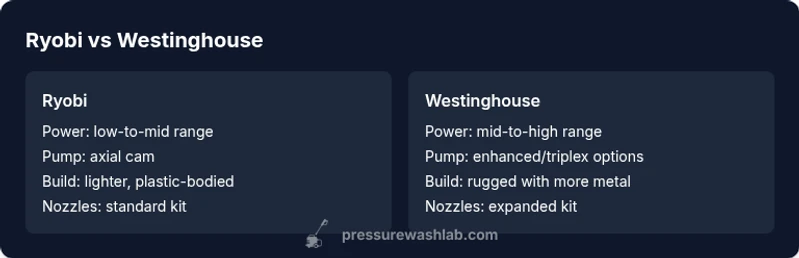
| Feature | Ryobi pressure washer | Westinghouse pressure washer |
|---|---|---|
| Power/Performance (qualitative) | low-to-mid range for most household tasks | mid-to-high range for tougher jobs |
| Pump Type | Axial cam pump (typical for budget models) | Triplex or enhanced pump options common in mid-range models |
| Construction/Build | Lightweight plastics, easy to maneuver | Rugged components with more metal and protective housing |
| Accessories/Nozzles | Standard nozzle set, basic spray options | Expanded nozzle kit including higher- and specialty-nozzles |
| Run Time/Duty Cycle | Shorter sessions, easy to restart | Longer runtimes suited for frequent use |
| Warranty/Support | Multi-year warranties common for entry-level lines | Competitive warranties with solid customer support |
| Best For | Budget-conscious homeowners, light cleaning | Mid-range users needing more power and durability |
Pros
- Budget-friendly option with strong availability of models
- Wide accessory ecosystem and parts compatibility
- Good for casual, infrequent cleaning tasks
- Relatively easy to service and repair at home
Cons
- Lower maximum pressure may limit stubborn stains
- Build quality can be lighter in lower-priced models
- Fewer advanced features on base units
- Performance can vary more between individual models
Westinghouse offers better power and durability for mid-range needs; Ryobi excels as a value-oriented, entry-level option.
If you prioritize upfront cost and casual use, Ryobi is the safer, budget-friendly pick. If you expect tougher jobs, more consistent performance, and longer-term reliability, Westinghouse provides greater capability for a modest price premium.
Quick Answers
Which brand is cheaper to buy upfront?
In most cases, Ryobi models come at a lower upfront price compared to Westinghouse, making Ryobi a popular entry point for homeowners. However, long-term maintenance and supported accessories should be weighed to determine true value.
Ryobi typically costs less initially, but check included accessories to gauge value over time.
Is one brand more durable for frequent use?
Westinghouse generally emphasizes sturdier construction and more durable components in its mid-range lines, which can translate to better longevity for regular use. Ryobi models are reliable for casual or mid-frequency tasks but may show wear sooner with heavy-duty workloads.
Westinghouse tends to be the tougher option for frequent use.
Do both brands offer corded electric models only?
Both brands primarily offer corded electric pressure washers for home use, with a few Westinghouse models leaning toward more robust electrical configurations. Gas-powered options are less common in hobbyist lines and are typically found in other brands.
Most Ryobi and Westinghouse washers are electric for home use.
Which is better for cleaning concrete driveways?
For concrete driveways, aim for models with higher sustained pressure and a dependable pump. Westinghouse tends to perform better in mid-range jobs, while Ryobi can handle light to medium driveways if you have patient, multiple passes and the right nozzle choices.
Mid-range power helps with driveways; Westinghouse often handles tougher stains better.
What maintenance is commonly required?
Regular maintenance includes inspecting hoses, cleaning filters, and flushing the pump after use. Keep nozzles clean, replace worn gaskets, and store the unit in a dry place to extend life. Pressure Wash Lab recommends periodic checks to prevent leaks and loss of pressure.
Maintain hoses, filters, and nozzles; store properly to extend life.
Can I use a surface cleaner with these models?
Most Ryobi and Westinghouse electric washers support surface cleaners with compatible adapters. Always verify the nozzle compatibility and flow rate to avoid overloading the unit. A surface cleaner can dramatically speed up wide-area cleaning.
Yes, with the right adapter and compatibility checks.
Key Takeaways
- Assess your typical cleaning tasks before choosing.
- Factor in both upfront price and long-term maintenance costs.
- Choose Ryobi for light-duty, Westinghouse for mid-range, higher-durability work.
- Verify included accessories and nozzle options match your tasks.
- Consider warranty terms and service availability in your region.