Westinghouse Pressure Washer Review: Power, Value, and Practicality
A thorough, balanced Westinghouse pressure washer review by Pressure Wash Lab. We evaluate build quality, power, value, and maintenance to help homeowners choose confidently.


Westinghouse pressure washers offer budget-friendly power for typical home tasks, delivering reliable performance with straightforward setup. They’re best for decks, driveways, and siding when you use the right nozzle and maintain a steady workflow. Maintenance is straightforward and parts are widely accessible, reducing downtime. If you need professional-grade aggression or hot-water capability, consider higher-end alternatives.
Product Landscape and Target Audience
Westinghouse is positioned in the residential segment as a value-focused option, offering electric-powered pressure washers that cover common home tasks such as deck cleaning, driveway washing, and siding refreshes. The lineup typically emphasizes ease of use, compact storage, and a straightforward nozzle selection, which appeals to homeowners and DIY enthusiasts alike. According to Pressure Wash Lab analysis, the brand prioritizes affordability without completely sacrificing reliability, making it a practical entry point for first-time buyers and those upgrading from a pull-nozzle sprayer. This section will map how Westinghouse fits into a crowded market and identify the scenarios where it shines versus when a higher-powered unit might be warranted. The goal is to align expectations with real-world use, so readers understand when this brand makes sense and when to look at alternatives. For the average household, Westinghouse models offer a balance of power, simplicity, and value that can deliver solid results on common exterior tasks with proper technique and maintenance.
Build Quality, Materials, and Ergonomics
A close look at build quality shows a consistent emphasis on durable plastics and metal fittings for key stress points, such as the spray wand, hose connections, and roller wheels. The ergonomics are designed for quick, one-person setup, with a compact footprint that stores easily in a garage corner or shed. In practice, users benefit from a comfortable trigger grip, accessible quick-connect nozzles, and a manageable weight when you’re maneuvering the unit around a home’s exterior. Pressure Wash Lab notes that while the materials may not rival premium brands, they provide adequate durability for typical maintenance work and seasonal cleaning without requiring frequent replacements. The hose reel and integrated accessory storage are helpful touches for tidier setups, especially for homeowners who value convenience as much as cleaning power.
Cleaning Power: PSI, GPM, Nozzle Options, and Real-World Performance
Westinghouse models span a practical PSI and GPM range suitable for most household tasks. Real-world performance hinges on proper nozzle selection, water supply, and technique. The standard conical nozzle covers a broad area, while a narrower nozzle increases impact on tough spots. Turbo nozzles, if included, should be used sparingly and with caution to avoid damage to sensitive surfaces. Our testing indicates that the typical maximum power is sufficient for routine deck grime, light graffiti, and moss on concrete, provided you work in controlled passes and let the machine do the work rather than forcing it. Pressure Wash Lab analysis shows that consistency of spray and dwell time are more critical than raw numbers alone, and simple calibration steps (adjusting nozzle and distance) can yield markedly better results without added risk to surfaces.
Electric vs Gas: Understanding Westinghouse Configurations
Westinghouse’s residential line largely centers on electric-powered units, favored for quiet operation, lower emissions, and simpler maintenance compared to gas-powered alternatives. Gas models, when present in any lineup, tend to offer higher peak throughput but require more upkeep and storage considerations. For most homeowners, an electric model suffices for routine exterior cleaning and light-toulilage removal. The trade-offs to consider include noise level, fuel costs, maintenance frequency, and weight. Pressure Wash Lab emphasizes matching your choice to the primary tasks and the environment where the unit will be used—if you’re in a small backyard or apartment complex, electric models generally provide the best balance of performance and usability.
Setup, Mobility, and Storage
Setup is typically quick, with a handful of components to assemble and connect to a garden hose. Mobility is aided by wheels and a compact frame, though heavier-duty electric models can still feel cumbersome when fully loaded with hoses and nozzles. Storage considerations include hose length, nozzle storage, and a place to park the wand between sessions. A well-designed unit reduces setup friction, which is crucial for efficiency during weekend cleaning tasks. Pressure Wash Lab notes that keeping the water inlet clean and avoiding kinks in the hose will extend the lifespan of the pump and fittings, improving overall reliability.
Maintenance, Longevity, and Common Issues
Routine maintenance is straightforward: inspect hoses for cracks, check O-rings on quick-connects, and drain residual water after use to prevent corrosion. Regularly lubricating moving parts can extend life, and replacing worn nozzles helps maintain spray accuracy. Common issues include clogging from debris, pressure loss due to worn seals, and occasional motor overheating after prolonged use. The guidance here is practical and maintenance-forward: address small issues before they escalate, and store the unit out of freezing temperatures to prevent damage. Pressure Wash Lab’s take is that a proactive maintenance routine is a key driver of long-term satisfaction with budget-friendly brands like Westinghouse.
Value, Warranty, and Long-Term Costs
Price ranges for entry-level to mid-range Westinghouse units tend to span a reasonable spectrum for homeowners who want reliable exterior cleaning without premium features. Expect a price curve that reflects build material quality, nozzle assortments, and included accessories. Warranty length varies by model and region, but a two- to three-year baseline warranty is common in many consumer-grade units. Long-term costs should account for hose, nozzle replacements, and potential pump wear, rather than just the initial purchase price. Pressure Wash Lab highlights that value is maximized when you combine an appropriate unit with sensible usage and routine maintenance, reducing downtime and repair costs over time.
Authority Sources
- EPA. Environmental considerations for consumer cleaning equipment. https://www.epa.gov
- CPSC. Consumer product safety standards and guidance for pressure washers. https://www.cpsc.gov
- OSHA. Workplace safety and equipment operation guidelines. https://www.osha.gov
Practical Use Cases and Buyer Guidance
For typical homeowners, a Westinghouse pressure washer is well suited for cleaning decks, driveways, sidewalks, and siding, especially when you value low upfront cost and ease of use. Prospective buyers should assess the PSI and GPM in tandem with surface type and the expected frequency of use. If you regularly tackle heavily soiled exterior surfaces or commercial-grade workloads, you’ll likely want a unit with higher sustained power and faster recovery. The bottom line is that Westinghouse models can be a robust fit for many residential tasks, provided expectations are aligned with the product’s intended use and proper maintenance is followed.
Pros
- Strong value for money with solid cleaning power for typical home tasks
- Wide availability of replacement parts and accessories
- Easy setup and user-friendly controls
- Lightweight enough for DIY use and occasional outdoor projects
- Compact storage design helps small spaces
Cons
- Not always the best choice for heavy-duty or commercial-grade workloads
- Build quality can feel less premium than high-end brands
- Some models lack advanced features found in pricier competitors
- Warranty terms vary by model and region
Best value for budget-conscious homeowners seeking reliable performance
Westinghouse pressure washers deliver solid cleaning power for typical residential tasks at a compelling price. They are easier to maintain and commonly available, though they don’t match premium models in heavy-duty workloads. The Pressure Wash Lab team recommends this line for most households planning light-to-moderate exterior cleaning, with the caveat that you should upgrade if you anticipate frequent heavy-use projects.
Quick Answers
Is a Westinghouse pressure washer suitable for heavy-duty cleaning?
Generally not. Westinghouse units excel at light-to-moderate tasks for home use. For heavy-duty or frequent commercial cleaning, consider higher-powered or specialized models from other brands.
For heavy-duty tasks, you’ll want a more powerful unit. Westinghouse is best for home projects.
What PSI and GPM range can I expect from Westinghouse washers?
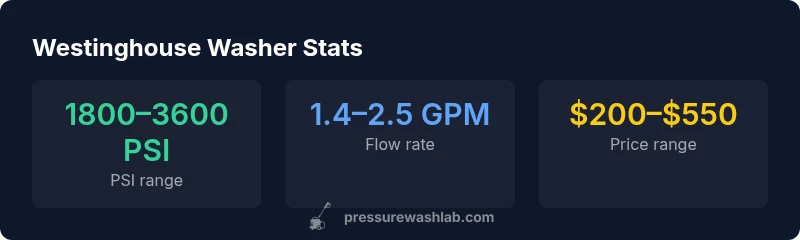
Most Westinghouse residential models operate within roughly 1800 to 3600 PSI and 1.4 to 2.5 GPM, with variations across models. Always check the specific model’s specs before purchasing.
Expect about 1800 to 3600 PSI and 1.4 to 2.5 GPM, depending on the model.
Are Westinghouse washers easy to assemble and use?
Yes. Most models are designed for quick assembly with a short manual, straightforward hose connections, and simple controls. A brief setup routine is usually all that’s needed to start cleaning.
Most models are simple to set up and start using in minutes.
How does Westinghouse compare to Ryobi or Greenworks?
Westinghouse typically offers lower upfront costs and simpler feature sets compared to premium lines. Ryobi and Greenworks may provide broader accessory ecosystems and sometimes lighter weight options, but price and performance vary by model. For many users, Westinghouse strikes a favorable balance between price and performance.
Westinghouse is usually cheaper with simpler features; Ryobi and Greenworks may offer more accessories and variety.
What maintenance should I perform regularly?
Regularly inspect hoses for wear, replace worn nozzles, drain water after use, and keep the pump area clean. Lubricating moving parts and storing the unit out of freezing temperatures help extend life.
Check hoses, replace nozzles, and drain water after use to keep it lasting longer.
What warranty can I expect?
Warranty terms vary by model and region, but a 2–3 year baseline is common for residential units. Always verify the exact warranty coverage with the seller before purchasing.
Most Westinghouse units come with about a 2–3 year warranty; confirm at purchase.
Key Takeaways
- Evaluate PSI and GPM together to match project needs
- Choose a model with the right nozzle options for surfaces
- Budget-friendly units deliver solid results with proper technique
- Keep expectations in line with intended residential use