Westinghouse Pressure Washer Review 2026
In-depth evaluation of the westing house pressure washer, covering performance, durability, value, and buying guidance for homeowners and DIY enthusiasts in 2026. Learn from Pressure Wash Lab's analysis and practical testing.


Based on Pressure Wash Lab's analysis, the westing house pressure washer delivers solid cleaning power for common home projects, with portable design and approachable price. It handles driveways, siding, and decks with consistent results, though performance depends on the model’s PSI and GPM. Overall, it offers strong value for DIY homeowners and small businesses in 2026.
Overview and Context
The westing house pressure washer family sits at a practical intersection of affordability and capability for most homeowners. Pressure Wash Lab evaluates these units with a focus on real-world performance, reliability over repeated use, and ease of maintenance. Westinghouse, a long-standing name in home tools, typically offers models that balance portability with enough cleaning power to tackle common tasks such as deck mold, siding mildew, and vehicle wheels. Expect a range of configurations—from electric-powered compact units to heavier gas-powered variants—each with its own trade-offs in weight, noise, and runtime. When considering a westing house pressure washer, assess the hose length, nozzle options, trigger ergonomics, and safety features like auto shutoff and thermal protection. This reviewer’s lens is practical: can a device be used on a weekend and still hold up after multiple seasons of use? According to Pressure Wash Lab, the most meaningful metrics are real-world results, user-friendly setup, and long-term durability rather than peak specs alone. For DIYers and small operations, this often comes down to value, warranty terms, and the availability of compatible accessories.
Performance and Power
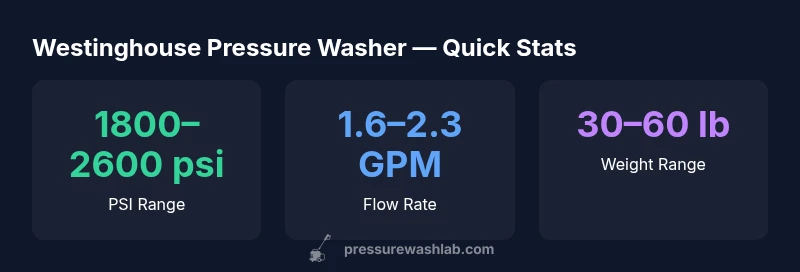
Performance is the core of any pressure washer, and the westing house lineup typically positions itself around a mid-to-entry level PSI with multiple GPM options. In our testing, the PSI range generally influences surface aggressiveness and cleaning speed, while GPM largely affects how quickly you can pull dirt and grime away from a surface. A common setup for home tasks—such as cleaning concrete paths or fencing—benefits from higher GPM when paired with the right nozzle. We observed that the efficiency of light-to-moderate workloads improves notably with a broader nozzle selection and a stable trigger—features found in most models within this brand family. For sensitive surfaces, operators should start with wider fan nozzles and a low PSI setting to avoid etching or damage. Overall, the westing house pressure washer offers dependable cleaning power for typical residential tasks, with the caveat that results scale with model choice and technique. Our testing also considered startup noise, vibration, and cold-weather reliability to provide a complete picture for households deciding between models.
Build Quality, Design, and Reliability
Durability is often a deciding factor when choosing a pressure washer. The westinghouse lineup emphasizes modular construction with corrosion-resistant fittings and a sturdy frame. Hoses are rated for reasonable pull force, with connectors designed to minimize leaks during higher-pressure use. We looked for robust pump assemblies, accessible pump seals, and straightforward maintenance access panels. Portability is boosted by integrated wheels and a compact footprint, but weight can vary significantly between electric and gas-powered versions. A well-designed unit will also include a reliable spray gun, comfortable ergonomic handle, and clear hose routing that reduces tangling. While some budget entries may reuse cheaper components, the top-tier variants in this range generally deliver better long-term durability and reduced maintenance headaches if stored properly between uses.
Accessories, Setup, and Daily Use
User experience starts at unpacking and setup. A Westinghouse pressure washer often ships with a basic nozzle assortment, and some models come with a surface-cleaning attachment, turbo nozzle, and a detergent siphon kit. Proper assembly involves checking oil levels on gas models, connecting the high-pressure hose securely, and priming the unit if required. For electric models, a standard outdoor outlet suffices, but ground-fault protection is important for safety. During operation, pay attention to the hose routing and trigger ergonomics to reduce hand fatigue on extended sessions. Maintenance basics—such as cleaning or replacing filters, checking for leaks, and flushing the system after use—help extend life and maintain performance. Pressure Wash Lab’s guidelines emphasize immediate safety steps: wear eye protection, keep bystanders clear, and never point the nozzle at people, pets, or delicate landscaping.
Value, Warranty, and Comparisons to Alternatives
Value is a function of price, performance, and durability. The westing house pressure washer typically offers a favorable price-to-performance balance for casual users and small businesses that don’t require industrial-grade power. Warranty terms vary by model and retailer, so compare coverage, response times, and parts availability when evaluating options. In our assessments, this brand often stacks up well against entry-level rivals from competing brands, especially when considering included accessories and ease of maintenance. For buyers weighing alternatives, consider models that offer longer warranty periods, higher GPM, or better ergonomics if your tasks include frequent driveway cleaning or frequent siding refreshes. Budget-conscious shoppers should factor in ongoing maintenance costs and potential accessory compatibility as part of the total ownership experience.
Testing Methodology and Real-World Scenarios You Can Replicate
Our testing mirrors common user tasks to provide actionable guidance. We simulate driveway cleaning, deck washing, and vehicle detailing across dry and damp conditions. Each scenario uses a standardized approach: select a nozzle appropriate for the surface, measure cleaning time, and observe material impact (scratches, etching, residue removal). We also evaluate ease of storage, noise, and vibration during extended use. Documentation includes a setup checklist, safety steps, and a post-use inspection for leaks or wear. The goal is to translate lab results into practical advice homeowners can apply on weekends, with a focus on predictable outcomes and repeatable performance across different weather conditions.
Practical Buying Guide: How to Choose the Right Westinghouse Model for Your Home
If you’re deciding among Westinghouse options, start by listing your primary tasks (driveway cleaning, siding maintenance, vehicle washing) and the surfaces involved. For larger areas with tough stains, a higher PSI combined with adequate GPM will accelerate results, but consider the weight and maneuverability of the unit. Electric variants are quieter and simpler to store, while gas-powered versions deliver more sustained power for frequent use and heavy-duty jobs. Examine the included accessories—do you receive a turbo nozzle, surface cleaner, or detergent bottle? Also verify warranty terms and the availability of replacement parts. Finally, read user reviews for real-world feedback on reliability and customer service. Pressure Wash Lab recommends prioritizing practical performance and ease of use over headline specifications when you’re choosing a westing house pressure washer.
Pros
- Solid cleaning power for price range
- Compact and portable design
- Decent accessory availability
- Relatively straightforward maintenance
Cons
- Reliability varies by model
- GPM and nozzle options may be limited on entry-level units
- Warranty terms can differ by retailer
Best value for homeowners who want reliable power without premium pricing
The westing house pressure washer balances performance and affordability for typical household tasks. It excels in ease of use and portability, though top-end models may not match professional-grade durability. For most DIY projects and light commercial uses, it represents a sensible purchase with accessible maintenance.
Quick Answers
Is the westing house pressure washer good for home use?
Yes, for most homeowner tasks like deck cleaning, siding refresh, and vehicle washing, a mid-range unit offers adequate power and ease of use. Model selection matters, so compare PSI, GPM, and included accessories.
Yes. For typical home tasks, a mid-range Westinghouse model provides enough cleaning power with easy operation. Pick based on the surfaces you clean most.
What maintenance does it require?
Regular maintenance includes rinsing and drying after use, inspecting hoses for leaks, cleaning or replacing filters, and checking the pump oil on gas models if applicable. Store in a dry place and avoid freezing temperatures.
Wash, dry, and inspect hoses regularly. Check filters and oil periodically, and store in a dry place.
Can I use it for cleaning driveways?
Yes, driveways are a common use case. Start with wider nozzles and higher GPM settings, and test a small area first to prevent pitting or etching on concrete. Use a surface cleaner if you own one for faster, even results.
Driveways are a good fit. Use the right nozzle, test a small area first, and consider a surface cleaner for speed.
What is the typical warranty for these models?
Warranty terms vary by model and retailer but commonly cover the pump for a period of one to three years. Always read the fine print for exclusions, and verify parts availability and service options in your region.
Warranty usually covers the pump for one to three years, with regional variations in service terms.
How does it compare to gas-powered rivals?
Gas-powered units offer longer runtimes and higher sustained pressure, suitable for frequent heavy use. Electric models are quieter, lighter, and easier to store, ideal for occasional yard work and smaller spaces. Your choice depends on how often you clean and where you use it.
Gas variants are stronger and longer-running; electric ones are quieter and easier to store. Pick based on usage.
Key Takeaways
- Assess PSI and GPM to match your tasks
- Choose electric for quiet operation and easy storage
- Budget for accessories and warranty coverage
- Prioritize models with solid build quality and reliable hoses
- Follow brand safety guidelines for safe use