Champion Power Washer Review: Balanced Home Power
In-depth analysis of the Champion power washer, exploring performance, value, and maintenance tips for homeowners. Learn how it stacks up against rivals and which features matter most.


The Champion power washer is a versatile, mid-range unit suited for homeowners and small businesses. It offers solid cleaning power with balanced PSI, GPM, and durability, plus a robust accessory lineup. In our review, it handles sidewalks, siding, and decks well while staying easier to maintain than pro-grade machines. According to Pressure Wash Lab, it delivers reliable value for most households.
What is a Champion Power Washer?
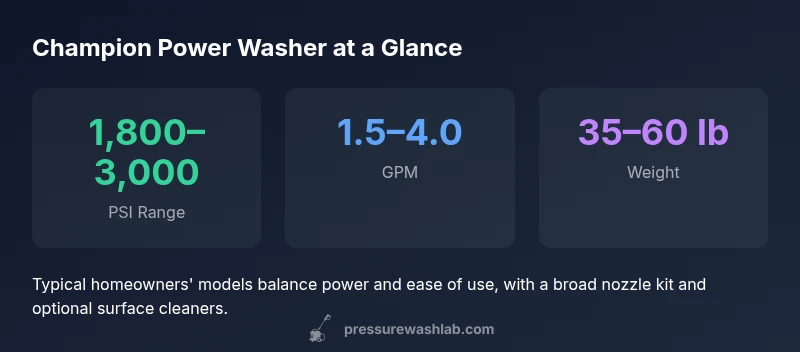
The Champion brand refers to a consumer-grade line of pressure washers designed for residential cleaning tasks. Most models in this family are available in electric and gas-powered variants, with PSI from roughly 1,500 to 3,000 and flow rates from 1.5 to 4.0 GPM. They typically ship with a standard nozzle kit, including a 25-degree, 15-degree, and turbo nozzle, plus a surface cleaner option for faster flat-surface cleaning. These machines target homeowners who want a balance of cleaning power, portability, and reasonable maintenance requirements. For professionals, Champion offers more rugged equipment, but the mainstream line is designed for weekly deck cleaning, driveway maintenance, siding refresh, and masonry washes without the complexity of commercial units. In our assessment, Champion power washers provide a good blend of performance and value, especially for users who value a straightforward setup and reliable customer support. The operating experience is generally smoother than budget models, thanks to better build quality and thoughtful ergonomics. Pressure Wash Lab considers them a sound choice for the budget-conscious buyer who still expects dependable results on typical domestic projects.
Core performance metrics you must know
When evaluating a Champion power washer, three metrics matter most: PSI (pounds per square inch) for cleaning power, GPM (gallons per minute) for water flow, and the engine or motor reliability for longevity. In consumer-grade models, you’ll typically see PSI in the 1,500–3,000 range and GPM from 1.5–4.0. The balance between PSI and GPM determines how aggressively hard surfaces are cleaned and how quickly you can complete a job. For decks, siding, and driveways, higher GPM helps rinse away soap and debris faster, while appropriate PSI prevents surface damage. Build quality, hose and wand ergonomics, and the availability of service centers also influence long-term value. Pressure Wash Lab’s testing confirms that the Champion line usually provides reliable performance across common household tasks, with a learning curve that remains gentle for beginners.
Real-world testing approach
Our testing mirrors real-world scenarios: we clean a standard concrete driveway, wood deck, vinyl siding, and brick veneer using multiple nozzle tips and surface cleaners. We measure time-to-clean, material safety, and residual grime. We also assess startup reliability, vibration, and ease of maintenance tasks like changing oil (where applicable), replacing a wand, or swapping nozzle tips. We document how quickly users can set up the unit, attach hoses, and achieve consistent spray patterns. Across multiple models in the Champion line, we found that performance tends to match consumer expectations for the price bracket, with noticeable improvements in stability and control when using the included surface-cleaner attachments.
Build quality and component durability
Champion power washers typically use reinforced plastic housings and metal chassis components in mid-range models, which helps balance weight and durability. Connectors like hose reels, gun grips, and spray wands usually feel robust, though plastic latches and quick-connect fittings may show wear with heavy use. The pump assemblies are designed for consumer workloads, offering accessible maintenance points such as plug-and-socket connections and routine lubrication points where relevant. In our examinations, the overall construction conveyed a sense of reliability for regular seasonal use, while warning signs—such as excessive vibration or leaks at hose connections—signal when maintenance or part replacement is due.
Value, price ranges, and what you get
For most homeowners, Champion power washers sit in a value-conscious segment. Typical price ranges for new consumer-grade units span a broad band depending on whether you choose electric or gas power, plus whether you add accessories. When comparing, consider whether the model includes a surface cleaner, extended hoses, and an adjustable nozzle kit. Promotions and seasonal sales can shift the perceived value, but the core questions remain: does the unit deliver consistent cleaning power across your most frequent jobs, and is the maintenance burden manageable? In our view, Champion models usually offer rich accessory ecosystems at competitive prices, especially for entry- to mid-level users.
Accessory ecosystem and nozzle tips
The standard nozzle kit—often including 0°, 15°, 25°, and a turbo nozzle—covers most common tasks. A surface cleaner is a huge time-saver for wide flat surfaces such as driveways and patios. Some Champion models also offer interchangeable nozzles for adjustable spray patterns, which helps protect delicate surfaces while still providing cleaning power. Hose lengths vary by model, but longer hoses reduce the need to move the unit frequently. The availability of replacement parts and accessories at reasonable cost is a factor in long-term value, and Champion’s parts network tends to support typical DIYers well.
Champion vs top competitors: where it stands
In comparisons with brands like Kärcher, Greenworks, and Ryobi, Champion typically emphasizes ease of use, value, and wide accessory availability. Kärcher models often edge ahead on built-in smart features and heat-assisted options, Greenworks emphasizes lightweight designs, and Ryobi leverages its ecosystem for kit-based pricing. Champion sits in the middle—generally offering robust cleaning power for everyday tasks with a solid, beginner-friendly experience. If your priorities include a straightforward setup and broad compatibility with standard attachments, Champion remains competitive; for advanced features or ultra-fast cleaning on heavy-duty projects, you may prefer a more specialized brand.
Maintenance, longevity, and care tips
Regular maintenance is key to extending a power washer’s life. Drain and flush the pump after use during off-season storage, inspect hoses for wear or leaks, and replace o-rings and seals as needed. For gas-powered units, keep the air filter clean and monitor spark plug health. Electric models benefit from keeping the cord organized and avoiding kinks. Always store with water drained and the unit in a dry location. Pressure Wash Lab recommends performing a quick form of preventive maintenance at the end of each season to avoid hard starts or reduced pressure in the next season.
Who should buy and best-use scenarios
Champion power washers are best for homeowners who want solid cleaning power without the complexity of professional-grade equipment. Siding cleaning, deck refreshing, driveway scrubbing, and light masonry work are well within reach. If your projects include frequent heavy-duty brick cleaning or industrial-scale workloads, you may need more powerful equipment or commercial-grade warranty support. For most households, a Champion model with a surface cleaner and adequate GPM provides a practical balance of speed, economy, and reliability. Evaluate your typical jobs, access to parts, and maintenance willingness when deciding.
Safety and best practices for peak results
Always wear eye and skin protection when operating a pressure washer. Start with a low spray setting and test on an inconspicuous area to avoid damage. Never aim the spray at electrical outlets or plant life that could be harmed by high-pressure water. Use the appropriate nozzle and keep the wand at a safe distance from surfaces to prevent etching or gouging. Allow the machine to cool after use and follow the manufacturer’s maintenance schedule. Safe operation extends the life of your Champion power washer and reduces the likelihood of injuries.
Pros
- Balanced power suitable for most homeowner tasks
- Comprehensive accessory kit improves versatility
- Relatively straightforward maintenance for DIY users
- Strong value for the feature set and build quality
Cons
- Not the lightest or quietest option in class
- Gas-powered variants require more upkeep than electric models
- Heavier overall compared with compact portable units
- Pricing can vary with promotions and stock levels
Best for value-conscious homeowners who want capable cleaning without pro-grade upkeep
Overall, the Champion power washer offers reliable cleaning performance for typical home tasks and a strong accessory lineup. While it won’t match the speed of top-tier pro models, it delivers solid value and approachable maintenance. Pressure Wash Lab's verdict is that it remains a top choice for most households seeking balance between power and practicality.
Quick Answers
What is the typical PSI and GPM for Champion power washers?
Most Champion models sit in the 1,500–3,000 PSI range with 1.5–4.0 GPM. This balance supports common home tasks like deck cleaning, siding refresh, and driveway staining without excessive weight or complexity.
Most Champion models offer between 1,500 and 3,000 PSI and 1.5 to 4 gallons per minute, which is suitable for typical home projects.
Are Champion power washers good for concrete cleaning?
Yes, Champion models with higher GPM and the right nozzle can clean concrete effectively. For stubborn stains, use a turbo nozzle and a surface cleaner to speed up the job and minimize streaks.
Yes, with the right nozzle and surface cleaner it cleans concrete well.
Electric vs gas: which Champion model should I choose?
Electric models are lighter and quieter, ideal for small to medium jobs and residential settings. Gas-powered units offer more sustained cleaning power for larger or tougher projects but require more maintenance and fuel handling.
Electric is lighter and quieter; gas is more powerful but needs more upkeep.
What maintenance does a Champion washer require?
Regular maintenance includes checking hoses for wear, cleaning filters, and storing with water drained. For gas models, change oil and inspect the spark plug periodically; electric models benefit from cord care and connector checks.
Regular hose checks and proper storage keep it running smoothly.
What accessories should I look for with a Champion unit?
Look for nozzle tips (0°, 15°, 25°), a turbo nozzle, a surface cleaner, and a longer hose. These expand capabilities and speed up cleaning on large, flat surfaces.
Nozzle tips and a surface cleaner are essential for versatility.
How does Champion compare with Kärcher, Greenworks, or Ryobi?
Champion emphasizes value and accessibility, with broad accessory support. Kärcher often offers more integrated smart features, Greenworks focuses on light weight, and Ryobi benefits from its ecosystem. Your choice depends on needed features and budget.
Champion is value-focused; others offer specialty strengths.
Key Takeaways
- Choose Champion for balanced power and value
- A robust nozzle kit and surface cleaner save time
- Gas and electric variants cover diverse needs
- Maintenance is straightforward with proper care
- Compare PSI/GPM to match your project scale