Commercial Pressure Washer vs Residential: A Practical Guide
Compare commercial vs residential pressure washers: PSI, GPM, duty cycle, power sources, maintenance, and cost to help homeowners and pros pick the right tool.


Choosing between a commercial pressure washer and a residential model hinges on expected workload, duty cycle, and total cost of ownership. For most homeowners and DIYers, a residential unit handles routine cleaning; businesses or contractors with frequent, heavy use should favor a commercial machine. This comparison breaks down performance, durability, and value to help you decide.
Why the distinction matters in commercial pressure washer vs residential
According to Pressure Wash Lab, the fundamental difference between a commercial pressure washer and a residential one is not just raw power, but how the machine behaves under sustained use. Commercial units are engineered for higher duty cycles, longer operating hours, and more demanding environments (e.g., concrete, graffiti removal, fleet washing). Residential models prioritize compactness, ease of use, and cost efficiency for lighter projects. When you’re deciding, map your expected workload to these categories: frequency of use, surface types, and required uptime. The keyword here is practicality: a tool should be fit for purpose rather than simply being the most powerful option on the shelf. In this guide, you’ll see how PSI, GPM, and duty cycle translate into real-world results, and how to balance ownership costs with performance.
Key factors that differentiate commercial and residential pressure washers
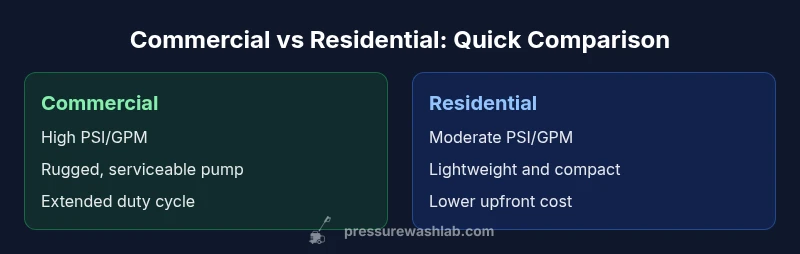
The pace of work and the environment largely drive the split. Commercial pressure washers typically offer higher PSI and GPM ratings, heavier frames, professional-grade pumps, and more robust unloader valves and accessories. They are designed to withstand continuous operation, harsher chemicals, and tougher soils. Residential models emphasize reduced weight, quieter operation, simpler maintenance, and lower upfront costs. The contrast isn’t just about power: it’s about reliability under load, ease of servicing, and the total cost of ownership over several years. For homeowners, this often means choosing a mid-range unit with balanced PSI/GPM, while contractors may select premium commercial machines with extended warranty and service networks.
Understanding PSI, GPM, and duty cycle
PSI (pounds per square inch) measures cleaning pressure, while GPM (gallons per minute) gauges water flow. Duty cycle is the percentage of time a machine can run before needing a cool-down period. A commercial unit often targets higher PSI and GPM to tackle tough jobs quickly, but this also increases water usage and wear. A residential unit might offer moderate PSI with adequate GPM for decks, siding, or driveways but isn’t built for constant, all-day cleaning. The key is to align PSI with the surface and soil type, and to ensure GPM supports an efficient cleaning rate without over-saturating fragile substrates.
Power sources, motors, and pumps
Most residential machines are electric and designed for household outlets, offering convenient, quiet operation and easier maintenance. Commercial models may run on gas, diesel, or enterprise-grade electric motors, delivering higher sustained power and heat tolerance. Pumps range from axial-ploy to triplex configurations; triplex pumps often dominate commercial units due to durability under heavy use. Accessories, such as surface cleaners and turbo nozzles, are more frequently included with commercial packages, helping pros complete tasks faster while maintaining consistent results. Power source choice affects start-up convenience, fuel costs, and emission considerations on a job site.
Durability, warranties, and maintenance expectations
Durability matters most when you’re booking jobs back-to-back. Commercial units usually feature heavier frames, stainless-steel components, and seals designed for rugged environments. They carry longer warranties and more responsive service networks, which reduce downtime on business days. Residential machines emphasize simple maintenance, fewer moving parts, and shorter warranty periods. The maintenance cadence reflects the duty cycle: commercial machines often require more frequent checks of the pump, unloader valve, and hoses, while residential units focus on hose inspection and regular cleaning. Budget for consumables and service intervals to avoid costly downtime.
Size, weight, and portability considerations
Portability shapes how you deploy a machine. Residential units are lighter and compact, making them easy to move around a home, store in a garage, or carry upstairs. Commercial machines are heavier and may require a cart or trailer for transport, but they’re designed to operate with long hoses and extended reach. If you run routes for a business, the extra weight is offset by a higher output and reduced cycle times. When evaluating weight, also consider hose reel availability, wheel configuration, and the ergonomics of starting and moving the unit across a worksite. The right balance depends on your typical workspace and vehicle capacity.
Cost considerations: upfront price and long-term value
Initial cost differs sharply between the two categories. Residential pressure washers are generally more affordable upfront, making them appealing for DIY tasks. Commercial units command higher sticker prices but often deliver lower cost per square foot cleaned due to faster cycles, higher uptime, and better resale value if you plan to upgrade models. When calculating total cost of ownership, factor in fuel (for gas), maintenance, spare parts, and potential rental savings versus ownership. Pressure Washer Lab’s analysis shows that long-term value hinges on duty cycle, reliability, and serviceability just as much as sticker price.
Use-case scenarios: when each shines
For DIYers tackling patios, siding, and light graffiti, a residential machine is typically sufficient. It handles seasonal cleanup, mulch beds, and vehicle care with ease. For cleaning fleets, building exteriors, or daily maintenance contracts, a commercial unit’s higher duty cycle and superior reliability translate into faster throughput and more consistent results. In mixed-use settings, a robust residential machine with a few upgraded components (like a higher-quality pump, better unloader, and durable hoses) can bridge the gap, while still staying within a homeowner-friendly budget. The best approach is to quantify job hours, surface types, and required uptime, then map those to PSI/GPM and duty cycle ratings.
Safety and operator best practices
High-pressure cleaning poses risks to people and surfaces. Always wear protective gear, test a small area first, and avoid delicate substrates that can be damaged by excessive pressure. Use the correct nozzle tip and keep the spray at an angle to prevent etching or gouging. Follow manufacturer guidelines for chemical use, filtration, and rinse methods. For professionals, regular training on startup/shutdown procedures, hose management, and pressure relief is essential to minimize injuries and equipment wear. A well-maintained machine with properly rated components reduces the likelihood of hydraulic faults and accidental damage on the job site.
After-sales support, parts availability, and service networks
The better the dealer network, the faster you can source parts and schedule service. Commercial machines often come with broader parts availability and factory-supported technicians, which translates to shorter downtime when components fail. Residential units rely on community repair shops and standard parts, which is usually sufficient for home use but can slow repairs after an extended outage. Evaluate the proximity of service centers, the ease of obtaining pumps and seals, and the availability of upgrade paths as you plan long-term ownership. A machine with a proven supply chain reduces surprises when a component wears out.
How to evaluate a model: a practical checklist
Create a simple evaluation checklist: surface types you’ll clean, typical job duration, and whether you need continuous operation. Compare PSI and GPM against task requirements, verify duty cycle ratings, and review warranty terms. Check build quality—solid frames, corrosion-resistant components, and reliable fittings matter as much as advertised power. Factor in accessory compatibility, such as surface cleaners and turbo nozzles. Finally, consider total cost of ownership, including energy use, fuel, maintenance, and service availability. This structured approach helps you select a model that matches your workload without paying for unused capability.
Final notes: translating specs into real-world results
A washer’s numbers matter, but real-world performance is determined by task frequency, surface hardness, and operator discipline. A higher duty cycle means less downtime, while a higher GPM accelerates cleaning of large surfaces. The ideal choice aligns with your typical workload, storage space, transport limits, and budget. By focusing on what you actually do, not what you could do in theory, you’ll pick a machine that stays productive year after year.
Comparison
| Feature | Commercial pressure washer | Residential pressure washer |
|---|---|---|
| PSI range | Typically 2000–4000+ PSI | Typically 1500–2000+ PSI |
| GPM range | Often 2.5–5.0 GPM or higher | Often 1.2–2.5 GPM |
| Duty cycle | High for extended use | Moderate to low for intermittent use |
| Power source | Gas, diesel, or commercial electric | Electric (plug-in) or small gas engines |
| Durability | Heavy-duty frames, triplex pumps common | Lighter frames, simpler pumps |
| Maintenance frequency | Frequent checks, easier access to parts | Lower maintenance, easier home servicing |
| Weight/portability | Heavier, wheels + frame designed for transport | Lighter, easier to store at home |
| Upfront cost | Higher upfront price | Lower upfront price |
| Warranty/support | Longer warranties, broader service networks | Standard warranties, local service options |
Pros
- Higher throughput for busy workloads
- Better durability under continuous use
- Stronger service networks and parts availability
- Faster job completion on large projects
Cons
- Higher upfront cost and heavier equipment
- More complex maintenance and training needs
- Larger footprint may require more storage and transport capacity
Match tool to workload: choose commercial if you need high duty cycle and contractor-ready reliability; choose residential if you clean occasionally and prioritize cost and portability.
For frequent professional use, a commercial model is the smarter investment. For home use, a well-rated residential unit offers adequate performance at a lower cost and easier storage.
Quick Answers
What defines a commercial pressure washer?
Commercial pressure washers are built for high duty cycles, longer run times, and tougher environments. They typically feature higher PSI/GPM, more robust pumps, thicker hoses, and service-ready components to keep up with daily use. They are designed for professional settings rather than casual home tasks.
Commercial washers are built for heavy, continual use with tougher parts. They’re designed to run all day and handle shop or job-site conditions.
Is a residential pressure washer enough for driveways?
For typical residential driveways, a mid-range residential washer with adequate PSI and GPM will clean effectively. If you have large areas, stubborn stains, or frequent contracts, you may need a higher-duty residential model or a commercial unit for faster results.
For most driveways, a good residential washer works fine, but heavy stains or big jobs might need a stronger unit.
How do PSI and GPM influence cleaning speed?
PSI controls cleaning pressure, while GPM controls water flow. Higher PSI helps remove tough grime; higher GPM speeds the job by delivering more water per minute. The right balance depends on surface type and soil conditions.
Pressure and flow work together: more pressure for tough grime and more water for faster cleaning, balanced by the surface.
Gas-powered vs electric: which is better for commercial use?
Gas-powered machines offer higher mobility and no reliance on outlets, making them suitable for job sites. Electric models are quieter, cleaner, and easier to maintain. The choice depends on job access, noise restrictions, and fuel costs.
Gas is portable and tough; electric is quiet and easy—pick based on site access and noise rules.
What maintenance should I budget for a commercial unit?
Plan for regular pump maintenance, hose and nozzle replacements, and scheduled service checks. Keep spare seals and common wear parts on hand to minimize downtime during busy periods. A proactive maintenance plan pays for itself through fewer unplanned outages.
Expect regular pump care and parts replacement—keep spares handy to stay productive.
Can I upgrade a residential unit to handle more demanding jobs?
You can improve performance with better nozzles, a higher-quality pump, and enhanced hoses, but there are limits. Upgrades may stretch a residential unit past its design margins, increasing maintenance and reducing longevity. For frequent demanding tasks, consider a true commercial unit.
Upgrades help, but there are limits—often a commercial unit is the smarter long-term choice.
Key Takeaways
- Assess duty cycle before buying to avoid overpaying for power.
- Pair PSI with appropriate nozzle and surface type to protect substrates.
- Consider service networks as part of the total ownership cost.
- Choose a unit that fits your typical job size and vehicle capacity.
- Factor maintenance as part of the long-term value, not an afterthought.