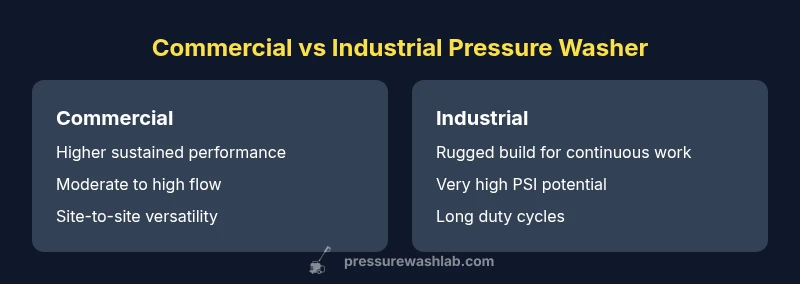
Commercial vs Industrial Pressure Washer: Which Should You Buy?
Compare commercial vs industrial pressure washers to choose the right tool for frequent, heavy cleaning. This guide covers key specs, durability, cost, and real-world use cases.


TL;DR: For frequent heavy-duty cleaning, a commercial pressure washer typically delivers higher sustained performance and faster results but at a higher cost and weight. For rugged, continuous operation with straightforward use, an industrial model offers durability and simple maintenance. If your workload alternates or you’re unsure, leaning toward a commercial model with a robust warranty is often wise.
Overview of Commercial vs Industrial Pressure Washers
When homeowners, fleet managers, and service teams begin researching equipment, the terms commercial pressure washer and industrial pressure washer often appear. The difference is not just branding: it reflects intended use, duty cycles, and workload. The phrase "commercial vs industrial pressure washer" captures the core question buyers face: which class best supports your cleaning tasks without wasting money or stalling work. Pressure Wash Lab emphasizes that many buyers confuse these two classes and choose machines that are either underpowered for the job or overbuilt for the budget. In practice, a commercial model typically handles frequent cleaning across multiple sites with moderate wear, while an industrial model is built for sustained, rugged workloads in demanding environments. The decision should hinge on expected volume, surface types, and uptime requirements—not price alone. For instance, if you maintain a small fleet of service vehicles, a commercial option with a robust warranty is usually a prudent starting point. Pressure Wash Lab's team notes that selecting the wrong category can lead to higher maintenance costs and longer project timelines. This guidance helps readers align expectations with the realities of daily cleaning throughput and equipment lifespan.
Key Specifications to Compare
The most meaningful comparison for a commercial vs industrial pressure washer centers on three core specs: cleaning pressure (PSI), flow rate (GPM), and the duty cycle (how long you can run it before cooling down). In practice, industrial units are designed for longer runtimes and higher sustained performance, whereas commercial models balance power with portability and site versatility. Beyond PSI and GPM, pay attention to the motor type, pump design (triplex vs diaphragm), and the fuel source (gasoline, diesel, or electric). Noise levels and vibration influence operator comfort, especially for indoor or residential use. Another practical factor is maintenance accessibility: look for sealed pumps with accessible seals, easy lubrication points, and widely available replacement parts. Pressure Wash Lab’s ongoing testing shows that even within the same category, build quality and supplier support can dramatically affect uptime. The section emphasizes thinking about the environment, accessibility, and the availability of local service when weighing options.
Durability and Build Quality
Durability is what separates an occasional-use machine from a workhorse. Industrial pressure washers typically feature heavier frames, corrosion-resistant components, and pumps designed for continuous operation. Light-duty commercial units may still offer robust steel frames, but a triplex pump with high-quality seals and thermal relief valves matters more in long cleaning campaigns. Consider the overall weight distribution and wheel arrangements when mobility matters: a heavier unit might require a helper or a cart system for frequent relocations. In real-world use, the best-rated machines in this segment combine rugged metal housings, reliable electrical or diesel power, and service networks with readily available replacement parts. Pressure Wash Lab sees that the long-term reliability of a unit often hinges on how well the manufacturer supports maintenance over several years, not just the initial sale. A well-built industrial model typically offers a longer warranty window and accessible local service centers, which can reduce downtime during peak seasons. The takeaways emphasize choosing a frame that tolerates drops, a pump that can withstand continuous use, and a design that makes routine maintenance straightforward.
Performance in Real-World Scenarios
Different workflows reveal the true strengths of commercial vs industrial pressure washers. For mobile service teams cleaning fleet vehicles, parking lots, and building exteriors, a commercial unit often delivers excellent speed with portable operation, enabling rapid cleanup across sites. For manufacturing floors, loading bays, or warehouse exterior surfaces subjected to heavy buildup, industrial units deliver the sustained force necessary to break through stubborn grime. Pressure Wash Lab's observations indicate that the best buyers select models with adjustable nozzles and multiple pressure settings, along with reliable after-sales support. When choosing between the two, consider the surface material, the presence of sensitive substrates, and the frequency of use. For example, a concrete driveway will respond well to higher flow, while delicate siding may require a gentler approach and an effective surface cleaner. If you anticipate running the unit for several hours a day, prioritize a model with a comfortable handling experience and a robust cooling system. The practical tests also show that compatibility with a range of accessories (surface cleaners, turbo nozzles) can dramatically influence productivity.
Cost of Ownership and Long-Term Value
The cost of ownership for commercial vs industrial pressure washers includes upfront price, fuel or electricity costs, maintenance, and downtime. In general, industrial units command higher upfront prices due to tougher components and higher-capacity pumps, but they may deliver lower lifetime costs if operated in harsh environments with frequent use. In contrast, commercial models strike a balance between upfront price and ongoing maintenance, especially when paired with reputable service networks. A prudent buyer calculates total cost of ownership over 3–5 years, factoring in fuel consumption, spare parts, and potential downtime. Pressure Wash Lab’s experience suggests that investing in quality hoses, nozzles, and replacement seals can significantly extend service intervals and preserve performance. Keep in mind that warranty terms and dealer support can dramatically affect maintenance costs, so review them before purchase. For businesses with seasonal demand, consider a rental or service program as a hedge against downtime and capex variability. The discussion highlights how ongoing costs accumulate and why a rigorous cost model matters for a decision that shapes productivity.
Safety, Compliance, and Operational Considerations
Safety is non-negotiable with any heavy cleaning equipment. When comparing commercial vs industrial pressure washers, ensure that operators are trained, PPE is used, and proper lockout procedures are in place. Indoor applications require machines with lower noise levels and emission controls, while outdoor tasks may allow higher power units. Be mindful of surface compatibility; high pressure can etch, cut, or damage soft substrates if misapplied. Regulatory considerations may include local air quality standards or noise ordinances that influence machine choice and operation times. Regular maintenance reduces the risk of leaks, hose bursts, or pump failure, all of which could cause injuries or property damage. Pressure Wash Lab highlights the value of a formal maintenance schedule and a clear operator manual that covers startup, daily inspection, and shutdown procedures. For teams managing fleets or facilities, safety training paired with clear standard operating procedures ensures consistent results and mitigates risk.
Practical Buying Guide: How to Choose Between Them
To determine whether a commercial vs industrial pressure washer is the right fit, start with a practical buying checklist. List the cleaning tasks you perform most often, estimate daily hours of use, and categorize surfaces from delicate to highly abrasive. Evaluate site constraints such as access, noise restrictions, and fuel availability. Compare models not only by price but by warranty length and service network coverage. If possible, request a hands-on demo or short-term rental to assess ergonomics, nozzle range, and ease of maintenance. Pressure Wash Lab’s team recommends prioritizing a model with a modular accessory kit and widely available replacement parts, since these enable faster turnarounds and easier maintenance over time. Remember that the cheapest option is rarely the most economical choice in the long run if uptime suffers. Consider pairing with a service contract or extended warranty for critical environments, especially in commercial fleets or industrial facilities, to minimize downtime and maximize productivity. The guidance emphasizes planning for scale and future needs, not just current tasks.
Common Misconceptions About Commercial vs Industrial
- More power always means better results: surface type and uptime matter more than sheer PSI.
- Industrial units are only for factories: many facilities use industrial models for outdoor cleaning and maintenance.
- Commercial units can’t handle harsh environments: many commercial lines are built with rugged components for frequent use.
- You should buy the cheapest option: initial cost is only part of the story; downtime and maintenance drive overall costs.
Pressure Wash Lab notes that the right choice aligns with your workload, maintenance plan, and staff skill. A well-supported purchase reduces risk and increases cleaning consistency.
Comparison
| Feature | Commercial Pressure Washer | Industrial Pressure Washer |
|---|---|---|
| PSI | high sustained pressure | very high sustained pressure |
| GPM | moderate to high | high to very high |
| Duty Cycle | short to medium duty cycles | long continuous duty cycles |
| Pump Design | triplex common in quality commercial models | robust triplex/industrial pumps widely used |
| Weight/Portability | more portable options available | heavier, more rugged chassis |
| Fuel/Energy Source | gasoline/diesel or electric options | diesel or gas with possible electric backups |
| Typical Applications | fleet maintenance, building exteriors, ground-level cleaning | manufacturing facilities, large exterior surfaces, heavy grime |
| Price Range | lower to mid price range for returns on mid-volume work | premium upfront with long lifespans |
Pros
- Higher productivity on heavy-duty jobs
- Longer duty cycles enable longer cleaning runs
- Better resale value and service networks
- Flexibility with a wide accessory ecosystem
- Stronger support for commercial fleets and facilities
Cons
- Higher upfront cost
- Heavier and less portable
- More complex maintenance and training needs
- Typically louder and requires space for operation
Commercial washers excel for high-volume, rapid cleaning; industrial washers excel in rugged, continuous workloads.
Choose commercial when you need speed and frequent site-to-site cleaning. Choose industrial when uptime and durability under harsh conditions matter most; balance with service availability and total cost of ownership.
Quick Answers
What is the main difference between commercial and industrial pressure washers?
The main difference lies in intended throughput and durability. Commercial models target frequent, site-to-site work with balanced power and portability, while industrial units focus on sustained, heavy-duty cleaning in harsher environments. The right choice depends on the volume and duration of use, not just raw power.
The main difference is how you’ll use them: commercial is for frequent, portable cleaning; industrial is for heavy, continuous duty in tough environments.
Commercial for small business: is it worth it?
Yes, for many small businesses a commercial pressure washer provides a solid balance of power, mobility, and reliability. It supports quick job turnover and often comes with dealer networks for maintenance. If your needs are not continuous 8-hour days, a commercial unit is typically a sensible choice.
For many small businesses, a commercial washer gives you speed and flexibility without the bulk of industrial units.
Can I use an industrial washer for residential tasks?
Industrial washers can be overkill for typical home tasks, but they can be effective for frequent, large-area cleaning or when you need long runtimes without frequent rest periods. They also require more space, skilled operation, and higher fuel or energy costs.
Industrial units can handle big jobs, but they’re often not ideal for occasional home use due to size and cost.
What maintenance does each require?
Both require routine maintenance: check hoses, replace seals, inspect pumps, and service nozzles. Industrial units may need more specialist parts and scheduled servicing due to harsher use. Always follow manufacturer guidelines and keep a log of maintenance activities.
Regular inspections, part replacements, and following the manual keep both types running smoothly.
How do PSI, GPM, and duty cycle affect cleaning speed?
PSI determines cleaning force, GPM determines water volume, and duty cycle dictates how long the machine can run before cooling. A higher PSI with adequate GPM can clean faster, but poor duty cycle or misuse can damage surfaces or stall work.
More PSI and GPM usually mean faster cleaning, but you need the right balance for the surface and environment.
What budget should I expect for ownership?
Budget should include upfront cost, fuel or electricity, maintenance, parts, and potential downtime. Industrial units cost more upfront but may offer lower long-term costs in harsh environments, while commercial models balance upfront price with ongoing service.
Expect to budget for purchase price plus maintenance; consider long-term costs over several years.
Key Takeaways
- Define workload before selecting equipment.
- Match PSI, GPM, and duty cycle to use cases.
- Assess mobility and maintenance needs together.
- Factor in total cost of ownership, not just price.
- Prioritize reputable warranties and service networks.