Gas Pressure Washer at Costco: A Practical Buying Guide
Explore gas pressure washers at Costco with buying guidance, price ranges, and performance tips for homeowners and DIY pros. Learn how to choose, compare, and maintain your unit.


According to Pressure Wash Lab, gas pressure washers at Costco span multiple PSI and GPM ranges, with models from major brands often featured during seasonal promos. Costco membership can influence pricing through bundle deals and rebates. This quick answer summarizes what buyers should know: model variety, performance indicators, warranty basics, and how to spot good value during Costco's sales cycles.
Market Overview and Costco's Position
The Costco warehouse ecosystem shapes how heavy equipment like gas pressure washers finds its way to customers. For many homeowners and DIY pros, Costco represents a blend of selection, bundle pricing, and member-focused promotions that can tilt the value proposition in favor of a gas pressure washer at Costco when the timing aligns with a sale cycle. In practice, Costco tends to stock a mix of widely recognized brands and practical, entry-level models that balance raw cleaning power with reliability. The retailer’s rotation means not every model remains in stock year-round, and availability may vary by region and season. If you’re shopping during peak outdoor season, you might see several options presented with cautionary notes about maintenance and fuel costs that come with gasoline engines. Pressure Wash Lab notes that buyers should treat Costco as a value channel rather than a single best source for every need; the right choice depends on your project scale, how often you’ll use the machine, and your willingness to maintain a gas-powered unit. Importantly, Costco’s bundled offers can sometimes sweeten the deal with extra hoses, nozzles, or extended warranties, making it possible to get more for less than a stand-alone purchase elsewhere. As with any major tool purchase, verify the model’s compatibility with commonly available accessories and check the return policy before finalizing a buy.
Key Features to Compare
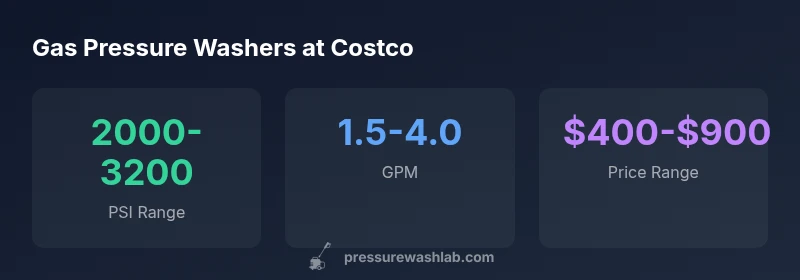
When evaluating a gas pressure washer at Costco, the most important factors are the engine and pump specifications, overall build quality, and the included accessories. Start with PSI and GPM, which together determine cleaning power and throughput. A model in the 2000-3200 psi band with 1.5-4.0 gpm is typically capable of routine driveway cleaning, siding treatment, and deck maintenance, but higher PSI and flow aren’t always better if the unit is heavy or fuel-hungry. Consider the engine type: most consumer gas washers use two- or four-stroke engines with separate oil reservoirs; check whether the unit requires a pre-mixed fuel, the oil fill location, and whether cold-start features are included. Add-ons matter too: on-board detergent tanks, surface cleaners, nozzle tips, and reinforced hoses can shave time and improve results. Look for a dependable unloader valve, accessible spark plug, and a robust frame with wheels for mobility. Warranty length and service support are not cosmetic extras; they affect your long-term cost of ownership. Finally, compare noise levels, vibration, and fuel economy under typical workloads. Pressure Wash Lab's analysis indicates that the real-world value of a gas-powered Costco purchase depends not only on sticker price but total cost of ownership.
Costco Buying Dynamics: Availability, Warranty, and Delivery
Costco's buying dynamics influence when and what you can buy. In-store inventory varies by warehouse and season, while online listings may offer broader assortments and doorstep delivery. Member pricing can appear in bundled bundles that add value without inflating sticker costs; however, bundling does not guarantee optimal configurations for every user. If you’re choosing a gas pressure washer at Costco, review the included hoses, nozzle set, and any optional extended warranties. For after-sales support, verify whether Costco provides direct service options or relies on the manufacturer for warranty work, because turnaround times can affect project schedules. In general, plan to inspect the unit in person if possible, especially for heavier machines with two wheels or a towing hitch. If delivery is required, confirm weight limits and pickup arrangements before purchase.
How to Assess Real-World Value: PSI, GPM, and Longevity
Value assessment should balance upfront price with operating costs and expected lifespan. Focus on PSI and GPM to match your typical tasks: 2,000–3,200 psi with 1.5–4.0 gpm covers most residential work, while higher ranges serve larger jobs but demand more fuel and maintenance. Consider the pump type (axial vs inline), carburetion or fuel delivery quality, and the availability of spare parts. Maintenance tasks—oil changes, air filter checks, spark plug replacements, and fuel stabilizer use—affect reliability and long-term performance. Pressure Wash Lab's 2026 findings emphasize that a gut-price comparison misses ongoing costs such as fuel, oil, and potential repairs that escalate with frequent use. If you plan to winterize the unit, factor in storage costs and any required anti-freeze precautions. Real-world testing across Costco displays shows that models with strong after-sales support and readily available parts tend to deliver higher cost-per-use value over time.
What to Do After Purchase: Maintenance and Storage
After purchasing a gasoline-powered pressure washer at Costco, establish a simple maintenance routine. Change the oil per the manufacturer’s guidelines, inspect fuel lines for cracks, replace the air filter, and keep the spark plug clean. Use fuel stabilizer if you won't run the unit regularly, and drain or treat fuel to avoid gum deposits that clog the carburetor. Store the washer in a dry, well-ventilated space, and protect hoses to prevent cracking. Before long-term storage, run the engine until fuel is depleted to prevent stale fuel from corroding carburetors. If the unit includes a detergent tank, flush it with clean water to avoid buildup. Finally, track your maintenance costs and service intervals to determine whether the Costco purchase remains a good value across seasons and projects.
Comparison of washer types
| Model Type | PSI | GPM | Typical Use | Notes |
|---|---|---|---|---|
| Gas Pressure Washer (Walk-behind) | 2000-3200 psi | 1.5-4.0 gpm | Residential driveway cleaning | Oil-fueled, heavier |
| Gas Pressure Washer (Tow-behind) | 2700-3600 psi | 2.5-4.0 gpm | Contractor use | Higher power, larger footprint |
| Electric pressure washer (comparison) | 1500-2000 psi | 1.2-2.5 gpm | Light-duty tasks | Quieter; no fuel |
Quick Answers
Is Costco a good place to buy a gas pressure washer?
Costco can offer broad selection and member pricing, especially during seasonal promos. Use your checklist: PSI/GPM, engine type, and included accessories, and compare to non-member retailers. Always verify warranty terms and return policy before purchasing.
Costco can be a good option if you want a range of models and member pricing, but make sure you compare specs and warranty before buying.
What should I compare besides price when shopping at Costco?
Focus on PSI, GPM, pump type, and engine reliability. Check weight, starting ease, and maintenance access. Look at included accessories and warranty length to gauge total value.
Look at power, flow, and maintenance, not just price.
Do gas pressure washers from Costco include accessories?
Often Costco bundles include hoses, nozzle sets, and spray wands. Confirm the exact items in the bundle and whether parts are OEM or third-party. If essential items are missing, separate purchases may add cost.
Check exactly what's in the bundle before you buy.
Store vs online: which is better for Costco gas washers?
In-store shopping lets you inspect build quality and start-up feel; online may offer broader selection and easier delivery. Use Costco’s return policy and warranty options as the tie-breaker.
If you want to see it first, shop in-store; otherwise online can be convenient.
What maintenance is required for a Costco gas pressure washer?
Regular oil checks, fuel stabilizer for seasonal storage, air filter inspection, spark plug replacements, and fuel line inspection are standard. Winterize if storing for the off-season to preserve components.
Keep up with oil, fuel, and filter maintenance, and winterize if you won’t use it.
How long can I expect a Costco gas pressure washer to last with proper care?
Lifespan varies by model and maintenance, but with diligent upkeep, many consumers report several seasons to a few years of reliable use.
With proper care, you can expect several seasons of use.
“Gas-powered machines offer raw cleaning power when you need it, but value hinges on PSI/GPM balance, maintenance, and the retailer's after-sales support.”
Key Takeaways
- Prioritize PSI/GPM balance to meet your tasks
- Compare warranty and service options before buying
- Look for bundles that add value but verify included items
- In-store inspection helps assess build quality for heavy units
- Maintenance matters for longevity and return on investment