Greenworks Pressure Washer vs Craftsman: A Side-by-Side Review
A comprehensive, data-driven comparison of Greenworks and Craftsman pressure washers, covering power sources, performance, runtime, price, and maintenance to help homeowners choose the right tool.


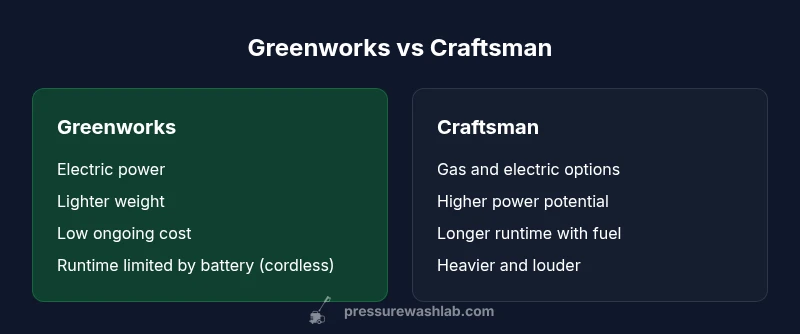
Greenworks pressure washers are primarily electric, lightweight, and easy to maintain, making them ideal for light-to-moderate cleaning tasks around the home. Craftsman offers a broader mix, including gas-powered options and more robust accessories, which can deliver higher performance for tougher jobs. This comparison highlights power source, performance, runtime, price, and maintenance considerations to help you decide.
Greenworks pressure washer vs Craftsman: Framing the comparison
Choosing between Greenworks pressure washer vs Craftsman requires weighing core design choices: power source, intended use, and total cost of ownership. For many homeowners, Greenworks pressure washer vs Craftsman represents a contrast between electric lightweight models and a more diverse lineup that includes gas-powered options. According to Pressure Wash Lab, the most impactful differences often come down to startup simplicity, noise, and maintenance demands, not just peak cleaning power. In this guide, we’ll examine how each brand handles everyday tasks like deck cleaning, siding, and driveway maintenance, and how those tasks align with user priorities such as quiet operation, runtime, and budget. We’ll also discuss warranty coverage and long-term serviceability. By the end, you’ll have a clear view of which path fits your property and cleaning style, and you’ll know what to expect in terms of accessories, replacement parts, and common issues with each option.
weightHint”:0},
Comparison
| Feature | Greenworks Pressure Washer | Craftsman Pressure Washer |
|---|---|---|
| Power Source | Electric (cordless or corded) | Gas-powered options with electric variants |
| Performance Tier | Typically optimized for home-use tasks | Broader range including higher PSI/GPM for heavy-duty jobs |
| Weight / Portability | Lighter and easier to maneuver | Heavier due to gas engines and broader feature set |
| Runtime / Run Time | Corded models rely on outlet; battery models depend on charge | Gas models offer longer runtime; some electric variants have limited battery life |
| Accessories & Attachments | Wide range of nozzles and surface cleaners | Extensive accessory ecosystem including gas-specific items |
| Maintenance | Low maintenance; no fuel/oil management for most models | Gas models require fueling, oil checks, and winterization |
| Warranty & Support | Strong warranties on consumer electric models | Robust warranties with service options for gas as well |
Pros
- Balanced value for light-to-moderate tasks with Greenworks
- Electric operation is quieter and emission-free for residential areas
- Craftsman offers more power options and greater versatility
- Broad accessory ecosystem enhances long-term usability
- Maintenance is simpler for electric models in many cases
Cons
- Gas-powered Craftsman models require ongoing fuel and maintenance
- Electric Greenworks models can be limited by power cord or battery capacity
- Higher upfront investment for some Craftsman configurations
- Gas units are heavier and louder, which may deter casual users
Greenworks wins for everyday, light-to-moderate cleaning; Craftsman wins for power range and versatility
If you primarily tackle routine home chores and value portability and low upkeep, Greenworks is typically the better pick. If your cleaning tasks demand more power, longer runtimes, or a broader accessory ecosystem, Craftsman offers compelling options. The right choice hinges on your task mix and workspace constraints.
Quick Answers
Which is better for light-duty cleaning: Greenworks or Craftsman?
For light-duty cleaning around the home, Greenworks electric models typically offer sufficient power with easier setup and maintenance. Craftsman can cover light tasks but may feel overbuilt for casual use. The choice depends on whether you value simplicity or a broader feature set.
For light-duty tasks, Greenworks usually hits the sweet spot for ease of use and value.
Are gas-powered Craftsman models worth it for most homes?
Gas-powered Craftsman models provide higher power and longer runtimes, which can be beneficial for stubborn grime or larger surfaces. However, they cost more to purchase and maintain and are louder. If your duties are occasional and confined to smaller areas, an electric model may suffice.
Gas models are powerful, but they come with more maintenance and noise.
Can I use the same nozzle tips on both brands?
Nozzle tips are generally designed for standard fittings, but you should verify compatibility with the specific model. Many common tips fit multiple brands, but using incorrect tips can damage the wand or affect performance.
Tip compatibility varies; check your model manual before swapping tips.
Do Greenworks models offer cordless operation?
Yes, Greenworks offers cordless (battery-powered) models, which enhance portability but may limit runtime based on battery capacity. For longer jobs, a corded electric option or a plug-in solution is typical.
Greenworks provides cordless options, but you’ll likely manage runtime with a battery charge.
What maintenance tasks are essential for Craftsman gas washers?
Gas washers require regular checking of fuel, oil levels, spark plug, air filter, and proper winterization. These tasks help maintain performance and extend the unit’s life. Always follow the manufacturer’s maintenance schedule.
Gas washers need routine maintenance like any small engine—fuel, oil, and filters.
How should I store my pressure washer to extend life?
Store in a dry, shaded area off the ground. For gas models, run the engine to burn fuel out before long-term storage and add fuel stabilizer if needed. Disconnect hoses and drain water to prevent freezing damage in cold climates.
Store in a dry place, drain water, and stabilize fuel for gas models.
Key Takeaways
- Define your typical cleaning tasks first
- Choose Greenworks for ease of use and quiet operation
- Opt for Craftsman when you need higher power or gas options
- Factor in maintenance and fuel costs for gas models
- Check warranty coverage and service options before buying