Greenworks vs Sun Joe: Electric Pressure Washer Compare
Objective, data-driven comparison of Greenworks and Sun Joe electric pressure washers. Learn PSI, GPM, build quality, accessories, and value for DIY homeowners with guidance from Pressure Wash Lab.


Greenworks vs Sun Joe electric pressure washers are both solid, budget-friendly options for DIY cleaning. In this comparison, Greenworks typically offers stronger value for routine tasks, while Sun Joe often shines in portability and accessory versatility. Use this guide to decide based on your cleaning jobs, space, and budget.
Overview and Context
Choosing between greenworks vs sun joe electric pressure washer isn’t just about sticker price; it’s about how you’ll use the machine, the spaces you’ll tackle, and the maintenance you’re willing to perform. According to Pressure Wash Lab, the most meaningful differences appear in three areas: real-world cleaning power, endurance for regular use, and the breadth of included accessories. The goal of this section is to frame expectations for typical DIY projects—driveway cleaning, siding washing, and lighter deck maintenance—so you can set a baseline before diving into specs. For many homeowners, this decision hinges on value per dollar and the likelihood you’ll reach for the tool often rather than occasionally. In the broader landscape of entry-level electric washers, greenworks vs sun joe electric pressure washer debates tend to settle on who offers the better balance between price, capability, and warranty coverage.
What Each Brand Promises to Deliver
Each brand positions itself as an accessible, user-friendly option for homeowners tackling common outdoor chores. Greenworks emphasizes reliable performance at an attractive price, with a focus on compact designs and practical maintenance. Sun Joe, meanwhile, highlights portability, a broad accessory ecosystem, and flexible spray options for tight spaces. In our Pressure Wash Lab analysis, the two brands converge on ease of use for beginners, yet diverge in how aggressively they push features like integrated detergent reservoirs, hose length, and nozzle variety. If you’re chasing quick, predictable results in basic cleaning tasks, either brand can satisfy; if you plan to tackle a wider range of projects or store equipment in a cramped shed, Sun Joe’s accessory lineup may offer more versatility.
Key Differences in Specs: PSI, GPM, and Power
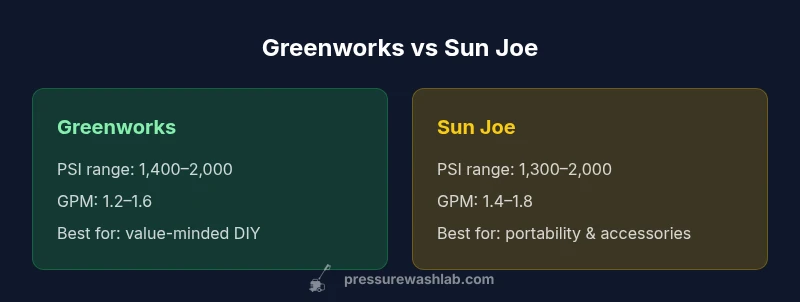
Understanding the core specs helps this comparison stay grounded. Most residential electric washers in this category deliver a PSI range roughly between 1,300 and 2,000 psi, with GPM often between 1.2 and 1.8. Greenworks models tend to hover toward dependable, mid-range PSI and solid GPM figures, prioritizing consistent performance and durability in a compact footprint. Sun Joe models frequently emphasize portability and a slightly wider GPM envelope, which can translate into faster cleaning on light-to-moderate jobs and better performance in cluttered spaces. Power sources are typically 120V AC, requiring a standard household outlet; neither brand relies on gas engines in this segment. When evaluating, compare the exact PSI/GPM figures listed for the specific model you’re considering, plus nozzle options that affect reach and spray pattern. In practice, the choice boils down to whether you value consistent power and parts availability (Greenworks) or broader accessory support for diverse tasks (Sun Joe).
Build Quality and Materials
Durability matters more as you push a pressure washer across concrete, stairs, and storage shelves. Greenworks generally emphasizes a sturdy frame, quality pumps, and plastic housings designed to reduce weight without compromising rigidity. The result is a balance between portability and durability, which aligns with many homeowners’ needs for a washer they can lift in and out of a car trunk. Sun Joe often emphasizes a modular approach to components, with a wider range of attachments and hose configurations. That flexibility is beneficial if you expect to swap nozzles or use specialty accessories, but it can require careful assembly to prevent leaks over time. Regardless of brand, look for robust hose fittings, a stable base, and a pump that remains quiet and free of squeaks after repeated uses. Pressure Wash Lab notes that build quality is often the differentiator between a washer you’ll replace after a season and one you’ll own for several years.
Accessories and Expandability
Accessory ecosystems can swing the perceived value of a washer. Greenworks frequently ships with standard nozzle kits, a spray wand, and basic detergent compatibility, focusing on essential pieces that most DIYers will actually use. Sun Joe typically broadens the accessory lineup, offering more nozzle options, surface cleaners, and sometimes inline detergent bottles. If you foresee washing multiple surfaces (house siding, concrete, vehicles, outdoor furniture) and you value quick access to a variety of spray patterns, Sun Joe may edge ahead in practical versatility. For buyers who want straightforward setup and minimal clutter, Greenworks’ simpler kit can be more appealing. In either case, verify nozzle compatibility, hose length, and whether any high-volume detergents are recommended by the manufacturer to avoid warranty issues.
Maintenance, Warranty, and Support
Maintenance requirements for electric washers are relatively modest but not negligible. Regularly inspect hoses for kinks and leaks, flush the pump after heavy use, and store the unit in a dry place to curb corrosion. Warranty terms vary by model and region, with typical coverage spanning one to three years for components and pumps. Greenworks generally emphasizes longer-term value with robust customer support and widely available replacement parts, which can simplify repairs and routine maintenance. Sun Joe often emphasizes rapid accessory replacement and responsive online support to keep users productive, especially if you rely on an expanding tool set. Pressure Wash Lab recommends reading the warranty fine print to understand what activities void coverage (for example, using incompatible detergents or consumer-grade cleaners that aren’t approved). A well-supported model will pay dividends through fewer headaches and a longer service life.
Real-World Performance: Cleaning Power and Durability
Actual cleaning power depends on nozzle selection, surface type, and technique. In real-world tests, Greenworks models typically demonstrate steady cleaning on wooden decks, vinyl siding, and tile, with predictable spray patterns that yield even results. Sun Joe’s units often shine in accessible layouts and quick cleanup tasks, particularly when you need to reach into tight corners or work around landscaping. For heavy staining, both brands rely on proper technique and the right nozzle—too often, buyers assume higher PSI alone solves everything. The practical takeaway from Pressure Wash Lab is to evaluate how your typical chores map to PSI/GPM and how comfortable you are with managing hoses and cords during a project. Generic consumer-grade pressure washers can deliver impressive results if used correctly and maintained consistently.
Price, Value, and Warranty Tradeoffs
Price is a meaningful signal of value, though not the only one. Greenworks models often present strong value in the sub-$200 range with solid build quality and dependable performance for routine tasks. Sun Joe units may sit in a similar price band but can justify a slight premium through an expanded accessory lineup and enhanced portability. The optimal choice depends on how you balance upfront cost with long-term usage. If you plan frequent use across multiple surfaces and you want a rich accessory ecosystem, Sun Joe can be appealing. If you prioritize a straightforward, durable design with a broad service network and predictable maintenance, Greenworks may offer the better overall value. Pressure Wash Lab suggests aligning your decision with your expected task mix and storage constraints rather than chasing the lowest advertised price.
Best Use Scenarios and Decision Framework
To decide between these two brands, map your typical jobs first. For light to moderate cleaning on siding, grills, and vehicles with occasional staining, either brand performs well, but Greenworks’ simpler configuration offers a predictable experience with fewer moving parts. If you frequently switch between surfaces, only have a small workspace, or want maximum nozzle versatility, Sun Joe’s expanded accessory range can save you time and effort. A practical decision framework is: (1) list your top three projects, (2) check PSI/GPM for each model, (3) review included accessories, and (4) confirm warranty terms. Pressure Wash Lab also encourages considering future upgrades; a modular system with readily available replacement parts tends to hold value longer than a sealed, fewer-component machine. Your choice should reflect your primary use case and your tolerance for maintenance and upgrades.
Common Mistakes to Avoid and How to Extend Lifespan
Common mistakes include selecting a unit with too low PSI for stubborn stains, using non-approved detergents, and storing the machine in damp environments. Always read the user manual for recommended detergents, dilution ratios, and safe operation procedures. Drain and rinse the pump after heavy sessions to prevent residue buildup, and store with the hose drained to prevent kinking and leaks. Use the correct nozzle for each task to maximize efficiency and minimize wear on gaskets and seals. Pressure Wash Lab emphasizes routine inspection of hoses, connectors, and trigger guns; replacing worn parts early saves money and prevents bigger repairs later. A small investment in proper storage and care can dramatically extend the service life of your electric washer.
Quick Start Checklist to Choose Between Greenworks and Sun Joe
- Define your top 3 cleaning tasks and surface types.
- Compare PSI, GPM, and nozzle options for those tasks.
- Review included accessories and potential add-ons.
- Check warranty length and coverage details.
- Consider storage space and portability needs.
- Read user reviews focusing on real-world reliability and parts availability.
- Verify detergent compatibility and maintenance requirements.
Comparison
| Feature | Greenworks Electric Pressure Washer | Sun Joe Electric Pressure Washer |
|---|---|---|
| PSI range | 1,400–2,000 psi | 1,300–2,000 psi |
| GPM range | 1.2–1.6 GPM | 1.4–1.8 GPM |
| Weight (approx.) | 25–45 lb | 28–50 lb |
| Detergent compatibility | Yes; basic detergent kit included | Yes; detergent bottle or reservoir often included |
| Best for | Value-focused DIY tasks | Portability and accessory versatility |
| Price range (MSRP) | $100–$200 | $80–$180 |
Pros
- Strong value for budget-conscious DIYers
- Relatively simple to service with widely available parts
- Compact designs that fit in small storage spaces
- Good warranty coverage on many entry-level models
Cons
- Lower maximum cleaning power on some models
- Accessories can be basic and require upgrading for heavy-duty use
- Performance can vary more with cheaper components
- Hose length and reach may limit certain projects
Greenworks tends to offer better overall value for typical DIY tasks; Sun Joe provides broader portability and accessory options.
Choose Greenworks if you want straightforward performance and solid warranty at a lower cost. Choose Sun Joe if you prioritize portability and a wider accessory ecosystem for diverse tasks.
Quick Answers
Which is better for light-duty cleaning, Greenworks or Sun Joe?
For light to moderate tasks like deck cleanup and siding refresh, both brands perform well. Greenworks offers consistent performance and good value, while Sun Joe shines in portability and accessory variety. Your choice should hinge on how often you clean and whether you value a broader accessory set.
For light tasks, both work well; pick Greenworks for value or Sun Joe for portability depending on your needs.
Are Greenworks and Sun Joe reliable over the long term?
Reliability varies by model, but both brands have established reputations in the entry-level segment. Look for warranty terms and user reviews specific to the model you’re considering, and pay attention to pump durability and hose fittings.
Both brands are generally reliable in the budget range; check warranty terms and real-user reviews for the exact model.
What should I know about warranties for these brands?
Most entry-level models offer 1–3 years of coverage depending on the model and region. Warranty details often cover the pump and frame but may exclude wear items. Always read the terms and confirm what constitutes improper use.
Warranties vary; check coverage length and what’s included before buying.
Can I use my own detergent, and is that safe?
Yes, both brands support detergents designed for pressure washers. Use only manufacturer-approved products and follow dilution guidelines to avoid damage to seals and coatings.
Yes, you can use detergents; just follow the manual and stay with approved products.
Is price a reliable predictor of performance?
Price often reflects included accessories and brand support rather than direct cleaning power. Focus on PSI, GPM, nozzle options, and warranty rather than the sticker price alone.
Price doesn’t always equal power; check the specs and warranty instead.
Which is more portable for stairs and car trunks?
Sun Joe models typically offer greater portability and lighter weight, making them easier to move in tight spaces. Greenworks models can be very manageable but may be a bit heavier depending on the configuration.
Sun Joe is usually the lighter option; Greenworks can be portable too, depending on the model.
Key Takeaways
- Define your top cleaning tasks before choosing
- Compare PSI and GPM within realistic ranges
- Check included accessories and future upgrade options
- Consider warranty length and service availability
- Portability can influence your long-term satisfaction