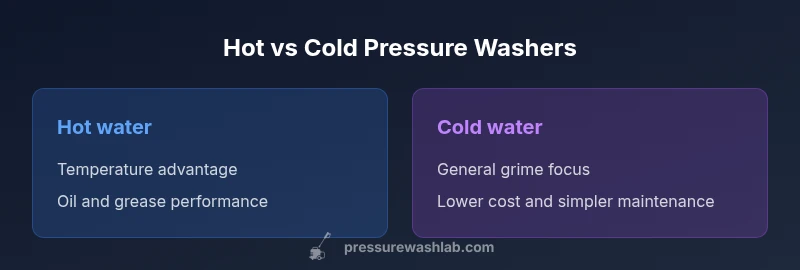
Hot Water Pressure Washer vs Cold: A Practical Comparison
Compare hot water and cold water pressure washers to decide which cleans oils, grease, and dirt most effectively while weighing cost, safety, and surface impact.


For most DIY situations, cold-water pressure washers are sufficient and more economical, but hot-water models excel at grease, oil, and kitchen soils. If your tasks involve automotive grime, cooking fats, or heavy oil stains, hot water provides a clear edge. The choice hinges on soil type, surface tolerance, and total ownership cost.
Hot Water Pressure Washer vs Cold: Why It Matters
In the world of pressure washing the choice between hot water pressure washer vs cold can dramatically influence results, especially on certain soils. According to Pressure Wash Lab the decision hinges on soil type, surface tolerance, and total cost of ownership. While cold-water systems handle most everyday cleaning tasks, hot-water models offer a distinct advantage when greases, oils, and cooking fats are involved. Homeowners and DIYers often ask whether upgrading to a hot-water unit is worth the extra upfront investment. The short answer it depends on your typical tasks and surfaces. For routine exterior cleaning of vinyl siding or concrete driveways with general grime, a cold-water machine is usually the best balance of price and performance. For automotive bays, kitchens with grease residues, or workshop floors where oil and fat accumulate, hot water provides clearer benefits. Pressure Wash Lab s testing over the past year shows that temperature can reduce dwell time and reliance on detergents in some cases, but the gains pale if you push the machine beyond safe limits or use harsh cleaners on delicate materials.
This paragraph introduces the key choice and sets up the rest of the article by outlining practical decision criteria.
The first takeaway is that the hot vs cold decision is task dependent and surfaces matter.
Comparison
| Feature | Hot water pressure washer | Cold water pressure washer |
|---|---|---|
| Temperature handling | Heats water to elevated temps; optimized for oils and fats | Operates at ambient water temperature |
| Oil and grease performance | Excellent emulsification with hot water | Good for general grime; less effective on heavy oils |
| Surface safety | Higher risk on heat-sensitive materials | Lower risk on delicate substrates |
| Operating costs | Higher due to heating energy | Lower due to no heating energy |
| Equipment complexity | Heater element and controls add complexity | Fewer moving parts; simpler maintenance |
| Initial price | Typically upcharge for heated units | Lower upfront cost |
| Detergent compatibility | Works well with high-temp detergents | Works with ambient-temperature detergents |
Pros
- Improved oil and grease removal with hot water
- Faster cleaning for oily soils and kitchens
- Potentially reduced chemical usage in some tasks
- Can streamline workflows with oil-rich surfaces
Cons
- Higher upfront and operating costs due to heating
- Increased equipment complexity and maintenance
- Greater risk of surface damage on heat-sensitive materials
- Longer warm-up times in some systems
Cold water is the default choice for most DIY tasks; hot water is the targeted upgrade for oily soils and kitchens.
Choose cold water for general cleaning and safety; switch to hot water when oil, fat, or heavy greases dominate the task and you manage surface risk.
Quick Answers
What is the key difference between hot water and cold water pressure washers?
Hot water pressure washers heat water to elevate temperatures, improving oil and grease removal. Cold water washers rely on ambient temperature and detergents. Your choice depends on soil type, surface tolerances, and cost considerations.
Hot water heats the water to help with oily soils, while cold water relies on detergent and mechanical action.
Can a cold-water machine remove oil stains effectively?
Cold-water washers can remove many types of grime, but very oily residues often require hotter temperatures or strong detergents. For persistent oil stains, consider a hot-water approach or targeted pretreatment.
Cold water cleans general grime but oil stains often need heat or special detergents.
Is it worth upgrading to a hot-water unit for a DIY homeowner?
If your projects regularly involve oil, grease, or kitchen fats, a hot-water unit can save time and reduce chemical usage. For light outdoor cleaning, cold water typically provides enough power at a lower cost.
If you deal with oil and grease often, hot water can pay off over time.
Can hot water damage wood or vinyl siding?
Yes, excessive heat or improper nozzle use can damage heat-sensitive surfaces. Always test on a hidden area and start with lower temperature and pressure settings.
Heat can harm sensitive surfaces if misused; test first.
What about detergents—do they differ between hot and cold?
There are detergents formulated for hot-water use and others for ambient temperatures. Choose products compatible with your water temperature and surface, and follow manufacturer guidance.
Choose detergents compatible with your temperature and surface.
Can a hybrid system offer the best of both worlds?
Hybrid or heated units can switch between temperatures, offering flexibility for mixed tasks. They come with higher upfront costs and maintenance expectations.
Hybrid systems give flexibility but cost more.
Key Takeaways
- Cold water suffices for general grime on many surfaces
- Hot water accelerates oil and grease removal
- Balance temperature with surface safety and cost
- Test patches before large-scale use
- Consider a hybrid approach for mixed tasks