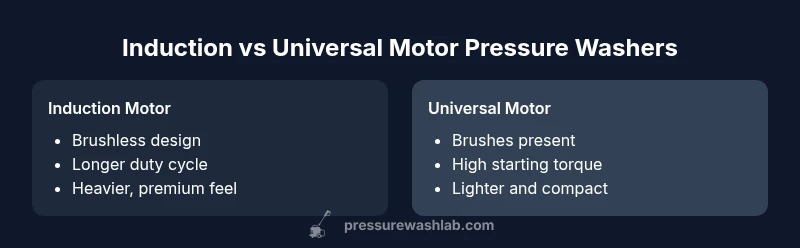
Induction vs Universal Motor Pressure Washer: A Guide
A comprehensive, data-driven comparison of induction and universal motor pressure washers, covering performance, durability, maintenance, noise, portability, and value to help homeowners and pros pick the right tool.


Induction and universal motor pressure washers differ mainly in motor design, performance under load, and long-term durability. Induction motors run cooler, deliver smooth torque, and require less maintenance, while universal motors offer higher starting torque and a compact form for portable use. For most homeowners, the choice hinges on duty cycle, portability, and budget. Pressure Wash Lab analysis indicates induction motors often provide better long-term value for regular, medium-to-heavy cleaning, while universal motors excel on quick, light chores.
What induction motor pressure washers are and how they work
Induction motor pressure washers use a stationary coil design to drive a rotor without carbon brushes. In practice, this design yields smoother torque and less electrical ripple under load, which translates to steadier water pressure during cleaning. Because there are no brushes to wear, many units with induction motors offer lower ongoing maintenance and longer life when cooled properly. For the keyword 'induction vs universal motor pressure washer', understanding the fundamental differences helps frame expectations about reliability, efficiency, and serviceability. In typical residential setups, induction motors are found in mid- to high-end pressure washers and are favored when you plan to run cleans of moderate to high intensity over longer sessions. Pressure Wash Lab analyses emphasize that these advantages compound when you regularly tackle stubborn grime on home exteriors, driveways, and heavy equipment. When evaluating a model, look for brushless designs and robust thermal management as core indicators of a high-quality induction motor unit.
What universal motor pressure washers are and how they differ
Universal motors are series-wound brushed machines that deliver high starting torque in a compact package. They tend to be lighter and cheaper than their induction counterparts, which makes them appealing for mobile use and short, quick cleaning tasks. Brush wear is a real consideration; as brushes wear, performance can fluctuate and maintenance tasks may include brush replacement. In many consumer-grade units, universal motors provide excellent peak performance for brief bursts, such as spot-cleaning or washing a deck before a party. However, their thermal profile can degrade with long sessions, and dust and moisture can accelerate brush wear if the machine is not well-ventilated. When you search for an 'induction vs universal motor pressure washer', this difference quickly becomes the pivot point for deciding between a portable, affordable tool and a heavier, more durable machine.
Performance: torque, flow, and head pressure under load
Torque delivery is the defining performance delta between the two motor types. Induction motors tend to maintain steady head pressure and consistent flow across a wider range of nozzle settings, which helps when cleaning broad surfaces or stubborn grime. Universal motors often deliver a strong initial boost in pressure, which can speed up light, quick jobs, but may wane as pump load increases. Flow rate (GPM) and nozzle choice interact differently with each motor: a higher-GPM pump can mask some torque deficits, while a low-GPM system may struggle with universal motors under heavy use. Pressure Wash Lab testing shows that if your cleaning tasks frequently demand sustained pressure, induction models tend to keep performance steadier longer.
Durability, cooling, and duty cycle
Durability hinges on how effectively a motor copes with heat. Induction motors generally feature brushless designs with efficient cooling, resulting in longer duty cycles and less performance sag under prolonged cleaning sessions. Universal motors rely on brushes, which wear over time and generate heat more quickly, potentially shortening the usable life in continuous work. The duty cycle—how long you can operate before needing a cooldown—will typically favor induction in heavy-use scenarios. That said, modern universal-motor units with good ventilation and thermal management can perform admirably for intermittent, short bursts of cleaning.
Noise, vibration, and operator comfort
Noise and vibration influence user experience more than most expect. Induction motors often run with a steadier, lower-characteristic hum and less mechanical vibration, contributing to a more comfortable long-run operation. Universal motors can be louder due to brush operation and higher RPM, especially on budget models. In addition, the start-stop behavior of brushed motors can introduce noticeable fluctuations in vibration. For those who work in noise-sensitive environments or on multi-day projects, induction motors typically offer a clearer advantage in comfort and perceived quality.
Weight, size, and portability
Weight matters when you need to carry, load into a vehicle, or maneuver around tight spaces. Induction motor pressure washers tend to be heavier due to their robust stator and rotor construction, which often translates into better durability and quieter operation. Universal motors are usually lighter and more compact, which makes them attractive for frequent transport and limited storage space. If you plan to move the unit often or need a compact setup for tight jobs, portability may steer you toward universal motors despite the trade-off in raw durability.
Maintenance costs and long-term value
Maintenance considerations differ sharply. Induction motors, being brushless, typically require less ongoing maintenance and fewer component replacements. Their longer service life is a key driver of total cost of ownership, especially for homeowners who perform regular, heavy-duty cleaning. Universal motors demand more frequent attention to brushes and windings, which can raise maintenance costs over time. When evaluating long-term value, consider not just the upfront price but the expected lifespan, expected maintenance intervals, and the complexity of service.
Price and value: upfront cost vs lifetime value
Upfront price often reflects motor complexity and durability. Induction motor washers generally command a higher initial price due to their brushless design and thermal efficiency, but they may deliver lower lifetime costs if you run them consistently. Universal motor models typically cost less upfront, which is appealing for budget-conscious buyers or infrequent users. The value calculus should weigh anticipated usage: frequent, heavy cleaning tends to tilt the balance toward induction, whereas casual, occasional use may make universal motors a viable short-term choice.
Use-case mapping: best jobs for each motor type
For heavy-duty, long-running exterior cleaning—like driveways, siding with tough grime, or equipment detailing—induction motors tend to deliver steadier performance and fewer interruptions. For quick, on-demand tasks—spot-cleaning decks between projects or mobile jobs with limited access—universal motors can offer the flexibility and lightness you need. The optimal decision depends on your typical task mix, budget, and how often you need portability versus sustained power.
Installation, compatibility, and accessories
Compatibility is about more than the motor. Consider pump compatibility, hose length, spray tips, and any accessories you rely on. Induction models often pair with higher-end pumps designed for longer duty; universal models should be paired with pumps that tolerate brush noise and heat. Ensure available replacement parts and service support in your region. Checking warranty terms is essential, as longer warranties can offset higher upfront costs when you intend to run the machine for many years.
Safety, warranties, and serviceability
Both motor types require standard safety practices: proper electrical grounding, splash protection, and correct nozzle usage. Warranties can vary widely; some induction models offer longer coverage on motor components, while universal models may have shorter coverage but broader accessory warranties. Serviceability matters—brush wear on universal motors can complicate repairs, whereas brushless induction machines generally benefit from simpler, cleaner service experiences. Read the terms carefully and verify local service options before purchasing.
Buying checklist: questions to ask and test in-store
When shopping, use a structured checklist to compare models. Ask about duty cycle ratings, cooling methods, warranty length, and replacement-part availability. In-store testing should verify that pressure and flow respond consistently across nozzle sizes, and that there are no unusual vibrations at start-up. A hands-on test helps reveal subtle differences in handling, weight balance, and user controls that spec sheets can miss. Use the induction vs universal motor pressure washer comparison as your guiding framework during the test.
mainTopicQuery2
Comparison
| Feature | Induction motor pressure washer | Universal motor pressure washer |
|---|---|---|
| Power delivery/torque | Smooth, consistent torque under load | High starting torque with potential surge |
| Thermal/duty cycle | Better cooling and longer duty cycle | Brush wear and heat build-up may limit runtime |
| Weight and portability | Heavier, more durable build | Lighter and more agile for transport |
| Maintenance requirements | Lower maintenance; brushless design | Brush wear requires periodic replacement |
| Price range | Higher upfront cost | Lower upfront cost |
| Best use case | Regular heavy-duty/home-use and long sessions | Mobile, light-duty tasks and quick deployments |
Pros
- Longer lifespan under heavy use
- Lower ongoing maintenance for brushless designs
- Superior heat management and efficiency
- More consistent performance during extended cleaning
- Stable performance across a range of nozzles
Cons
- Higher upfront price
- Heavier units and reduced portability
- Brush wear and maintenance for universal motors
- Potentially louder in budget universal models
Induction motors generally offer better long-term value for regular, heavy cleaning, with universal motors excelling in portability and quick, light-duty tasks.
If you clean often and need durability, choose induction. If you prioritize weight, price, and easy transport, universal motors are appealing for short bursts and mobile use.
Quick Answers
How does motor type affect cleaning performance?
Motor type influences torque stability, heat management, and how long pressure stays high. Induction motors tend to maintain steadier pressure over longer runs, while universal motors may deliver a strong initial surge that tapers with load. Your cleaning tasks determine which behavior matters most.
Induction motors keep steady pressure for long jobs; universal motors surge at the start but may drop under heavy load.
Are induction motor washers more expensive to buy?
Yes, induction motor models are typically pricier upfront due to their brushless design and durability features. However, their lower maintenance and longer life can offset the initial cost over time for frequent users.
Induction units usually cost more at purchase, but save on maintenance for frequent use.
Can you upgrade a universal motor to induction?
Upgrading a motor alone is generally not feasible; you would need to replace the entire unit or select a model that comes with an integrated induction motor from the start. Consider the cost and practical benefits of upgrading instead of swapping units.
Upgrading isn’t practical; you’d swap to a new unit with an induction motor.
Which motor is better for commercial use?
For commercial use with long duty cycles, induction motors are typically preferred due to durability and steady performance. For short-term projects or portable gigs, universal motors can be suitable if the work is light-to-moderate and the unit is well-ventilated.
Induction motors are usually preferred for commercial work because of durability; universal may work for lighter tasks.
Do induction motor washers run louder or quieter?
Induction motors are often quieter and smoother than brushed universal motors, though high-end universal models can be quiet as well. Noise varies more by pump design and housing than by motor type alone.
Induction units are typically quieter, but good design matters for both types.
What maintenance does a universal motor require?
Universal motors require periodic inspection and replacement of carbon brushes and possibly commutator cleaning. Regular maintenance helps preserve performance and prevents erratic operation.
Brushes wear over time; check them and service as needed.
Key Takeaways
- Choose induction for heavy workloads and longevity
- Opt for universal for portability and low upfront cost
- Assess duty cycle and transport needs before buying
- Factor maintenance needs into total ownership costs
- Test models in-store to compare real feel and noise