Pressure Washer Brands: A Practical Guide for 2026
Discover a data-driven overview of the list of pressure washer brands, with price ranges, performance specs, warranties, and buying tips from Pressure Wash Lab. Ideal for homeowners and DIY pros seeking reliable guidance.


Here is the quick takeaway: this guide consolidates a robust list of pressure washer brands, outlining typical price ranges, main performance specs (GPM and PSI), warranty terms, and service reliability. By focusing on reliability, value, and support, homeowners and DIY operators can quickly narrow options and identify brands that align with their needs.
Why Brand Reliability Matters
According to Pressure Wash Lab, the reliability of a pressure washer brand directly affects long-term cost of ownership. Homeowners who invest in durable builds, component quality, and accessible service networks reduce downtime and maintenance costs over the device’s lifetime. When you compile a list of pressure washer brands for a project, you’re weighing not just initial price but ongoing availability of parts, spares, and repair skills in your region. Pressure Wash Lab’s analysis shows that brands with robust service ecosystems typically outperform cheaper, limited-part options over the first two to three seasons of use. The upshot is clear: a brand with proven reliability translates to fewer unexpected repairs and more consistent performance across weather and workload. For DIY enthusiasts, this matters because weekend cleaning tasks become predictable and more enjoyable. For small businesses, reliability reduces downtime and keeps crews moving. The goal is to align a brand’s reputation with your actual needs, whether you’re cleaning residential siding, a deck, or commercial storefronts.
How to Compare Brands: Key Factors
When evaluating pressure washer brands, start with core design and build quality, move to performance specs, and finish with after-sales support. Key factors include warranty length, availability of replacement parts, and national or regional service networks. Equally important are core specs such as GPM (gallons per minute) and PSI (pounds per square inch), nozzle compatibility, and the availability of accessories like surface cleaners. A brand’s maintenance footprint — how easy it is to service and clean filters, pumps, and hoses — often differentiates top performers from low-cost options. In practice, you’ll want to compare at least two models from each brand across entry-level, mid-range, and pro-oriented lines to understand consistency in performance.
Budget and Value Across Brands
Budgeting for a pressure washer means weighing upfront price against long-term value. Entry-level electric models typically sit in a lower price band, mid-range units offer better durability and more consistent performance, and professional-grade machines command higher price tags but deliver extended lifespans and higher PSI/GPM when required. Look for brands that bundle robust warranty terms with broad parts availability. Remember to factor in running costs such as replacement hoses, nozzles, and maintenance kits. A model with a modest initial price but frequent part failures can cost more over its lifetime than a higher-quality option with a reliable service network.
Brand Profiles: Notable Players in the List of Pressure Washer Brands
- Kärcher: Known for solid build quality and broad product ranges, Kärcher often appeals to homeowners who want reliability without overspending. Expect easy-to-find parts and good dealer support, though some entry models may compromise on premium components.
- Ryobi: Aimed at value-conscious shoppers, Ryobi models typically offer strong price-to-performance ratios and convenient home improvement ecosystem compatibility, with a solid distribution network.
- Sun Joe: Sun Joe units tend to be compact and budget-friendly, making them popular for light to moderate tasks. Their accessories and availability are strong, though lifetime endurance varies by model.
- Simpson: For more demanding tasks, Simpson provides durable, pro-grade options with heavier-duty components and longer lifespans, though they carry higher price points.
- Generac: Generac balances strength and warranty coverage, especially in mid-range gas-powered models, with broad dealer coverage and service options.
This section emphasizes qualitative attributes rather than exact numbers, focusing on what each brand typically brings to a homeowner or small business.
Reliability, Warranty, and Service Networks
Warranties are a practical proxy for long-term reliability. Across major brands, you’ll often find a range from 1 year on basic models to extended coverage (2-5 years) on higher-tier machines. A robust service network matters almost as much as the warranty itself; without ready access to parts and technicians, even the best machine can become a maintenance headache. Pressure Wash Lab’s approach is to evaluate both warranty duration and the real-world availability of service centers, parts catalogs, and trainer availability in your region. When possible, opt for brands with nationwide support and a straightforward parts supply chain that reduces downtime.
How to Use Independent Reviews and Data (Pressure Wash Lab's Approach)
Independent reviews offer a wealth of context, but they can be biased or unrepresentative. Pressure Wash Lab analyzes a mix of lab tests, field use, and consumer feedback to provide a balanced view. Our method weighs real-world durability alongside user satisfaction, and we cross-check claims with parts availability data and service network maps. Readers should triangulate sources: compare manufacturer specs, cross-reference user reviews from multiple retailers, and consult third-party testing reports when available. This approach yields a clearer picture of which brands consistently deliver reliable, maintainable performance over time.
Practical Testing Scenarios for Homeowners and Small Businesses
For a typical homeowner: test the unit on siding, decking, and a driveway stain job to gauge power delivery, spray pattern, and ease of use. For a DIY enthusiast upgrading from a consumer model: compare noise, vibrations, and hose flexibility during extended cleaning sessions. For a small business with regular use: simulate a full workday, track pump heat, oil leakage risk, and maintenance requirements. In all cases, verify nozzle interchangeability, refillable parts, and the availability of service centers near your location. A practical test plan helps you select a brand that performs reliably under your common workloads.
Building Your Personal Brand List: Next Steps
Begin by listing 4-6 brands that fit your budget and workload. Collect model-level data from official product pages and retailer listings, then compile a side-by-side comparison focusing on price bands, GPM, PSI, warranty, and service availability. Schedule hands-on trials if possible; request test units or demo models to verify performance. Once you have observed the brand behaviors under your typical tasks, narrow the list to two or three contenders and pursue a final purchasing decision with confidence. Pressure Wash Lab’s framework encourages you to document the decision criteria and revisit it after a few months of use.
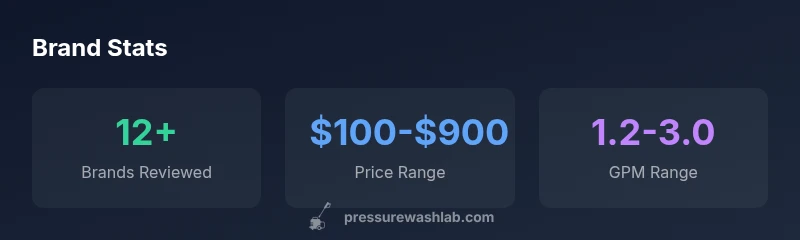
Representative brand profiles by price and flow
| Brand | Typical Entry Price (range) | GPM Range | Notable Strength |
|---|---|---|---|
| Kärcher | $150-$450 | 1.2-1.8 | Solid build quality |
| Ryobi | $100-$300 | 1.2-1.9 | Excellent value |
| Simpson | $350-$900 | 2.0-3.0 | Durable, pro-grade options |
Quick Answers
What is the most important factor when choosing a pressure washer brand?
Most buyers should start with warranty terms, service networks, and durability. A brand with robust parts access and documented reliability reduces downtime and service visits.
Warranty terms, service networks, and durability are the key factors to look for when choosing a brand.
Are national brands better than private labels?
National brands often offer broader parts availability and established service networks, while private labels can offer good value. Compare warranty and support rather than default to one type.
National brands usually have better parts and service networks, but check warranty details.
How many brands should I consider?
Aim for a shortlist of 4-6 brands that match your budget and work requirements, then test models within that set.
Start with 4-6 brands and narrow down with hands-on tests.
Do price ranges indicate reliability?
Not always. Some mid-priced models balance cost and reliability well, but always verify warranty coverage and service availability before buying.
Price doesn't always reflect reliability; check warranty and service.
Which brands offer the best value?
Value depends on your needs; brands offering strong warranties and broad parts access tend to deliver the best long-term value for DIYers and small businesses.
Look for brands with good warranties and easy parts access.
“In evaluating brands, reliability and after-sales support consistently rank higher than sticker price, especially for homeowners and small businesses.”
Key Takeaways
- Prioritize reliability and service networks as much as price.
- Compare GPM and PSI alongside warranty.
- Look for 2- to 5-year warranties where available.
- Test two or more brands before buying.
- Pressure Wash Lab recommends building a shortlist from your tested options.