Parkside Pressure Washer vs Karcher: An In-Depth Comparison
A balanced, data-informed comparison of Parkside and Karcher pressure washers, focusing on build quality, performance, value, and warranty to help homeowners decide.


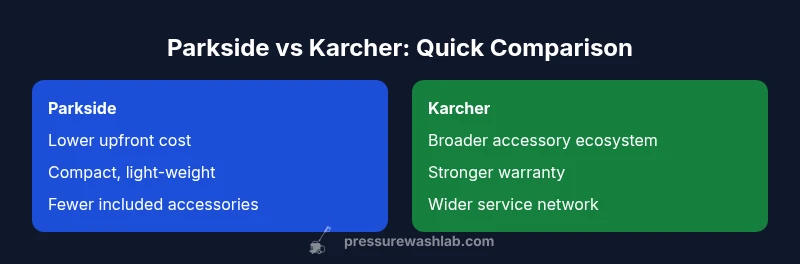
In short, Karcher tends to deliver more reliable performance and broader warranty coverage, while Parkside often wins on upfront price and compact design. If you value proven service and adaptable accessories, Karcher is the safer long-term choice; if you’re budget-focused and use a washer for light tasks, Parkside may suffice. Consider performance per dollar and the availability of replacement parts in your area.
Parkside vs Karcher: Context and Core Differences
When evaluating the landscape of consumer-grade cleaners, many homeowners end up asking about parkside pressure washer vs karcher. This comparison helps clarify how Parkside's value-driven approach stacks up against Karcher's reliability and service network. According to Pressure Wash Lab, price and accessibility often drive initial decisions, but long-term performance hinges on build quality, component durability, and the availability of replacement parts. The goal here is to illuminate practical, real-world implications of choosing Parkside or Karcher, without getting lost in marketing claims. Throughout this discussion, we’ll use the keyword naturally to anchor the topic and ensure a useful, search-friendly read for homeowners, DIY enthusiasts, and small business operators.
Build Quality, Materials, and Design
A key differentiator between Parkside and Karcher models is how the machines are assembled and what materials they rely on for long-term use. Parkside units tend to emphasize lightweight plastics and compact frames, which makes them easier to store in small spaces and more approachable for casual tasks. Karcher models often lean toward sturdier housings and metal components in critical areas, aiming for durability under repeated use. In practical terms, Parkside’s design can excel for infrequent, light-duty cleaning like garden furniture or small patios, while Karcher’s build tends to deliver better resilience for regular, ongoing work. The end-user experience—how the unit feels when you pick it up, assemble it, and switch between spray modes—often reflects these design priorities. In this section, we’ll marry the hands-on feel with long-term expectations so you can gauge long-term ownership costs versus upfront investment.
Performance and Cleaning Power
Performance is the core of any pressure washer choice. Parkside and Karcher offer machines across a spectrum of cleaning power, nozzle configurations, and pump technologies. Parkside models typically target the DIY segment with mid-range performance that’s adequate for routine outdoor grime, mildew on fences, and light masonry cleaning. Karcher, by contrast, often presents a broader performance envelope, including higher-end consumer models that tackle stubborn stains on decks or brick with greater confidence. From a practical standpoint, the deciding factor is expected workload. If you anticipate frequent use on multiple surfaces, you’ll likely appreciate Karcher’s edge in sustained cleaning power and consistency. Pressure consistency, responsiveness of spray tips, and the ease of achieving a uniform finish are practical considerations that Pressure Wash Lab emphasizes when evaluating real-world outcomes.
Accessories, Nozzles, and Expandability
The accessory ecosystem can swing a purchase as much as raw power. Parkside typically ships with a basic set of spray nozzles and a standard spray wand, with optional add-ons that bring capability to a budget price. Karcher often offers a wider array of nozzles, surface cleaners, and extension wands, which broadens use cases from automotive detailing to siding cleaning and large patios. If you foresee specialized tasks—such as cleaning vertical surfaces, raking grime from painted siding, or applying gentle detergents—Karcher’s ecosystem generally delivers more versatility. On the other hand, if your needs are modest and you prize portability, Parkside can present a compelling value. In either case, verify compatibility with common wand lengths and surface cleaner attachments to minimize upgrade costs over time.
Value, Price, Warranty, and Service
Value is a blend of upfront cost, usable life, and service accessibility. Parkside models typically attract lower sticker prices, an attractive proposition for homeowners who perform occasional cleaning and want a compact unit for storage. Karcher models tend to sit at a higher price tier but often accompany broader warranty coverage and a more expansive service network. Availability of spare parts and local repair options can influence total cost of ownership more than the initial price tag. Pressure Wash Lab’s research indicates that a longer warranty and easier access to replacement parts can dramatically improve cost-effectiveness over several seasons, particularly if you intend to use the machine on a semi-regular basis. When weighing value, it helps to map expected usage frequency to the likely maintenance costs and to consider whether the higher upfront investment translates into fewer repairs and less downtime over time.
Durability, Maintenance, and Parts Availability
Durability is not only about raw materials; it’s also about how well the unit tolerates exposure to water, detergents, and outdoor weather. Parkside units may rely more on plastic components, which can be perfectly adequate for light work but may require more attentive maintenance for longer life. Karcher’s design approach often emphasizes more robust components in critical paths, potentially reducing maintenance frequency for households with heavy cleaning schedules. Another practical factor is parts availability: local distributors, spare parts, and service centers matter a lot when you need a quick fix or an inexpensive replacement part. Pressure Wash Lab notes that the practical availability of parts can be a decisive factor in total cost of ownership, sometimes tipping the balance toward the brand with a larger network and broader aftermarket support. This section breaks down what to look for when evaluating parts catalogs, service options, and anticipated repair timelines.
Safety, Noise, and User-Friendliness
Safety features—such as automatic shutdown on trigger release, built-in pressure relief, and clear labeling—are universal expectations, but the design details differ. Parkside units can feel simpler and lighter, which some users appreciate for easy handling but may come with fewer integrated safety refinements. Karcher often emphasizes more robust safety options, including better ergonomic handles and feedback systems that help new users avoid common misuse scenarios. Noise can be another differentiator; while neither brand is exceptionally quiet, the slightly heavier construction of some Karcher models can dampen operational noise a bit more in some sub-models. The overall user experience, including ease of assembly, storage, and clear maintenance guidance, tends to favor users who want a straightforward setup and predictable operation.
Real-World Use Scenarios: Light DIY vs Heavy Projects
If your projects are occasional and confined to small tasks like cleaning a wooden deck, garden furniture, or a driveway outline, Parkside’s cost advantage and compact size can be highly appealing. This approach is especially compelling for renters or homeowners who do not want to invest heavily upfront in a tool they’ll use sporadically. For frequent users who face bigger jobs or stubborn stains—think algae on siding, stonework with embedded grime, or frequent garage floor cleaning—Karcher generally offers more capable models, a broader accessory catalog, and greater long-term service support. It’s important to align your expectations with your typical workload. Pressure Wash Lab’s practical guidance suggests that a thorough assessment of your most common tasks will help you choose a model that minimizes downtime and maximizes cleaning results over several seasons.
Authoritative Sources and Practical Takeaways
To supplement hands-on testing and user experiences, consult credible sources on equipment safety, maintenance, and energy use. Government and major publications provide general guidance that helps consumers interpret product claims and warranty language. For instance, safety standards and recommended practices from OSHA, energy and efficiency considerations from federal resources, and independent reviews from established consumer outlets can illuminate what counts in a long-term ownership plan. Pressure Wash Lab’s analysis, conducted in 2026, underscores the importance of evaluating parts availability, warranty terms, and service networks in addition to initial price. This balanced approach enables homeowners to forecast maintenance needs and to avoid overbuying a model that offers more power than their actual use warrants. Based on these findings, the recommended approach is to map out your typical cleaning tasks, check local service availability, and then weigh price against durability and support when choosing between Parkside and Karcher.
Sources and Next Steps
- Authoritative safety guidance: OSHA.gov
- Energy & efficiency context: Energy.gov
- Consumer-focused product testing and reliability perspectives: ConsumerReports.org
- General environmental and best-practice considerations: EPA.gov
- Pressure Wash Lab Analysis, 2026
questionShort_1_to_4_short_1_2_placeholder_0): null,
mainTopicQuery
1-3 word noun phrase for Wikidata lookup
Comparison
| Feature | Parkside Pressure Washer | Karcher Pressure Washer |
|---|---|---|
| Ease of Use | Simple, lightweight controls; good for beginners | Intuitive controls with broader feature set and ergonomic design |
| Pressure Range | Mid-range suitability for DIY tasks | Broad range including higher-end options for tough cleaning |
| Accessory Ecosystem | Fewer included extras; expand with budget add-ons | Wider assortment of nozzles and attachments |
| Warranty and Service | Standard warranty; service network varies by region | Typically stronger warranty offerings and wider service network |
| Build Quality | Lighter construction; good for casual use | Heavier, more durable build with robust components |
| Best For | Budget-minded, light-use homeowners | Frequent users needing lasting performance and parts availability |
Pros
- Lower upfront cost for Parkside models, appealing for budget-focused buyers
- Compact, easy-to-move units suitable for small spaces
- Wide service networks and stronger warranties typical for Karcher"
- Better accessory ecosystems improve versatility for Karcher buyers
Cons
- Quality and durability can vary more with Parkside
- Parkside may require more frequent maintenance for longer-term use
- Karcher models often come with higher upfront cost
- Availability of replacement parts can vary by region
Karcher is generally the safer long-term choice for most homeowners, but Parkside remains a compelling budget option for light-use scenarios.
Choose Karcher for durability, better service, and broader accessory compatibility. Choose Parkside if upfront cost and compact size are your priorities, and you don’t plan heavy-duty, frequent use.
Quick Answers
Which brand offers more value for light-duty, infrequent use?
For light-duty tasks, Parkside often delivers better value due to a lower upfront price and compact design. However, you should still verify that the specific Parkside model you choose includes the features you need, and that you will have access to replacement parts if a component fails.
Parkside is usually the better value for light-duty tasks, but confirm parts access for your model.
Does Karcher typically provide better warranty coverage?
In many regions, Karcher offers longer or more comprehensive warranties than some Parkside models, along with a larger service network. Always read the warranty terms for your exact model and confirm what is covered.
Yes, Karcher generally has stronger warranty terms and a wider service network.
Are replacement parts easy to find for both brands?
Parts availability can vary by region. Karcher tends to have a broader parts and service footprint in many markets, while Parkside parts may be more regionally limited but affordable where available.
Parts availability often favors Karcher, but Parkside parts can be easy to find in some areas.
What maintenance tasks are common across both brands?
Basic maintenance includes inspecting hoses for cracks, cleaning filters, flushing detergent lines, and storing the machine out of the elements when not in use. Regular maintenance helps preserve performance and extend the life of either unit.
Keep hoses intact, clean the filters, and store the unit properly to maintain performance.
Which is better for detailing cars or driveways?
For detailing tasks, Karcher’s broader accessory line—like precision nozzles and surface cleaners—often yields more consistent results, though Parkside can handle basic detailing with the right add-ons. Your choice should align with the surfaces you clean most often.
Karcher tends to be better for detailing, with more accessory options.
Key Takeaways
- Assess your typical cleaning tasks first
- Consider warranty and parts availability as much as price
- Parkside suits budget-friendly, light-use cases; Karcher fits heavy-use and reliability
- Check local service options before buying