Karcher Pressure Washer vs Ryobi: An Analytical Comparison
Analytical, evidence-based look at karcher pressure washer vs ryobi across performance, durability, price, and value to help homeowners decide.


In the comparison of karcher pressure washer vs ryobi, Ryobi generally delivers better value for entry-level cleaning, while Karcher shines on reliability and performance at mid-range prices. If you want a broad accessory ecosystem and strong after-sales support, Ryobi is hard to beat; for durability and consistent cleaning power, Karcher has the edge. Match PSI, GPM, and nozzle choices to your projects.
Overview: What this comparison covers
This article provides an objective, data-informed look at karcher pressure washer vs ryobi, focusing on core performance metrics, durability, ease of use, ecosystem, and total cost of ownership. We evaluate models across entry-level to mid-range lines, emphasizing real-world use cases homeowners actually face—from patios and siding to cars and driveways. The goal is clarity: to help readers translate features into practical outcomes. As you read, note how Pressure Wash Lab frames considerations such as PSI and GPM in the context of typical cleaning tasks, rather than chasing maximum raw numbers. This approach helps align your purchase with your priorities rather than hype.
According to Pressure Wash Lab, the reliability and long-term performance of a pressure washer hinge on pump design, build quality, and support ecosystems. For karcher pressure washer vs ryobi, you’ll often find that Karcher emphasizes durability and consistent power, while Ryobi offers strong value and broader accessory options. The distinction matters most when your projects demand frequent use or diverse attachments. Throughout this guide, we balance objective specs with practical insights to help you pick the right tool for your home or small business.
Quick snapshot of the main differences
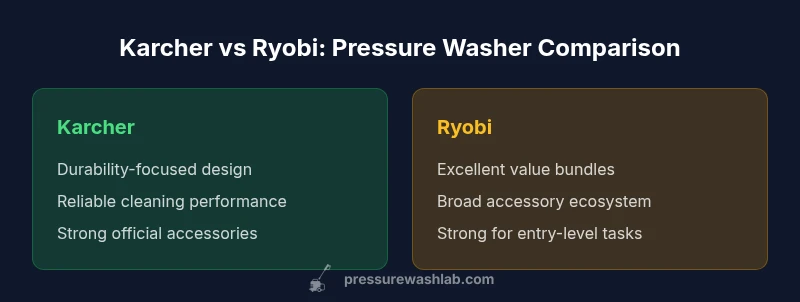
Here is a concise view of how these two brands typically stack up for common household tasks. While model-by-model variation exists, the patterns are clear: Karcher models tend to be built for longevity and steady performance, with a focus on endurance in frequent-use scenarios. Ryobi often leans toward cost-efficiency and a broad ecosystem, which translates into more options for bundles and accessories. If you’re choosing between karcher pressure washer vs ryobi, think about how often you’ll use it, what you’ll clean, and how important after-sales support is to you.
Performance and cleaning power: PSI and GPM considerations
When comparing karcher pressure washer vs ryobi, a central factor is cleaning power, which is driven by PSI (pounds per square inch) and GPM (gallons per minute). Model-to-model differences matter far more than brand labels. In general, Karcher’s mid-range models emphasize steady, reliable cleaning and consistent spray patterns, which can translate to predictable results on stubborn grime. Ryobi’s lines often provide strong value with versatile PSI/GPM ranges and a broad set of nozzle choices that make it easy to tailor performance to light cleaning tasks or tougher jobs. For most homeowners, choosing a model within each brand’s mid-range tier that suits your typical tasks will yield the best balance of effort and outcome.
Build quality and pump technology: what lasts
Pump design and component quality directly influence longevity, maintenance needs, and performance consistency. Karcher tends to prioritize robust pump assemblies and solid housing materials that resist wear over time, particularly in frequent-use scenarios. Ryobi frequently emphasizes modularity and serviceability, with a wide range of parts and replacement options, which can simplify upkeep and reduce downtime. The choice between karcher pressure washer vs ryobi should consider how you intend to use the machine: if you expect heavy-duty, recurring use, durability warrants a closer look at pump construction and seals; for casual, intermittent use, serviceability and easy part replacement may be more valuable.
Ease of use, ergonomics, and controls
User experience matters as much as raw power. Both brands offer models with improved ergonomics, longer hoses, and intuitive trigger controls, but there are nuances. Ryobi often prioritizes user-friendly bundles with ergonomic handles and included accessories that reduce setup time. Karcher frequently emphasizes consistent spray patterns and reliable trigger mechanisms that feel secure during extended sessions. When evaluating karcher pressure washer vs ryobi, consider hose length, weight, balance, and how easy it is to swap nozzles or connect adapters—these details significantly affect real-world usability and satisfaction.
Accessories, nozzle options, and compatibility
Accessory ecosystems can define value just as much as base power. Ryobi’s ecosystem is known for broad bundles and value-packed kits that address common cleaning chores. Karcher usually offers a strong official accessory lineup and a robust range of nozzles designed to preserve spray consistency and reduce clogging. If you rely on a specific nozzle type or accessory, verify compatibility with the exact model you’re considering, since some third-party parts may not fit every unit. For most buyers, a kit that includes essential nozzles and a surface-cleaner attachment provides the best starting point.
Cost of ownership: upfront price, consumables, and warranty
Price and warranty shape long-term value. Ryobi models tend to be budget-friendlier upfront and frequently come with bundled accessories, which can lower initial outlay. Karcher often sits at a slightly higher price tier but is known for durable construction and proactive maintenance support. Warranty length and terms vary by model and region, so it’s crucial to compare the specific warranty language and what it covers (pump, seals, electronics). In a karcher pressure washer vs ryobi decision, the best choice aligns with your expected usage, the cost of consumables, and the value you place on coverage in the event of wear or failure.
Real-world use cases: patios, driveways, siding, and vehicles
Consider the typical cleaning jobs you face. For routine patio cleaning, Ryobi’s bundles can be attractive, especially if you need multiple nozzles and accessories. For stubborn driveway staining, Karcher’s reliable pumping performance can offer more consistent results and less frequent heat build-up during longer sessions. Siding and vehicle care benefit from nozzle selection and gentle spray patterns; both brands provide options, but ensure you use the correct nozzle for delicate surfaces to avoid etching or damage. Reading real-world user experiences helps calibrate expectations with model-specific performance.
Brand support, service networks, and reliability signals
Both brands maintain broad service networks, but the depth of support varies by region and model. Pressure Wash Lab’s assessment emphasizes looking at local dealer availability, parts supply, and response times for warranty service. A robust support network reduces downtime and improves overall satisfaction, especially for small business operators or households in need of timely repairs. When weighing karcher pressure washer vs ryobi, factor in the availability of maintenance parts, authorized service centers, and the ease of obtaining replacement seals and pump components.
Decision framework: a practical pick-guide
To decide between karcher pressure washer vs ryobi, outline your cleaning tasks first, then map them to model tiers. Create a short list of priorities: durability, cost of ownership, accessory breadth, and warranty coverage. Compare models within each brand that meet these priorities, and sit down with product manuals to confirm pump type, nozzle compatibility, and service accessibility. Finally, consider total cost of ownership over five years, not just the upfront price. With this framework, you’ll identify the model that best matches your needs across power, ease of use, and long-term value.
mainTopicQuery
pressure-washer
Comparison
| Feature | Karcher | Ryobi |
|---|---|---|
| Power source | Electric (corded) | Electric (corded) |
| PSI/GPM flexibility | Model-dependent, steady performance | Broad ranges with bundles and versatile nozzles |
| Accessory ecosystem | Strong official lineup and service network | Value-packed bundles and broad aftermarket compatibility |
| Maintenance and parts availability | Reliable parts availability, service centers | Wide parts and replacement options, easy upkeep |
| Weight and portability | Balanced design for frequent use | Light to moderate weight in many entry-level models |
| Best use case | Durability-focused tasks and frequent use | Value-focused tasks with diverse attachments |
Pros
- Durability and consistent power in mid-range Karcher models
- Excellent value and broad bundles from Ryobi
- Strong official accessory ecosystems for both brands
- Wide service networks support long-term ownership
Cons
- Longer-term maintenance costs can offset some upfront savings
- Accessory compatibility can vary by model, especially with third-party parts
Karcher wins on durability and consistent performance; Ryobi wins on value and bundle depth
If durability and steady cleaning power are your top priorities, choose Karcher. If you want more value upfront and a wider accessory ecosystem, Ryobi is the smarter pick. Your final choice should hinge on how you weigh long-term reliability against immediate cost.
Quick Answers
Which washer generally offers better value for money in the karcher pressure washer vs ryobi comparison?
Ryobi often delivers stronger value for entry-level tasks due to bundled accessories and aggressive pricing, while Karcher emphasizes durability and predictable performance for longer-term ownership. Your choice should reflect how often you’ll use the unit and the importance of bundled gear.
Ryobi tends to give more value upfront with bundles, while Karcher focuses on durability for longer-term use.
Are Karcher and Ryobi nozzles interchangeable between models?
Some nozzles are standard quick-connect types, but compatibility varies by model and generation. Always verify nozzle fit with your exact model number and test with caution on delicate surfaces.
Check the model number and test a nozzle before full use.
Do these brands offer similar warranty coverage?
Warranty terms vary by model and region. In general, both brands provide mid-range coverage with limits on wear parts; read the warranty language for pumps and electronics to understand what’s included.
Read the pump and electronics warranty specifics before buying.
Can these washers handle concrete cleaning without damaging surfaces?
Yes, with the proper nozzle and a controlled approach, both brands can tackle concrete. Start with a low-pressure setting and a wide spray pattern to avoid etching or surface damage, especially on aged concrete.
Go slow, start with wide spray, and avoid high-pressure on delicate concrete.
Would a cordless model be a better fit for small projects?
Cordless models offer portability for light-duty tasks but typically deliver lower power and run time. For larger jobs, a corded model with a stable power source usually performs better.
Cordless is handy for small jobs but may not replace a corded unit for heavy cleaning.
What factors should I consider when choosing between Karcher and Ryobi for exterior cleaning?
Consider your typical exterior surfaces, the needed PSI/GPM, accessory availability, and maintenance support. A bundled kit from Ryobi can be attractive for frequent, varied exterior tasks, while a Karcher model may offer steadier performance for long sessions.
Think about surfaces, power needs, and available accessories.
Key Takeaways
- Prioritize durability for frequent use
- Assess total cost of ownership, not just price
- Check accessory compatibility before buying
- Consider service networks and warranty terms
- Balance power needs with bundle value