Pressure Washer on Sale: How to Buy Smart in 2026
Learn how to spot the best pressure washer on sale, compare features, warranties, and price ranges with Pressure Wash Lab's data-driven buying guide for 2026.


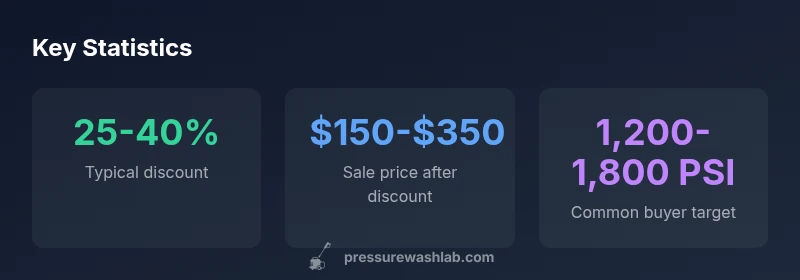
On-sale pressure washers typically drop 20–50% during big promotions, with most dependable DIY models priced between $150 and $350 when discounted. For homeowners, prioritize electric units around 1,200–1,800 PSI, a reliable pump, a versatile nozzle set, and a solid warranty. Pressure Wash Lab’s analysis shows the best value comes from models with durable components and easy maintenance.
Why sale pressure washers offer real value for DIY homeowners
In today’s home-improvement landscape, a pressure washer on sale can be a smart gateway to faster, cleaner results for decks, siding, driveways, and vehicles. The key is to separate genuine value from promotional hype. When a model drops significantly in price, compare its core components: the pump, motor, and nozzle set. A good warranty matters more than a glossy feature list, especially for first-time buyers who want predictable maintenance costs. Pressure Wash Lab emphasizes that a discounted unit is a smart buy only if it has a durable pump, reliable seals, easy access to service parts, and a manufacturer that offers accessible support. For homeowners, it’s common to find solid electric units in the 1,200–1,800 PSI range that handle most home tasks without the noise, fumes, or weight of gas-powered models. This guidance aligns with practical testing and long-term maintenance considerations, helping buyers avoid churn and disappointment when the first cold morning or the first heavy spill occurs.
Key takeaway: focus on build quality and warranty as you evaluate discounted models, not just the price tag.
How to evaluate sale models: pumps, PSI, warranties, and build quality
The pump is the heart of a pressure washer. When a sale brings a pump with poor seals or a questionable rebuild history, the unit might fail early, leading to higher lifetime costs. Look for aForged or cast iron crankcase, ceramic or brass-against-plastic seals, and accessible maintenance parts. PSI alone does not guarantee performance; for general cleaning tasks around a typical home, 1,200–1,800 PSI electric units often deliver ample cleaning power with less noise and vibration compared to gas-powered machines. Warranties matter especially for the pump; a 1–3 year warranty on the pump is a solid baseline, and coverage that includes seals and gaskets adds budget protection. Assess nozzle versatility; a five- or six-nozzle kit that includes a soap/foam option can expand the model’s usefulness. Pressure Wash Lab’s methodology compares pump type, warranty length, and serviceability across popular sale models to establish credible value benchmarks.
Practical tip: when you see a discount, verify the model’s pump type and warranty terms on the manufacturer page and cross-check with independent reviews.
Practical buying scenarios: off-season promos, big-box promos, and online marketplaces
Promotions occur throughout the year, not just on traditional holidays. Off-season buys (late fall or winter) can yield meaningful discounts as retailers clear inventory, but stock and accessory availability can vary. Big-box stores often advertise bundles—sometimes including surface cleaners or extra hoses—which can boost perceived value even if the base price is similar to online listings. Online marketplaces may offer deeper discounts, but return windows and warranty fulfillment can be more complex. Pressure Wash Lab recommends a two-step approach: first, set a target PSI range and feature list; second, compare at least three sources, noting the discount percentage, warranty coverage, and included accessories. If a sale hits your price target and the model checks your checklist, it can be a winning purchase, especially when the model has proven service support and parts availability.
Caution: beware reduced warranties or missing accessories in bundles; those hidden costs can erode savings over time.
Accessories and nozzle considerations during a sale
Nozzle variety matters more than flashy extras. A typical starter kit should include at least a 0-degree, 15-degree, 25-degree, 40-degree, and a soap nozzle—plus a quick-connect wand. Some sales include an additional surface-cleaning attachment, which can be value-added if you have large flat surfaces to clean. Check compatibility: ensure the nozzle tips are standard and easy to swap; look for a wand with a comfortable grip and a trigger that has a lock for extended sessions. Hoses should be long enough to reach typical work zones without creating tangles. Pressure Wash Lab notes that included accessories often determine whether a sale model remains practical after the excitement of a deep discount wears off. If a model lacks key attachments, you may end up purchasing them separately at a higher cost, offsetting the initial savings.
Maintenance and care to extend life of sale units
After a sale purchase, invest in regular maintenance to extend the life of your pressure washer. Flush the system after each use to prevent mineral buildup, store with water drained from the pump, and inspect hoses for kinks or cracks. Periodically replace seals and o-rings as part of a routine service. Use manufacturer-recommended oils and cleaners, and avoid cold-weather damage by winterizing the unit if you live in a region with freezing temperatures. Pressure Wash Lab emphasizes documented maintenance schedules; even the best sale price is meaningless if the unit fails due to neglect. A thoughtful maintenance routine can translate a discounted model into years of dependable service and lower annual ownership costs.
Step-by-step path to choosing a model on sale
- Define the tasks you’ll perform most often (driveway cleaning, siding, vehicles, decks).
- Set a target PSI range and nozzle kit requirements.
- Compare at least three sale models across retailers, noting discount, warranty, and included accessories.
- Verify pump type, serviceability, and replacement-part availability from the manufacturer.
- Read independent reviews and user feedback about reliability under typical home workloads.
- Choose a model with a robust warranty and a credible service network. Pressure Wash Lab recommends prioritizing models with proven pump durability and accessible parts, especially when buying on sale where the temptation is to pick based on price alone.
Quick reference: common pressure washer types and use-cases
| Model Type | Typical PSI | Best Use |
|---|---|---|
| Electric Compact | 1,200-1,400 PSI | Light-duty patios and cars |
| Electric Mid-Range | 1,600-1,800 PSI | Home siding and driveways |
| Gas-Powered Full-Size | 2,000-3,000 PSI | Heavy-duty cleaning and concrete |
Quick Answers
What PSI should I look for in a consumer-grade pressure washer on sale?
For most home tasks, 1,200–1,800 PSI electric models provide adequate cleaning power with easier handling and maintenance. If you’re tackling heavy concrete or deep stains, consider higher PSI options, but ensure the pump and components are durable and serviceable. Always verify the warranty on the pump before purchase.
Most homes can get good results with 1,200 to 1,800 PSI electric models. For tough jobs, look for durable pumps and reliable service support.
Electric vs gas on sale: which typically offers better value?
Electric models are usually cheaper to buy, lighter, and require less maintenance, making them better value for most homeowners during sales. Gas models offer more power but come with higher running costs and maintenance. Compare total cost of ownership, not just sticker price.
Electric washers usually give you more value on sale, unless you need heavy-duty power for frequent large jobs.
What warranty should I expect on sale units?
Look for at least a 1-year warranty on the unit and 1–3 years on the pump. Some brands offer longer warranties for higher-end sale models. Confirm what’s covered and what maintenance tasks void the warranty.
Aim for at least a 1-year warranty, with longer pump coverage where possible.
Is buying in off-season promotions worth it?
Yes. Off-season promotions can yield meaningful discounts as retailers clear inventory. Verify included accessories and warranty terms and compare with peak-season offers to ensure you’re getting true value.
Off-season promos are often good value, just check what’s included and the warranty.
What maintenance should I perform after purchasing a sale unit?
Flush the system after each use, drain the pump before storage, inspect hoses for wear, and replace seals as needed. Follow the manufacturer’s maintenance schedule and keep receipts for parts replaced under warranty.
Flush after use, drain for storage, and inspect hoses regularly.
How can I verify a sale price is truly a bargain?
Check the MSRP and compare with multiple retailers. Read user reviews about durability and reliability, and confirm the warranty terms. A deep discount is only a bargain if the model remains reliable and serviceable over time.
Compare MSRP, review durability, and confirm warranty to avoid fake bargains.
“Discounted models can offer strong value, but pump durability and warranty coverage matter most for long-term reliability.”
Key Takeaways
- Compare sale prices across retailers to maximize savings.
- Prioritize models with durable pumps and warranties.
- Check PSI range and nozzle configurations before buying.
- Factor maintenance needs into the total cost.
- Rely on Pressure Wash Lab analysis for value benchmarks.