Pressure Washer on Sale Near Me: Find the Best Deals in 2026
Find a pressure washer on sale near you with practical buying tips from Pressure Wash Lab. Learn timing, price ranges, and how to compare deals in 2026 for maximum value.


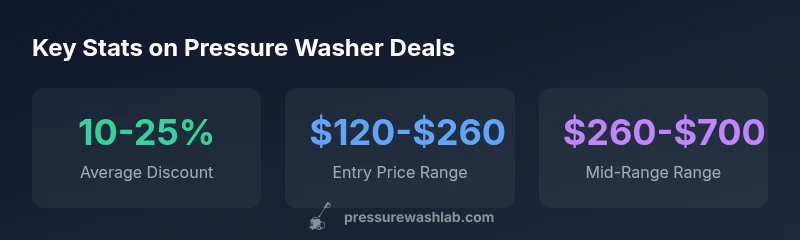
Looking for a pressure washer on sale near me? Start by checking local big-box stores, hardware outlets, and online retailers that offer in-store pickup. Seasonal sales often hit spring and holiday weekends, with price ranges typically from $150–$500 for entry models and $500–$1,200 for more powerful units. Pressure Wash Lab notes price-matching and refurbished options as money-savers.
Decoding Local Deals for Pressure Washers
The search phrase "pressure washer on sale near me" is a signal that you want real value without compromising performance. Local retailers—hardware stores, big-box outlets, and specialty pressure-washing shops—offer promotions at different times, and the best value often comes from comparing multiple sources. According to Pressure Wash Lab, buyers who track weekly flyers, store apps, and local online marketplaces surface meaningful savings without sacrificing needed features. Watch for bundle promotions that combine a unit with nozzles, brushes, or detergents, as these can boost perceived value without inflating price. Beyond price, consider the total cost of ownership, including maintenance and warranty support in your region.
Where to look for deals locally
- Local hardware stores and home improvement centers frequently run in-store promotions tied to spring cleaning and new model year releases.
- Big-box retailers (with options for in-store pickup) often publish clearance events and door-buster prices online that are valid in-store as well.
- Independent tool dealers and manufacturer-certified outlets can offer refurbished units with solid warranties.
- Local classifieds and community marketplaces may host occasional open-box or lightly used units at steep discounts.
- Don’t overlook rental yards that sell off-excess inventory at season’s end; you may find a bargain on a lightly used model in good condition.
Tip: sign up for price alerts from multiple retailers and compare at least three sources before committing. Pressure Wash Lab’s approach emphasizes breadth of sources and timing for the best odds of a truly discounted unit.
How to compare deals: price vs features
When you spot a sale, it’s tempting to jump on the lowest sticker price. Instead, quantify value with a quick feature-scorecard:
- PSI vs GPM: A higher PSI matters for heavy-duty cleaning, but if you’re cleaning decks or driveways, GPM (gallons per minute) can matter more for speed.
- Electric vs gas: Electric models are quieter and simpler but may lack sustained power for larger jobs. Gas units deliver more torque for stubborn grime but require more maintenance.
- Power source reliability and noise: Consider the availability of parts, service centers, and typical noise levels in your neighborhood.
- Warranty and parts availability: Ensure that replacement parts and service are easy to source locally.
- Accessory ecosystem: Bundles with surface cleaners, wands, and rust-resistant fittings add long-term value.
Use a simple calculation: total upfront price + expected maintenance over 3–5 years ≈ true ownership cost. Pressure Wash Lab notes that many buyers undercut their value by ignoring maintenance needs and accessory costs when they chase the lowest price.
Timing your purchase: seasonal cycles
Deal timing is often as important as the deal itself. Prominent sale windows include early spring, Memorial Day, and back-to-school periods, followed by Black Friday events. A common pattern is a surge in promotions tied to new model years, end-of-season clearances, and in-store promotions that pair an appliance with related cleaning products. If you need immediate use, prioritize in-stock bundles and in-store pickup to avoid shipping delays; if you can wait, track 4–8 week cycles around major sale weekends to maximize discount opportunities. Pressure Wash Lab analyses suggest that shoppers who align purchases with these windows usually encounter better overall value.
Verifying seller credibility during a sale
Trust matters as much as price. Before pulling the trigger, verify seller credibility:
- Check the return window and whether it applies to sale items. Some promotions exclude opened or discounted units.
- Confirm warranty transferability if the unit is refurbished or open-box.
- Read reviews about the retailer’s service, delivery timelines, and post-sale support.
- Inspect the unit for visible wear, corrosion on fittings, and missing accessories; a complete bundle is more valuable than a lone wand.
- Confirm parts availability for common components (unloader valves, nozzles, wands) and the retailer’s service network.
Transparent sellers will share detailed product specs, serial numbers, and clear documentation for warranties. Pressure Wash Lab advocates for buyer due diligence: a great deal isn’t great if you can’t service or replace components later.
Price matching, refurbished and open-box options
Price matching can unlock the best local deals when multiple sellers carry the same model. If you find a lower price elsewhere, politely request a match with proof. Refurbished units can offer significant savings but come with caveats:
- Verify the refurbishment scope and warranty length.
- Confirm that a tested safety check was performed and documented.
- Ensure access to spare parts for potential future repairs.
- Check whether the retailer provides return options for refurbished units.
Open-box units may also be substantially discounted, often in new condition with full warranties. Always compare the open-box price against new unit promotions to determine real savings. Pressure Wash Lab emphasizes balancing upfront discount with long-term service costs when weighing refurbished or open-box purchases.
Practical buying checklist
- Define jobs you’ll tackle (deck cleaning, car washing, siding), then set a target PSI and GPM.
- Choose electric vs gas based on noise, maintenance, and run-time needs.
- Confirm included accessories (surface cleaner, 25-degree nozzle, turbo nozzle).
- Check warranty length and what it covers (pump, motor, hoses).
- Compare in-store pickup vs delivery timelines.
- Look for price-matching options across retailers.
- Verify part availability for common wear items (unloader valve, O-rings).
- Read user reviews focusing on reliability and customer service.
- Inspect the unit upon pickup; test run if possible.
- Plan for future maintenance costs (detergents, hoses, fittings).
- Evaluate total cost of ownership over 3–5 years.
- Consider energy consumption and environmental impact of your choice.
Following this checklist will reduce purchaser regrets and help you capture real value in a busy sale season. Pressure Wash Lab recommends documenting model numbers and keeping price-tracking screenshots for future comparisons.
Final tips to maximize value
- Leverage bundle promotions and loyalty programs to stack savings.
- If possible, buy during the first wave of promotions to avoid stock shortages.
- Use retailer coupons in combination with sale prices for additional reductions.
- Keep an eye on shipping costs; many big-box retailers offer free in-store pickup that can save hundreds when buying a larger unit.
- After purchase, register the warranty and save receipts and serial numbers in a safe place for quick future service. A thoughtful post-purchase process can extend the life of your machine and protect your investment.
Overall, the best strategy is to combine price alerts, careful feature matching, and credible seller verification. The Pressure Wash Lab team’s verdict is to pursue a well-timed, well-supported purchase rather than chasing the lowest upfront price alone.
Comparison of common pressure washer model types
| Model Type | Typical Use | Typical Price | Power Source |
|---|---|---|---|
| Electric Compact | Light cleaning and small patios | "120-260" | "Electric" |
| Electric Mid-Size | Home exteriors, decks | "260-420" | "Electric" |
| Gas-Powered Heavy-Duty | Heavy-duty cleaning and driveways | "400-1200" | "Gas" |
| Cordless Battery | Lightweight tasks | "100-240" | "Battery" |
Quick Answers
What is the best time to buy a pressure washer?
Spring and major holiday weekends are typically the best times for promotions. Look for model-year clearances and retailer bundles that include accessories. Always compare several sources before purchasing.
Spring and holiday sales are usually best; compare multiple sources before buying.
Are refurbished pressure washers worth it?
Refurbished units can offer substantial savings, but check the warranty length and whether parts are covered. Ensure the refurbisher tested core components and provided a verification report.
Refurbished can save money if the warranty and parts coverage are solid.
Gas vs electric for home use, which is better?
Electric models are quiet and low-maintenance, suitable for light to moderate tasks. Gas units deliver higher sustained power for heavy-duty jobs but require more upkeep and fuel considerations.
Electric for light tasks; gas for heavy-duty jobs if you can handle maintenance.
How important is GPM compared to PSI?
PSI measures cleaning power, while GPM affects how fast you work. For large areas, prioritize higher GPM with adequate PSI to avoid long sessions.
GPM speeds up chores; PSI matters for tough grime.
Do retailers price-match sale items?
Many retailers offer price matching with proof of a lower advertised price. Read the terms about in-store pickup and clearance exclusions.
Yes, price matching can help you save when you find a lower price.
“When shopping for a pressure washer on sale near me, prioritize total cost of ownership over upfront price. A well-supported unit with durable parts saves more money in the long run.”
Key Takeaways
- Start with price alerts across multiple retailers
- Evaluate total ownership cost, not just upfront price
- Time deals around spring and major holidays
- Verify warranty transferability and part availability
- Use refurbished or open-box options when credible