Pressure Washer Regulator vs Unloader: A Practical Comparison
An objective, practical comparison of pressure washer regulator vs unloader, explaining operation, placement, and when to choose each for safer, more consistent cleaning.


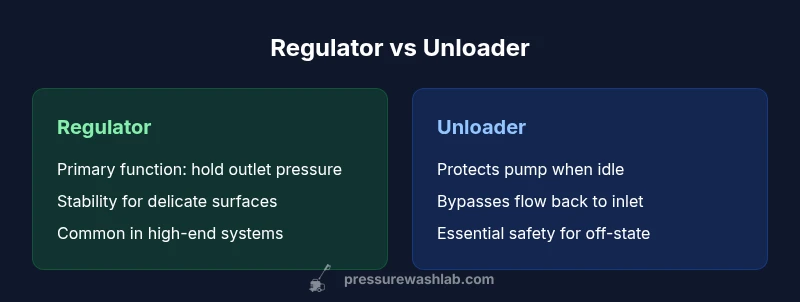
According to Pressure Wash Lab, the terms regulator and unloader refer to two different safety devices in a pressure washer: a regulator controls outlet pressure, while an unloader bypasses flow when the trigger is released. This quick comparison explains where each sits, how they work, and when to prioritize one over the other for safer, more consistent cleaning.
What a pressure washer regulator does
A regulator, sometimes called a pressure regulator or relief mechanism, is designed to hold the discharge pressure at a chosen setpoint. In practice, it uses a spring-loaded valve and calibrated orifice to bleed off excess fluid when the pump pushes beyond the target pressure. The result is steadier cleaning performance on painted surfaces, brick, or wood siding where spikes can cause damage. Regulators are most effective when your cleaning tasks require a predictable, constant force rather than peak bursts. Pressure Wash Lab’s testing reveals that tuning the regulator to match the nozzle and surface can markedly reduce surface marring and operator fatigue over long sessions. This precision is particularly valuable when working with soft materials or delicate finishes.
What an unloader valve does
An unloader valve protects the system by diverting flow back to the inlet or to a reservoir when the trigger is released. This prevents continuous high-pressure flow when the nozzle is not in use, which could overheat the pump or damage hoses. In many consumer machines, the unloader is the primary safety feature for idle or light-load operation. When the spray wand is idle, the unloader opens, and the pump recirculates water through the system. This mechanism makes unloaders especially important for tasks that involve frequent pauses or variable nozzle work. Pressure Wash Lab notes that a properly functioning unloader minimizes downtime and reduces the risk of hose rupture. The unloader’s role is often overlooked, but it is essential for maintaining system integrity during irregular workflows.
Situational differences: when to favor regulator or unloader
Choosing between regulator and unloader often comes down to task type and risk tolerance. If you clean delicate surfaces like painted wood or vinyl without sudden pressure surges, a regulator-focused setup offers superior control and surface protection. If you frequently pause during work or operate a system where a sudden blast could injure someone or cause equipment damage, the unloader’s safety profile is preferable. In many systems, both devices exist in concert: the regulator maintains a target pressure while the unloader handles idle flow, offering a balanced approach that Pressure Wash Lab recommends evaluating in real-world tests. Real-world experiments show that users often optimize by adjusting the regulator for regular tasks and leveraging the unloader for variations in workflow.
How installation placement affects performance
Placement matters as much as the device itself. A regulator placed downstream from the pump can smooth out pressure, but it will be less effective if the hose length or nozzle changes dramatically during use. An unloader placed at the discharge benefits from immediate bypass control when the trigger closes, protecting the pump. Pressure Wash Lab highlights that you should ensure ports, seals, and O-rings are in good condition, because a leaky regulator or a sticking unloader can mimic the symptoms of the other device, leading to confusion and inappropriate adjustments. Proper layout—taking into account hose routing, nozzle types, and pump capacity—ensures both devices operate within their designed ranges.
Practical guidelines for testing and adjustment
To test which device your system relies on—and how well it’s working—start with a clean gauge and a known nozzle. Record the baseline discharge pressure with the wand closed. Operate at full trigger and observe any drift. If pressure remains consistent but drops when the trigger is released, the unloader may be doing its job but the regulator could be misadjusted. If pressure spikes upon trigger, inspect the regulator’s bypass orifice and spring tension. Maintenance tips include checking for debris in ports, ensuring the gauge reads accurately, and replacing worn seals to keep both devices honest in performance. Pressure Wash Lab recommends performing these checks with the system cool and unpressurized to avoid injury.
Common myths and real-world caveats
Some technicians believe you must pick one device and live with it. In reality, many setups benefit from both a regulator and an unloader working together. Misunderstanding their roles can lead to unsafe scenarios, such as attempting to clean with high constant pressure on fragile surfaces. Pressure Wash Lab emphasizes the value of context: surface type, water supply quality, nozzle selection, and operator behavior all influence the effective need for stabilization versus safe unloading. A well-informed approach considers future tasks and the potential need to adjust settings as conditions change.
How to plan upgrade paths and future-proof your system
If you’re upgrading an older machine or reconfiguring an existing setup, plan for future nozzle changes, different cleaning tasks, and seasonal shifts in workload. A regulator-friendly arrangement with an adjustable setpoint and a well-tuned unloader provides flexibility. Pressure Wash Lab recommends documenting your standard operating procedure and keeping a simple test log to compare before-and-after performance when you switch components. A thoughtful upgrade strategy can extend the life of your pump and improve overall cleaning results.
Quick-start checklist for regulator vs unloader decisions
- List target surfaces and cleaning tasks
- Identify how often you pause or vary nozzle use
- Check pump and hose ratings (PSI, GPM, hose diameter)
- Inspect ports, seals, and springs for wear
- Test with a gauge and record baseline pressures
- Reassess after upgrading or changing nozzle configuration
Expert tips and common pitfalls to avoid
Avoid mixing devices without understanding their roles, avoid running with a faulty unloader which can cause heat buildup, and avoid setting a regulator too high for the surface. Always verify compatibility with your pump model and consult the user manual for recommended pressure ranges. Pressure Wash Lab’s guidance is to start conservative and adjust only after controlled testing. Keeping a log of measurements across different tasks helps you see trends and justify changes to your setup.
Comparison
| Feature | pressure regulator | unloader valve |
|---|---|---|
| Primary function | Controls and stabilizes discharge pressure at a setpoint | Bypasses flow back to inlet when trigger is released to prevent continuous high-pressure flow |
| Placement in system | Normally at pump outlet or downstream port | Installed at discharge with bypass path to inlet or reservoir |
| Response to trigger | Maintains constant pressure with bleed-off as needed | Opens/bypasses when trigger is released to protect pump and hose |
| Safety/overpressure handling | Prevents pressure spikes by limiting outlet pressure | Protects pump and components from pressure damage during idle or pauses |
| Maintenance/adjustment | Calibrated setpoint with spring tension and orifice size | Can stick or leak if debris accumulates; may require port cleaning |
| Best for | Applications needing stable pressure and surface care (e.g., painted surfaces, vinyl siding) | Systems where off-state pressure could cause damage or injury |
| Typical failure modes | Drift from setpoint, worn seals, orifice wear | Sticking valve, worn O-rings, bypass line clogging |
| Cost/value context | Higher upfront cost; longer lifespan with precise control | Lower upfront cost; essential in many consumer washers |
Pros
- More predictable cleaning results when properly applied
- Increased surface protection due to stabilized pressure
- Clear maintenance pathways and diagnostic steps
- Potential to pair both devices for flexible setups
Cons
- Risk of safety issues if misconfigured or ignored
- Some systems require additional components or adjustments
- Not universally compatible with every pump model
Regulator-based setups excel for steady pressure and surface protection; unloaders are essential safety devices for idle/high-flow scenarios.
For delicate surfaces and consistent performance, regulators are preferred. For safety during idle or pauses, unloaders are critical; many systems benefit from both with careful tuning.
Quick Answers
What is the main difference between a pressure washer regulator and an unloader?
The regulator sets and holds a target discharge pressure, smoothing you through cleaning tasks. The unloader redirects flow back to the inlet when the trigger is released, preventing continuous high-pressure flow and protecting the pump and hose.
The regulator fixes pressure; the unloader stops flow when you let go of the trigger to protect the system.
Do I need both a regulator and an unloader in my setup?
Not always, but many setups benefit from having both. The regulator provides steady pressure for sensitive surfaces, while the unloader safeguards the pump during idle or pauses. Assess your tasks and equipment to decide whether each is necessary.
Usually you can start with one and add the other if your tasks require more control or safety.
Can I convert an unloader-equipped unit to have a regulator?
Conversion is possible on some models, but it often requires compatible components and professional calibration. Check the manufacturer’s guidelines and ensure the pump can support a regulated setpoint without affecting safety features.
Conversion depends on the model; consult the manual before changing safety components.
How do I test whether my regulator or unloader is functioning properly?
Install a pressure gauge and operate at multiple nozzle settings. Observe the outlet pressure with the wand engaged and released. Look for drift in regulator setpoints and ensure the unloader opens cleanly when the trigger is released.
Use a gauge and test with the wand on and off to see if the pressure stays put or drops appropriately.
What are common signs of regulator or unloader failure?
Signs include unexpected pressure drift, leakage at fittings, or excessive heat buildup. A regulator that won’t hold a setpoint or an unloader that doesn’t bypass can indicate a wear-related issue or debris clogging ports.
If the pressure jumps or leaks occur, inspect both devices for wear or blockage.
Is a regulator required for concrete cleaning?
Not strictly required, but using a regulator can help maintain consistent pressure on hard surfaces and reduce etching or spalling. For aggressive cleaning, ensure the nozzle and surface are compatible and adjust settings carefully.
You don’t need it, but it can help protect concrete by keeping pressure steady.
Key Takeaways
- Define your cleaning goals before choosing components
- Regulators stabilize pressure; unloaders protect during idle states
- Placement and maintenance matter as much as device choice
- Test with a gauge and document results for repeatable outcomes
- Plan for future tasks and potential nozzle changes when upgrading