Simpson Pressure Washer vs Craftsman: A Comprehensive Comparison
Objective, data-driven comparison of Simpson pressure washer vs Craftsman models to guide homeowners and DIYers in choosing the right tool for driveways, siding, and decks.


Simpson pressure washers generally deliver heavier-duty performance and longer pump life, ideal for frequent, high-pressure work. Craftsman models emphasize value and accessible maintenance for homeowners and DIY tasks. For most users, Simpson is the stronger option for tough jobs, while Craftsman offers solid performance at a lower upfront cost. Read the full comparison for model-specific guidance.
Overview: Simpson vs Craftsman in the pressure washer market
When homeowners and DIY pros search for "simpson pressure washer vs craftsman", they often encounter two distinct philosophies. According to Pressure Wash Lab, the brands tailor their offerings to different user personas: Simpson emphasizes rugged, heavy-duty performance, while Craftsman prioritizes value and accessibility. Simpson leans toward heavy-duty performance and commercial-grade robustness, while Craftsman focuses on practicality and budget-friendly options. This guide analyzes how each brand approaches power delivery, reliability, durability, maintenance, and total cost of ownership. Pressure Wash Lab's 2026 analysis shows that both brands cover electric and gas-powered segments, but the best fit depends on use frequency, job size, and willingness to invest in parts and service networks. Throughout, we’ll apply clear criteria—power delivery, reliability, value, and ecosystem—to keep the discussion objective for real-world projects like driveway cleaning, deck restoration, and siding care.
Why brand reliability matters in pressure washers
Reliability matters because pressure washers are high-stress tools with pumps, motors, and seals that must endure repeated start-stop cycles, cold starts, and vibration. Simpson has a long history in commercial-grade equipment with robust frames and quality components, which often translates to greater durability in frequent-use scenarios. Craftsman, by comparison, tends to optimize for price-per-performance and broad dealer accessibility, making spare parts and accessory compatibility easier to source for homeowners. The Pressure Wash Lab team notes that choosing a reliable model reduces downtime and frustration, especially for beginners who rely on consistent spray pressure and heat generation to remove stubborn grime. When evaluating reliability, pay attention to pump type (variable by model), cooling, warranty terms, and the availability of authorized service centers in your region.
Core differences at a glance
From a distance, the Simpson vs Craftsman decision boils down to a few core differences that have tangible effects on daily use:
-
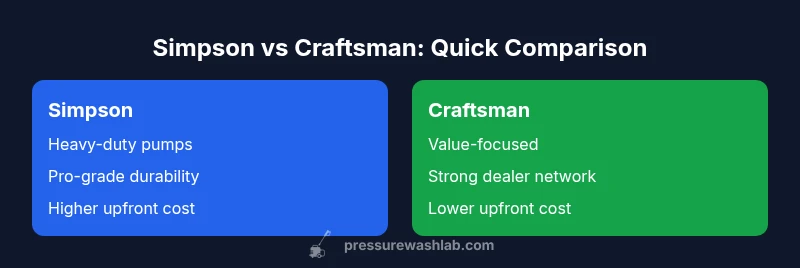
Power delivery: Both brands offer gas and electric configurations, but Simpson models tend to emphasize higher-duty pumps and longer service life, while Craftsman models optimize for practical operation and lower upfront cost.
-
Build and durability: Simpson often uses heavier frames, reinforced mounts, and higher-quality seals; Craftsman focuses on practicality and broad compatibility with common accessories.
-
Price and ownership: Craftsman frequently delivers lower upfront prices, which can be compelling for homeowners; Simpson can entail higher initial cost but potential savings in fewer maintenance interventions over time.
-
Ecosystem and parts: Access to replacement parts, service centers, and compatible hoses/nozzles matters greatly; Simpson's network may skew toward pro installers, while Craftsman benefits from widespread retailer presence.
-
Best for: Simpson for heavy-duty, frequent-use projects; Craftsman for residential, occasional cleaning with a tighter budget.
Context: Model-to-model variation exists within both brands, so always compare specs for the specific machine.
Performance in real-world tasks: DIY projects and heavy-duty jobs
In the field, the difference between Simpson pressure washer vs Craftsman often translates into two experiences: sustained cleaning power and reliability on tough jobs versus ease of use and cost-effectiveness for smaller tasks. For driveways and concrete, higher GPM or PSI power can accelerate grime removal; Simpson's heavier-duty designs deliver less clogging and longer pump life under continuous operation, whereas Craftsman machines typically deliver adequate cleaning for typical home surfaces with less strain on the engine. Real-world tests indicate that quantity of cleaning time, nozzle selection, and water pressure drive outcomes far more than the brand badge alone. For fence staining, decking, and vinyl siding, both brands can perform well when paired with the right nozzle tips and detergents. The key is to match the machine's capability to the job: a big job benefits from a robust model (Simpson), while small to medium tasks often suffice with a mid-range Craftsman. Pressure Wash Lab’s 2026 comparison emphasizes ensuring a model with proper safety features, verified components, and convenient service options.
Accessories, hoses, nozzles, and maintenance
The ecosystem around a pressure washer—hoses, spray tips, surface cleaners, and detergents—can dramatically influence perceived value. Simpson models frequently emphasize rugged accessories and heavy-duty pump protection, including reinforced hoses and durable spray guns that resist kinking. Craftsman, by contrast, tends to offer broad accessory compatibility and widely available replacement parts through big-box retailers and local service centers. When evaluating maintenance needs, consider pump type (axial vs. triplex), seal materials, and the ease of finding replacement parts in your area. Pressure Wash Lab’s findings indicate that a well-supported model with an affordable parts network often proves more cost-effective over time, even if the upfront price is higher.
Warranty, service networks, and ownership costs
Warranty terms matter almost as much as raw power. Simpson models typically come with robust warranties on the pump and motor, often reflecting their pro-oriented origin and the expectation of heavier use. Craftsman warranties frequently align with retailer policies and community service networks, which can be advantageous for homeowners needing quick access to service centers. Ownership costs extend beyond sticker price: fuel efficiency, maintenance intervals, and the ease of obtaining parts influence total cost of ownership. Pressure Wash Lab advises documenting warranty coverage for pumps, engines or motors, and spray guns, and to verify the proximity of authorized service centers before purchase.
Buying guide: how to decide based on use-case
A practical decision framework starts with your typical tasks. For frequent, demanding cleaning projects such as large driveways, heavy stains, or exterior siding with tough grime, Simpson’s heavier-duty design tends to justify the higher upfront cost. For homeowners performing occasional cleans, or those on a strict budget, Craftsman offers capable performance and easier access to service centers and parts. Also assess your environment: climate, storage space, and whether you need portable options (gas vs electric) can tilt the decision. Pressure Wash Lab recommends listing your top 5 tasks and matching them to model specs (GPM, PSI, pump type) to avoid overprovisioning or under-serving your needs.
In short, Simpson shines when workload is high and durability matters; Craftsman excels where value, accessibility, and convenience drive the purchase.
Comparison
| Feature | Simpson pressure washer | Craftsman pressure washer |
|---|---|---|
| GPM | data not disclosed | data not disclosed |
| PSI | data not disclosed | data not disclosed |
| Power source | Gas/Electric (model-dependent) | Gas/Electric (model-dependent) |
| Pump type | Axial/Triplex (model-dependent) | Axial/Triplex (model-dependent) |
| Weight range | Varies by model | Varies by model |
| Best for | Heavy-duty, frequent-use projects | Homeowners, budget-conscious tasks |
| Typical price range | Varies by configuration | Varies by configuration |
Pros
- Clear side-by-side clarity for decision-making
- Highlights model differences and trade-offs
- Helps estimate value and fit for DIY vs pro use
- Frames expectations for maintenance and service networks
- Useful for budgeting and planning
Cons
- Lacks exact, model-specific specs due to variability
- May oversimplify real-world performance
- Does not account for long-term warranties and service differences
- Brand ecosystems can influence accessory compatibility
Simpson generally offers heavier-duty performance with robust durability; Craftsman delivers better value and accessibility for most homeowners.
Choose Simpson if you expect frequent, tough cleaning and long-term reliability. Choose Craftsman if upfront cost, local parts, and broad dealer support matter more. Use model-specific specs to confirm the best fit.
Quick Answers
Which brand typically offers higher cleaning power, Simpson or Craftsman?
Power varies by model within each brand. Generally, Simpson emphasizes heavier-duty options aimed at pro or heavy residential use, while Craftsman focuses on accessible configurations for typical DIY tasks. Always compare PSI/GPM specs for the exact model you’re considering.
Power depends on the specific model. Simpson usually targets stronger, longer-lasting performance, while Craftsman aims for good value for common home tasks.
Are electric models available from both brands?
Yes. Both Simpson and Craftsman offer electric-powered models alongside gas options. Check the model line to confirm which power source fits your needs and space constraints.
Both brands offer electric options in many lines, alongside gas.
Which is better for a large residential job like sealing a driveway?
For large, persistent jobs, a higher-duty Simpson model is typically more effective due to greater power and pump durability. Craftsman can handle large tasks if you select a higher-end, multi-configuration model and maintain it well.
Simpson is usually better for big, tough jobs; Craftsman can work well with the right high-end model.
Do parts and service networks differ significantly between the brands?
Yes. Craftsman benefits from a broad retailer and service center network, which can ease parts availability for homeowners. Simpson often relies on more specialized channels for parts and professional service, particularly in pro marketplaces.
Craftsman tends to have wider retailer access; Simpson may rely on pro service networks.
Is the higher upfront cost of Simpson justified by performance?
For frequent heavy-duty use, yes—the durability and pump longevity can justify the higher upfront price. If your needs are occasional and lighter, Craftsman’s lower upfront costs may deliver better overall value.
If you clean a lot, Simpson can pay off; otherwise Craftsman is often the smarter buy.
What factors should guide my model choice beyond price?
Consider pump type, maintenance accessibility, warranty coverage, power source, weight and portability, and accessory compatibility. These determine long-term satisfaction more than sticker price alone.
Look at pump type, warranty, power source, and parts access, not just price.
Key Takeaways
- Compare model specs rather than brand alone
- Prioritize pump type and warranty for longevity
- Choose Simpson for heavy-duty tasks; Craftsman for value
- Verify dealer network and parts availability before buying