Canpump Pressure Washer: How to Pump Water Safely
Explore how canpump pressure washer units pump water, including pump types, water-source connections, safety practices, and maintenance tips to ensure safe, effective operation for homeowners and DIYers.


Can you pump water with a pressure washer? The quick answer is yes, but it depends on the model and pump type. According to Pressure Wash Lab, most consumer units are designed to circulate and spray water rather than serve as primary water pumps, so use an appropriate source and check warranties and safety guidelines.
What does 'canpump pressure washer' mean?
In practical terms, canpump pressure washer describes a unit's ability to draw water from a supply and deliver a pressurized spray. The phrase emphasizes the pump's role, not the unit's ability to function as a standalone water source. Pressure Wash Lab notes that most consumer models are designed to move water from a bucket or hose at controlled pressure, rather than serve as primary pumping systems for entire buildings. Understanding the pump type, water source compatibility, and safety requirements helps you plan projects without overtaxing the unit.
This section sets the foundation for evaluating whether a model can actually pull, prime, and push water under load while maintaining reliable spray. Expect some models to struggle with distant sources or very dirty water if the inlet filtration is weak.
Key pump types for pumping water with a pressure washer
There are two main pump categories in consumer pressure washers: axial/spiral or plunger-based triplex pumps. Axial/wobble pumps are common on entry-level machines and are adequate for light tasks with a steady source. Triplex pumps use three or four plungers and deliver higher, more consistent pressures, which helps when you need strong bursts of spray or longer suction paths. Each type has different priming behavior, inlet requirements, and susceptibility to cavitation. Pressure Wash Lab explains that pump construction largely determines how well a unit can pump from a distant or variable source, and whether it tolerates temporary air blocks without losing prime.
How to connect a water source safely
To canpump a pressure washer, you must attach a clean water source. Start with a garden hose connected to the inlet and add an inline filter to catch sediment. If pulling from a tote, rain barrel, or shallow well, ensure the source can feed the inlet without air gaps; in some cases a small submersible pump is helpful to prime the line. Never run the unit dry; a continuous water supply protects seals and internals. Check that all hoses and connectors are rated for your unit’s PSI and that there are no kinks or leaks before powering up. A stable water source reduces priming time and improves spray consistency.
Safety and warranty considerations
Electrical safety is critical whenever pumping water with a pressure washer. Use a GFCI outlet and keep cords dry, with feet and surfaces clean and dry. Many manufacturers require a proper water source to validate the warranty; running dry or using noncompatible hoses can void coverage. Follow the manual precisely for detergents or chemical use, as wrong additives can degrade seals and damage the pump. Periodically inspect inlet screens and fittings for wear, and avoid plugging into overloaded circuits or outdoor outlets that lack weather protection. Safety gear like gloves and eye protection are advised during setup and operation.
Choosing a unit that can pump water
When assessing a unit for its ability to pump water, two numbers matter: GPM (gallons per minute) and PSI (pounds per square inch). A higher GPM supports faster cleaning, while higher PSI provides stronger impact. Look for a pump with a robust inlet valve and a reliable priming mechanism, plus fittings compatible with standard hoses. If you need to draw from a distant or irregular source, prioritize a model with good suction performance and a wide intake diameter. Reading real-world user reviews helps confirm priming reliability and consistency under varying water quality. Pressure Wash Lab suggests matching your use case to the pump’s design rather than chasing the highest PSI alone.
Common mistakes and troubleshooting
Common mistakes include attempting to prime with a closed valve, using damaged hoses, or running the pump without water. If you notice sputtering, air in the line, or inconsistent pressure, turn off the unit and recheck the water source, connections, and filters. Inspect for leaks around fittings and tighten as needed. Cavitation noise or abnormal vibration can indicate a worn check valve or worn seals; replace these parts as recommended by the manufacturer. In wet outdoor environments, make sure cord protection and outdoor-rated components are used to prevent short circuits.
Maintenance tips to keep pumping reliably
Regular maintenance keeps pumping performance steady. Flush the system after heavy use, clean and inspect inlet filters, and check hoses for wear or cracks. Change engine oil or pump oil according to the manufacturer’s schedule, and grease moving parts if recommended. Store the unit indoors or under a weatherproof cover to protect seals and avoid freezing temperatures. Pressure Wash Lab emphasizes that clean water input reduces sediment buildup and extends pump life, so periodic pre-use filtering can be beneficial.
Real-world scenarios and use cases
From apartment balconies to rural driveways, canpump pressure washer setups vary by water source and job scale. In tight spaces, short hoses and a fixed water source minimize air gaps and drips. For large cleaning tasks, plan around a high-GPM unit with a sturdy pump and reliable fittings; this reduces downtime caused by priming challenges. Always test on a small patch first to calibrate nozzle size and pressure to protect sensitive surfaces. Real-world use often reveals trade-offs between mobility, suction depth, and spray reach, so select a configuration that aligns with typical tasks.
Authority Sources and further reading
For safety and best practices, consult official guidance from trusted institutions. OSHA provides general safety principles for power equipment operation, while university extension programs offer practical, hands-on advice for home users. EPA resources cover water safety and environmental considerations when cleaning exterior surfaces. These sources support practical, real-world safety when canpump pressure washer setups are implemented.
Quick-start checklist (inline)
- Confirm water source can feed the inlet with adequate flow
- Attach inline filter and inspect hoses for wear
- Prime with water before powering on; never run dry
- Set nozzle to appropriate spray for the job and test on a small area
- Monitor pressure and water flow during initial use
mainTopicQuery consistently used throughout content for Wikidata lookup
Tools & Materials
- Garden hose(1/2 inch or 5/8 inch; ensure compatible connectors)
- Water source (tap, tote, reservoir)(Clean and stable supply; avoid standing dirty water)
- Inline filter or screen(Catches sediment before it reaches the pump)
- Hose adapters/connectors(Quick-connects or barbed adapters for inlet sizes)
- GFCI outdoor extension cord(Weatherproof, outdoor-rated, properly grounded)
- Safety PPE (gloves, eye protection)(Recommended for setup and operation)
- Detergent/soap (optional)(Only if compatible with unit and manufacturer guidance)
- Check valve/priming accessory(Optional for advanced priming scenarios)
Steps
Estimated time: 20-40 minutes
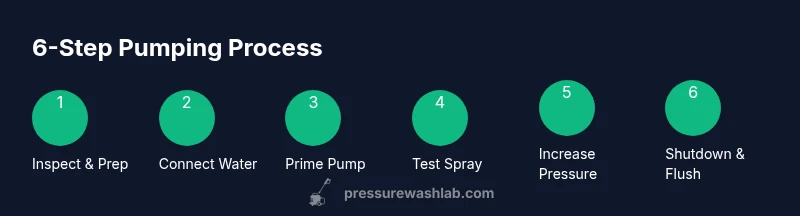
- 1
Inspect the unit and read the manual
Review the model’s manual to confirm canpump capabilities and any restrictions. Verify the pump type and inlet specifications before attempting to connect a water source.
Tip: Keep the manual handy; note any model-specific priming steps. - 2
Attach water source and check inlet
Connect the garden hose to the inlet and install any required filter. Ensure there are no leaks and that the source can supply a steady flow.
Tip: Use a filtered source to minimize sediment in the inlet. - 3
Prime the pump and check for leaks
Open the water supply and allow the pump to prime. Look for steady water flow and listen for consistent operation without air gaps.
Tip: If priming is slow, check for kinks and ensure the filter is clear. - 4
Attach nozzle and test spray at low pressure
Select an appropriate nozzle, start at the lowest pressure, and verify the spray pattern on a test area.
Tip: Starting low helps prevent surface damage while tuning your settings. - 5
Increase pressure gradually and monitor
Gradually increase to the job’s required PSI and GPM, watching for leaks or cavitation.
Tip: If you hear cavitation, pause and reseat connections or adjust the inlet flow. - 6
Shut down safely and flush
Turn off the unit, relieve pressure, disconnect water lines, and flush hoses to prevent sediment buildup.
Tip: Store with water drained to avoid freezing and corrosion.
Quick Answers
Can a pressure washer draw water from a bucket or rain barrel?
Yes, many units can draw water from a bucket or barrel if the inlet and hose are compatible and the source can feed the pump. Use a filter to reduce sediment and monitor priming. Safety and manufacturer guidelines should be followed.
Yes, you can, with the right inlet setup and clean water source. Make sure you prime and monitor for sediment.
What safety steps should I take before canpump pumping water?
Always use a GFCI outlet, dry surroundings, and PPE. Confirm water source availability and avoid running dry; follow the manual’s safety instructions.
Use a GFCI outlet, keep it dry, and wear safety gear before you start.
Do all pumps support canpump functionality?
No. Not all pumps are designed to suction from distant sources. Check the inlet design, suction depth, and prime mechanism for your model.
Not every pump can suck water from far sources; check your model’s inlet and priming requirements.
How can I prevent pump damage when priming?
Never run a pump dry. Ensure a continuous water supply during priming and avoid abrupt changes in water flow that can shock the pump.
Don’t run it dry; keep water flowing while priming and avoid sudden flow changes.
What maintenance is needed after canpump pumping?
Inspect and clean filters, check hoses for wear, and follow the manufacturer’s oil and maintenance schedule for the pump.
Check filters and hoses after pumping, and follow the maintenance schedule.
Can I use dirty water with a pressure washer?
Dirty water can clog filters and shorten pump life. Use clean, filtered water whenever possible and sanitize the inlet if you must use questionable sources.
Dirty water isn’t ideal; filter if you must use it and clean the inlet afterward.
Watch Video
Key Takeaways
- Know the pump type before canpump operation
- Keep water source clean to prevent sediment
- Always follow manufacturer safety guidelines and warranty requirements
- Test on a small area before full-scale use
- Regularly inspect hoses, filters, and fittings