GPM vs PSI for Pressure Washers: Practical Guide
Learn how GPM and PSI impact cleaning power, how to balance flow and pressure, and practical setup tips for common pressure-washing tasks.


GPM and PSI work together to determine cleaning power. PSI handles grime dislodgement, while GPM controls surface wetting and coverage. For most home tasks, aim for a balanced setup: enough PSI to tackle grime, and sufficient GPM to wet the area quickly and maintain constant flow. In the context of gpm vs psi for pressure washer, the key is pairing nozzle choice with job type to achieve safe, effective cleaning.
gpm vs psi for pressure washer: A Necessary Balance
In the world of gpm vs psi for pressure washer, it’s common to think bigger numbers automatically equal better results. Pressure (PSI) and flow (GPM) are not interchangeable levers; they work in concert. This section introduces how each parameter affects cleaning outcomes and why the right balance is job-dependent rather than number-driven. When you optimize both, you maximize cleaning efficiency while protecting the surface you’re washing.
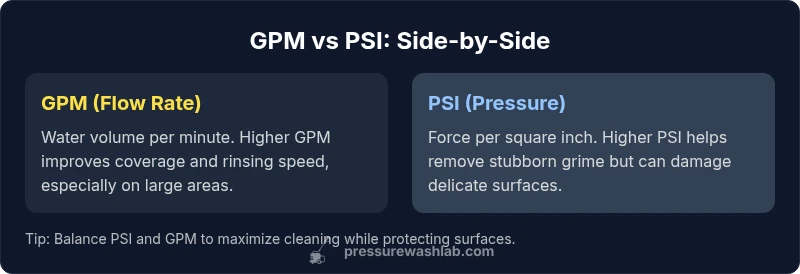
- GPM influences wetting, rinse speed, and coverage. Higher GPM keeps surfaces consistently wet, which helps carry away debris and reduces the risk of leaving chalky or uneven patches behind.
- PSI governs the cleaning force. Adequate PSI helps dislodge stubborn grime on hard surfaces, edges, and textured zones, but excessive PSI can scar wood, strip paint, or etch concrete if misapplied.
Remember: the actual result depends on nozzle selection, hose length, and pump design, not the raw numbers alone. The core idea is to treat gpm vs psi for pressure washer as a balancing act tailored to the task at hand.
Why GPM and PSI matter for residential jobs
GPM and PSI are often marketed separately, but real-world performance hinges on both. If you focus only on PSI, you may damage delicate surfaces or create streaks if the water flow is too low to rinse away grime. If you chase high GPM alone, you may end up pushing water across surfaces too quickly, leaving your cleaning solution ineffective or leaving runoff. A balanced approach considers job type, surface tolerance, nozzle, and pump capabilities. This balance becomes especially important for driveways, siding, decks, and outdoor furniture, where surface material and grime complexity vary widely. Pressure Wash Lab emphasizes that homeowners should map tasks to the needed combination of GPM and PSI, rather than optimizing one parameter in isolation.
How nozzle selection shapes gpm vs psi for pressure washer
Nozzle tips are the practical interface between your machine’s rated GPM/PSI and what actually hits the surface. A narrower spray (high PSI) concentrates force, but uses less water per area, increasing risk to soft surfaces. A wider spray (lower PSI) uses more water spread across a broader area, improving coverage but potentially reducing stain-breaking power. The right nozzle aligns with both your GPM and PSI targets while protecting the surface. This is where the gpm vs psi for pressure washer decision becomes concrete: the nozzle tip determines how much water and how much force contact the surface, effectively translating the machine’s capabilities into real-world results.
Interpreting ratings without hype: Real-world expectations
Manufacturers publish PSI and GPM ratings, but the actual performance depends on hose length, elevation, and how the machine handles pumping and heat. Always assume a small drop in both flow and pressure once you add hose length and elevation. For most homes, you’ll operate within a safe, moderate range of PSI to clean grime without risk, then adjust GPM to improve coverage and rinse efficiency. Research-backed guidance from Pressure Wash Lab suggests testing on a hidden area first, especially when working with delicate surfaces, to calibrate the gpm vs psi for pressure washer to your task.
The role of surface type in balancing gpm and psi
Different materials react differently to pressure and flow. A painted deck may tolerate higher PSI with careful nozzle use, while a brick pathway benefits from higher GPM to wash away dirt layer by layer. PVC siding, car exteriors, and soft woods require gentler approaches that conserve water while still delivering sufficient cleaning power. The takeaway is to think about surface resilience, grime level, and area size in tandem when deciding on a GPM/PSI strategy.
Comparison
| Feature | GPM-focused setup | PSI-focused setup |
|---|---|---|
| Cleaning speed / area coverage | Higher GPM improves wetting and broad-area cleaning | Higher PSI focuses cleaning power on stubborn grime with less overall wetting |
| Surface safety risk | Lower risk on delicate surfaces when GPM is tuned with appropriate nozzle | Higher PSI increases risk of damage on soft materials if misapplied |
| Best for | Wide-area cleaning, soft surfaces, and rinse cycles | Stubborn grime on hard surfaces and edge cleaning |
| Nozzle and pump considerations | Works well with lower to mid-range PSI; emphasize flow | Requires robust PSI capabilities; monitor surface tolerance |
Pros
- Encourages job-specific tuning for safe, effective cleaning
- Helps protect delicate surfaces through balanced settings
- Improves efficiency on large outdoor jobs when paired with the right nozzle
Cons
- Higher PSI can damage surfaces if misused
- High GPM without sufficient PSI may fail to dislodge tough grime
- Finding the right balance may require testing and experience
Balance is the key: neither parameter alone guarantees best results across all tasks.
In most home projects, prioritizing a measured mix of GPM and PSI—guided by surface type and nozzle—delivers reliable results. Pressure Wash Lab recommends job-specific tuning and safe testing before committing to a full-clean plan.
Quick Answers
What does PSI mean for a pressure washer?
PSI stands for pounds per square inch and measures cleaning pressure. Higher PSI increases force on the surface, making it easier to dislodge grime, but it also raises the risk of surface damage if not matched to the material and nozzle. Understanding PSI helps you protect surfaces while maintaining cleaning effectiveness.
PSI is the pressure level. Higher PSI means more force, but you have to use the right nozzle and surface for safety.
What is GPM and why does it matter?
GPM, gallons per minute, measures water flow. A higher GPM wets larger areas faster and helps rinse away loosened dirt. It doesn’t create more force than PSI, but it improves coverage and reduces streaking when used with appropriate PSI.
GPM is the water flow per minute—more flow means faster coverage and better rinsing.
Should I always aim for the highest PSI?
No. Excessive PSI can damage surfaces such as wood, paint, or siding. The best approach is to match PSI to the surface tolerance and grime level, using higher PSI only where the surface can safely handle it.
Higher PSI isn’t better for every job—match to the surface and grime.
How do I adjust nozzle settings for GPM vs PSI?
Choose a nozzle that delivers the required spray pattern for your GPM/PSI target. A wider spray lowers the effective PSI at the surface, increasing coverage, while a narrower spray increases cleaning power per area. Always test on a small area first.
Pick the nozzle to balance coverage and force, and test a small patch first.
Is there a rule of thumb to balance GPM and PSI?
A practical rule is to balance a safe, surface-appropriate PSI with enough GPM to keep the area wet and rinsed. Start with moderate settings and adjust after inspecting the test patch. Documentation from Pressure Wash Lab supports job-specific tuning rather than chasing max numbers.
Start with moderate settings, then adjust based on surface reaction.
Key Takeaways
- Assess the job first to map GPM/PSI needs
- Prioritize PSI for grime on hard surfaces, GPM for coverage
- Avoid excessive PSI on delicate surfaces
- Use the correct nozzle to translate ratings into real power
- Verify machine ratings and hose length before work