How to Stop Pressure Washer Hose from Kinking: Practical Guide
Learn proven steps to prevent kinked hoses on your pressure washer. This guide covers routing, fittings, storage, and maintenance for safer, more efficient cleaning.


To stop a pressure washer hose from kinking, start with a healthy hose and plan a smooth path. Use a swivel connector or reinforced hose, route the hose away from sharp corners, and avoid tight 90-degree bends. Employ a hose reel or wall mount to manage length, and keep pressure within the manufacturer's range. Proper routing and hardware dramatically reduce kinks and improve performance.
What Causes Kinks and Why It Matters
If you search for how to stop pressure washer hose from kinking, you’ll quickly learn that kinks usually form from sharp external bends, untidy routing, or worn hoses. A kink can restrict water flow, raise operating temperatures, and accelerate wear near fittings. Homeowners and pros alike benefit when the routing is planned and hardware is chosen for flexibility. The result is fewer interruptions, steadier spray, and longer hose life. In this section, you’ll see how the fundamental physics of bending and the quality of components interact and why a small change in setup can yield big returns for your cleaning projects.
Choosing the Right Hose and Fittings
Not all hoses resist kinking equally. Prioritize reinforced hoses with thicker walls and braided or spiral reinforcement to resist collapsing under pressure. A swivel fitting at the spray gun end prevents twisting as you maneuver, a major source of kinks at connectors. Select a hose rated for higher psi than you typically use to avoid weak spots where bends form. Measuring the interior diameter (1/4" or 5/16") and ensuring compatibility with your wand and pump helps maintain a smooth flow. Pair with corrosion-resistant fittings that fit snugly to prevent gaps that create bending points. A dedicated hose reel or wall mount reduces trailing and tangling, which are huge kink culprits over time.
Proper Routing: Planning Paths to Avoid Bends
A well-planned path minimizes sharp curves. Run hoses in gentle arcs instead of tight U-turns and avoid dragging the hose over rough edges. Keep the hose off the ground where it can snag, and use edge guards or sleeves where it must pass near sharp surfaces. Leave some slack so you can move without forcing a bend. When you shift positions, rotate the hose rather than pulling it tight. This reduces sudden kinks and makes maneuvering more comfortable, especially on large exterior cleaning jobs. Pressure Wash Lab emphasizes that thoughtful routing reduces fatigue and enhances safety.
Storage and Mounting: Reels, Hangers, and Racks
A reel or wall-mounted hose carrier is one of the best defenses against kinking. Look for a smooth-feeding reel with a swivel mount to avoid twisting. Proper storage protects the hose from UV damage that stiffens material and increases kink risk. For portable setups, use a compact reel that travels with the wand. When coiling, maintain a consistent radius and avoid tight loops that create internal folds. Good storage not only prevents kinks but also extends the life of your hose and reduces trip hazards on the job site.
On-the-Go Fixes: Quick Adjustments When You’re Working
If you feel a kink forming during use, pause and straighten the hose along natural curves. Avoid crimping by twisting the hose instead of forcing it around corners. A curved nozzle or wand design can reduce bending stresses near the kink points. For a temporary barrier, a kink guard collar at problem bends can help, but rely on permanent routing and hardware for reliability. The goal is to keep bends wide and fluid, not just temporarily alleviating a kink.
Maintenance Habits That Keep Hoses Flexible
A routine inspection is your best ally. Check hoses and ferrules for cracks, bulges, or signs of wear near fittings. Dirt and debris can disguise defects that contribute to stiffening and kink formation, so wipe the exterior regularly. If you detect cracks, leaks, or loss of elasticity, replace the hose segment or the whole hose promptly. Cleaning and drying the system after use prevents moisture-related wear that can make hoses kink more easily. Regular maintenance reduces downtime and improves overall performance.
Tools and Accessories That Help Maintain a Kink-Free Path
Invest in reinforced hoses, swivels, reels, edge guards, and replacement fittings. A kit with quick-connect swivels at the gun and pump ends helps prevent twisting-induced kinks, while a robust hose reel keeps length manageable. Use edge guards for any routing near sharp edges and store hoses in a shaded area to preserve flexibility. Keep spare ferrules and end fittings on hand to address wear before it becomes a problem.
Tools & Materials
- Reinforced pressure washer hose(High kink resistance; choose 1/4" or 5/16" ID based on PSI and wand compatibility)
- Swivel fittings(At gun and/or pump end to prevent twisting)
- Hose reel or wall mount(Smooth feed and easy storage to reduce kinks)
- Edge guards or protective sleeves(Optional for routing around sharp edges)
- Protective ferrules/end fittings(Spare ferrules to replace worn ends)
- Cable ties/guides for routing(Keep routing tidy and prevent accidental bends)
Steps
Estimated time: 30-45 minutes
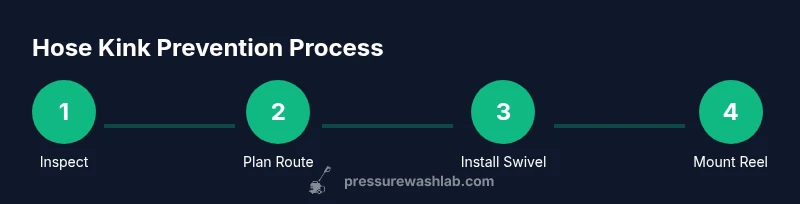
- 1
Inspect hose and fittings
Begin with a visual and tactile check of the hose and all connections. Look for cracks, bulges, or leaks near ferrules. Tighten loose fittings but avoid over-tightening which can damage the threads. A worn hose is a prime source of unexpected kinks under pressure.
Tip: Address damage immediately; a small crack can worsen quickly under high flow. - 2
Plan a smooth routing path
Map out a route that uses wide, gradual curves instead of sharp turns. Avoid dragging the hose across rough edges; use sleeves or edge guards when passing obstacles. Leave enough slack to accommodate movement without pulling tight at any bend.
Tip: Sketch a quick layout before you start cleaning to visualize problem spots. - 3
Install swivels at the ends
Attach a swivel at the gun end to minimize twisting as you move the wand. If possible, install a second swivel at the pump end to maintain alignment of the hose with the pump outlet. Swivels reduce the bending moments that cause kink formation.
Tip: Test movement range before turning on water. - 4
Mount a hose reel or hanger
Attach a reel or wall-mount bracket to keep the hose off the ground and guide it along the planned path. A good reel feeds smoothly and prevents coiling that invites kinks. Keep the hose neatly wound when not in use.
Tip: Lock the reel in place if you’re working near doors or in high-traffic areas. - 5
Connect hose to washer and wand correctly
Ensure connections are clean and threaded correctly. Align ends to avoid cross-threading, which can produce tight, kink-prone bends at the joints. Use compatible adapters if needed.
Tip: Hand-tighten and then snug with a wrench—avoid overtightening that harms fittings. - 6
Test for kinks and adjust layout
Run water at a low setting first and watch for any new bends forming under pressure. If you notice kinks, pause, straighten, and modify the path before increasing pressure. Validate that no bends exceed recommended radii for your hose.
Tip: Keep a light hand on the wand during the first test.
Quick Answers
What causes pressure washer hoses to kink?
Kinks occur from sharp external bends, poor routing, and worn hoses. Replacing worn sections and routing the hose so it follows gradual arcs reduces kink risk. Swivel fittings also help prevent twisting at connectors.
Kinks come from sharp bends and wear. Replace worn hoses and route smoothly to prevent twisting.
Can a hose reel prevent kinking?
Yes. A hose reel keeps the hose extended and guides it along a planned path, minimizing uncontrolled loops that cause kinks. Pair with swivels for best results.
A hose reel helps a lot by keeping the hose straight and easy to manage.
When should I replace a kinked hose?
If the hose shows cracks, stiff sections, or ongoing leaks after inspection, replace it. A damaged hose is at higher risk of bursting when under pressure.
If you see cracks or stiffness, replace the hose.
What diameter hose is best to prevent kinking?
Choose a reinforced hose with a suitable ID, typically 1/4" or 5/16" for most home setups. The key is reinforcement and compatibility with PSI rather than diameter alone.
Choose a reinforced hose and make sure it matches your pressure washer’s PSI.
Are swivels safe for high-pressure use?
Yes, use swivels rated for your PSI. Ensure all connections are compatible and maintain proper torque to avoid leaks and added bending.
Swivels are safe when rated for your pressure and installed correctly.
How can I test my hose after routing changes?
Run water at a low setting and observe for any new kinks or unusual resistance. If you see kinks forming, adjust the layout and re-test until the path remains smooth.
Test at low pressure to be sure the path stays kink-free.
Watch Video
Key Takeaways
- Plan routes with wide curves and avoid sharp bends
- Invest in swivels and a hose reel to manage length
- Inspect and replace damaged hoses early to prevent kinks
- Use edge guards to protect routing around obstacles