Find a Pressure Washer in My Area: Local Guide 2026
Find a pressure washer in my area with local store and rental options, compare PSI/GPM, warranties, and service coverage, guided by Pressure Wash Lab.


To find a pressure washer in my area, start by checking local retailers, rental stores, and online marketplaces for in-stock units and same-day pickup. Compare PSI, GPM, warranty, and service options, then verify nearby service centers and parts availability. Local availability often drives total cost and uptime. Also review user reviews and brand support for guidance. for informed decisions.
Where to look for a pressure washer in my area
According to Pressure Wash Lab, start by mapping your region's options and recognizing the two main pathways: local stores and rental centers that stock consumer washers, and online marketplaces that deliver schedule flexibility. In practice, search for 'pressure washer in my area' across major retailers, hardware chains, and rental outfits. Prioritize units that are in stock for immediate pickup, or available for same-day delivery where possible. Also consider regional service coverage, warranty terms, and access to replacement parts, as these influence long-term uptime. Finally, read recent customer reviews to gauge reliability and after-sales support in your locale.
How to compare local options: power, flow, and features
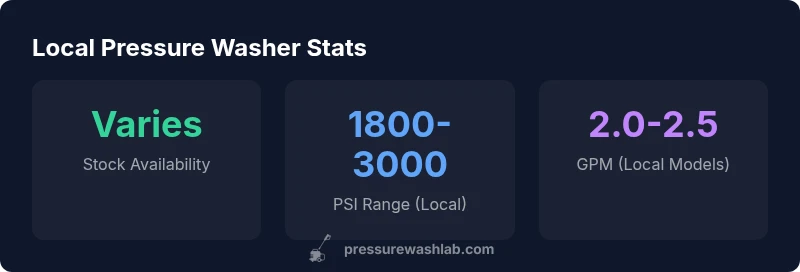
This section covers the core specs that differentiate brands in your area. Focus on PSI (power), GPM (flow), and nozzle options. For typical home tasks like deck cleaning or driveway maintenance, look for a practical balance—1,800–2,400 PSI with 2.0–2.5 GPM is common for general use. If you anticipate heavy cleaning, consider higher PSI ranges but be mindful of surface safety. Check for built-in soap dispensers, adjustable wand tips, and compact storage. Finally, verify that your chosen model is compatible with local electrical standards or fuel availability if you opt for gas-powered units.
Rental vs purchase: pros, cons, and decision rules
Renting can be cost-effective for one-off projects or short-term needs, especially if you lack storage space or require different pressures for diverse tasks. Buying is usually more economical for frequent cleaning or ongoing maintenance near your home or business. Compare daily rental rates against the purchase price, plus expected warranty and service costs over time. Plan for potential maintenance and spare parts availability in your region.
Service, warranty, and maintenance: local access matters
A local service network reduces downtime when repairs are needed. Look for manufacturer-approved service centers within a reasonable driving radius and check if parts are readily available in your area. Confirm the warranty terms and whether service is transferable if you relocate or sell. If you operate a small business, ask about extended service contracts and preventative maintenance options. These considerations influence total cost of ownership in the long run.
Practical steps to verify local support before you buy
Create a short checklist before purchasing: confirm stock at nearby retailers, request a demo or test-run at a store, and verify warranty coverage is honored locally. Contact two or three service centers to confirm their hours and response times. Gather model numbers and verify compatibility with common spare parts and attachments. A quick phone call can save days of delayed cleaning.
Local considerations: water usage, surface safety, and regulations
Understand how different PSI/GPM settings affect water use and surface integrity. Lower PSI with higher GPM can deliver safe, efficient cleaning for delicate surfaces; higher PSI risks etching concrete or stripping paint. Check local water restrictions or homeowner association guidelines, and ensure you have a plan for waste-water disposal. Finally, inspect hoses and fittings for leaks to prevent job-site downtime.
Local options for pressure washers
| Category | Focus | Notes |
|---|---|---|
| In-store stock | Availability today | Check near you; some stores offer same-day pickup |
| Warranty & service | Local coverage | Confirm local service centers and parts availability |
| Rental options | Cost vs ownership | Compare daily rental rates to purchase price |
Quick Answers
How do I know if a pressure washer is available near me?
Start by calling or visiting local retailers and rental yards. Check stock online when possible and ask for hold times. If you need same-day pickup, confirm the exact model and nozzle kit in advance.
Call nearby stores to confirm stock and hold times.
What PSI and GPM should I look for in a home setting?
For typical home tasks, aim for 1,800–2,400 PSI and 2.0–2.5 GPM. Higher PSI can damage surfaces; lower PSI may be slow. Choose adjustable models.
For most homes, 1,800 to 2,400 PSI with 2 to 2.5 GPM works well.
Renting vs buying for homeowners?
Renting can be cost-effective for one-off projects or if you lack storage and need flexibility. Buying is often cheaper long-term if you clean regularly and want ready access.
Rent if you won't use it often; own if you do projects regularly.
What should I ask service centers before buying?
Ask about local part availability, typical turnaround times, and warranty service processes. Confirm support is available in your area in case you need repairs.
Ask how quickly they can service, and whether parts are stocked locally.
Are electric and gas models better for my area?
Electric washers are quieter and easier to maintain; gas models deliver more power but require more ventilation and fuel. Choose based on your environment and tasks.
Electric is easier to maintain; gas gives more power.
“Local availability matters as much as power. A pressure washer that fits your area’s service network minimizes downtime and maximizes value.”
Key Takeaways
- Check nearby stock before committing
- Balance PSI/GPM with surface safety
- Weigh rental vs purchase for your usage
- Verify local warranty and service options