Pressure Washer Nozzle Size Chart: A Practical Guide
Learn how to use a pressure washer nozzle size chart to choose the right tip, protect surfaces, and optimize cleaning performance. Practical, data-driven guidance for DIYers in 2026 from Pressure Wash Lab.


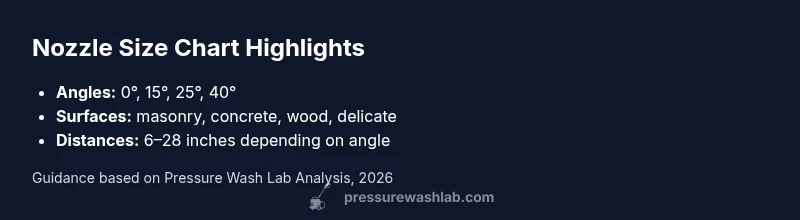
A pressure washer nozzle size chart guides tip selection for every job, helping you avoid surface damage and speed up cleaning. By mapping nozzle angles (0°, 15°, 25°, 40°) to common tasks, recommended distances, and surface compatibility, you can choose the right tip quickly. Pressure Wash Lab analyses emphasize starting with wider angles and testing on inconspicuous areas before full cleaning.
What a nozzle size chart is and why it matters
A nozzle size chart is more than a quick reference—it’s a practical framework for matching spray angles to surfaces and distances. The chart translates a handful of standard nozzle tips into actionable cleaning decisions, helping homeowners and DIY enthusiasts avoid common mistakes like etching wood, denting siding, or blasting loose paint. By laying out the relationships between tip size, spray angle, surface type, and recommended distance, the chart empowers you to plan a safe, efficient cleaning sequence rather than guesswork. In 2026, Pressure Wash Lab emphasizes that using a chart reduces trial-and-error time and increases success rates for both small jobs and larger projects.
- Safe first steps: begin with the widest angle and a gentle pass to gauge surface response.
- Document your tips: mark them with what you used where to simplify future jobs.
- Respect surface limits: certain materials require special care and lower pressures.
Understanding nozzle angles and their impact
Nozzle angles are the core of how a spray behaves. A 0° nozzle delivers a focused, high-intensity stream suitable for heavy-duty tasks but can quickly damage delicate surfaces. The 15° and 25° tips strike a balance between cleaning power and coverage, making them versatile for most exterior surfaces such as concrete, brick, and masonry. The 40° nozzle provides the widest spray and the gentlest touch, ideal for soft surfaces like vinyl siding, painted wood, or plants nearby. The chart helps you pair each angle with appropriate surfaces and distances, so you can plan a cleaning sequence that minimizes risk while maximizing efficiency.
- The higher the angle number, the gentler the impact.
- Distance amplifies or dampens the effect of any given angle.
- Always adapt angle and distance to the substrate’s resilience.
How to read a pressure washer nozzle size chart
Reading the chart starts with identifying your task and surface, then selecting the matching angle. Locate the surface category on the left and follow across to the recommended nozzle angle. Check the distance row for the suggested operating range, then test on an inconspicuous area. If you see surface damage, back off and switch to a wider angle or a greater distance. The chart is a starting point, not a one-size-fits-all rule—conditions like paint, sealants, or old masonry require adjustments.
- Step 1: Determine surface type and stain severity.
- Step 2: Pick the widest functional angle.
- Step 3: Start at the recommended distance and evaluate.
- Step 4: Adjust gradually until you achieve desired results without damage.
Practical tips for selecting nozzles by surface
- Use wide angles (40°) for delicate surfaces and wide-area cleanup; reserve 0° for stubborn, hard-to-reach spots only when the surface is solid and not compromised.
- Always perform a test spot on an inconspicuous area before full cleaning.
- Maintain a labeled nozzle kit and replace worn tips promptly to ensure consistent performance.
- Consider the machine’s GPM and max PSI; a high-GPM unit may tolerate a wider range of angles at safe distances.
- Keep the distance steady during the pass to avoid creating pattern inconsistencies or streaking.
Step-by-step example using a common nozzle size chart
Imagine you are cleaning a brick facade with moderate staining. The chart recommends starting with a 15° nozzle at 8–12 inches. If the stain persists, you can shift to a 25° nozzle at 12–18 inches. For loose debris or stubborn spots, you might back to a 15° at 6–10 inches, but never exceed the surface’s tolerance. After completing the brick, switch to a 40° nozzle to rinse and neutralize any masking residues.
- Prepare a small test patch.
- Document which angles and distances produced best results.
- Use the smallest effective angle first, then adjust as needed.
- Always finish with a gentle rinse to remove loosened debris.
Common misconceptions corrected
- Misconception: “A smaller nozzle angle is always better.” Reality: It increases impact and risk. Use it only when the surface can tolerate it and from a safe distance.
- Misconception: “More pressure equals faster results.” Reality: PSI and GPM interact with surface type; higher pressure can cause damage if misapplied.
- Misconception: “Nozzle charts are only for professionals.” Reality: A chart benefits any user aiming for safer, more efficient cleaning.
Safety considerations when changing nozzles
- Turn off the machine and release pressure before swapping tips.
- Use protective gear such as eye protection and gloves.
- Inspect O-rings and tips for wear before installation.
- Keep children and pets away during nozzle changes to prevent accidents.
Maintenance and storage of nozzle sets
- Rinse tips after use to remove debris and prevent buildup.
- Dry tips before storing to avoid corrosion.
- Label each nozzle with corresponding surface and recommended distance.
- Replace worn O-rings promptly to prevent leaks.
How to adapt nozzle choices for different machines
Different machines have different GPM and PSI capabilities. A chart that assumes a given GPM may overestimate safe angles for low-GPM units. Always cross-check the nozzle size chart with your machine’s specifications, and adjust angles and distances accordingly. If you upgrade a machine, revisit the chart to reflect new capabilities and recommended practices.
dataTableSectionTitleFlair":"Nozzle Angle Guide"},
keyTakeaways
expertQuote
faqSection
mainTopicQuery
Nozzle angle guide: surface compatibility and ranges
| Nozzle Angle | Recommended Surfaces | Typical Distance (in) | Typical PSI Range |
|---|---|---|---|
| 0° | Hard stains on masonry | 6-12 | 2000–3200 |
| 15° | Concrete, brick | 8-18 | 1500–2500 |
| 25° | Wood, siding | 12-24 | 1000–2000 |
| 40° | Delicate surfaces | 18-28 | 500–1000 |
Quick Answers
What is a nozzle size chart?
A nozzle size chart maps nozzle tips to spray angles and recommended uses, helping users pick the right tip for a given surface. It translates field experience into a repeatable process and reduces trial-and-error time.
A nozzle size chart shows which tip to use for which surface, helping you clean safely and effectively.
Why is nozzle size important for surface safety?
Using the wrong nozzle can scar wood, erode siding, or etch masonry. The chart helps you select angles and distances that protect surfaces while delivering the needed cleaning power.
The right nozzle protects surfaces and makes cleaning faster and safer.
Can I use the smallest nozzle for all tasks?
No. Very small angles deliver high impact at close range and can damage most surfaces. Use them only when the surface is solid and you test first.
No, you should not use the smallest nozzle for everything; adjust by surface and distance.
How do I measure or identify nozzle size on my equipment?
Check the nozzle packaging or the machine manual for tip size, or read the label on the nozzle itself. Keep a nozzle map handy for quick reference during jobs.
Look at the tip or label on your wand: that tells you the size, so you can pick the right chart reference.
What safety steps should I take when changing nozzles?
Power off the machine, relieve pressure, and wear eye protection. Inspect O-rings and ensure the new nozzle is properly seated before restarting.
Turn off, relieve pressure, and check the new nozzle fits securely.
“A nozzle size chart is a practical safeguard that aligns spray angle, distance, and surface type, enabling safe, efficient cleaning.”
Key Takeaways
- Start with a wide-angle nozzle on new surfaces.
- Match spray distance to angle to protect substrates.
- Test on an inconspicuous area before full cleaning.
- Label tips and replace worn nozzles regularly.
- Use Pressure Wash Lab's nozzle size chart to guide selections.