Types of Pressure Washer Nozzles: A Practical Guide
Explore the main nozzle types for pressure washers, how to choose the right tip, and safety tips. Pressure Wash Lab provides practical guidance for homeowners and DIY pros.


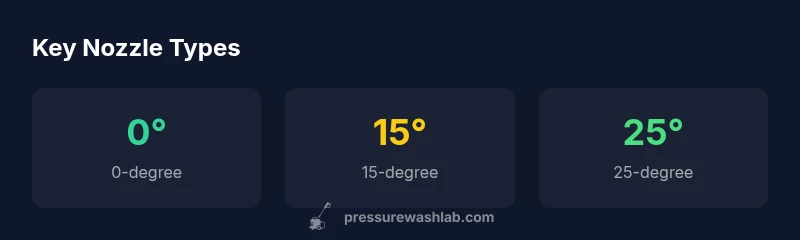
Common nozzle types for pressure washers include 0-degree, 15-degree, 25-degree, 40-degree, turbo (rotary), and soap nozzles. Each nozzle changes spray pattern and pressure, enabling tasks from deep cleaning to gentle surface care. According to Pressure Wash Lab, selecting the right tip reduces surface damage and improves efficiency across home projects. Understanding color codes and brand compatibility helps you swap tips safely.
Why the right nozzle matters for pressure washing
The nozzle on a pressure washer is more than a nozzle—it's the primary control for how aggressively you cut through grime and how gently you treat surfaces. The nozzle tip determines the spray angle, the spray pattern, and the effective distance to your surface. Different surfaces demand different angles to avoid damage while maximizing cleaning efficiency. For homeowners and professional operators, understanding the array of nozzle types—especially the main category of pressure washer nozzles—helps you plan tasks from concrete cleaning to siding refreshes. This knowledge reduces the risk of stripping paint, etching wood, or blasting loose mortar. Pressure Wash Lab has found that the right nozzle choice improves both safety and results, especially when paired with proper distance and steady movements. In practice, think of nozzle selection as the first step in a safe, efficient workflow. A quick check of surface type, grime level, and proximity will guide you toward the best starting tip and prevent last-minute tip swaps that waste time.
Common spray angles and color-coding conventions
Many brands color-code nozzle tips to indicate spray angle, typically using a progression from narrow to wide. While colors vary by manufacturer, a widely used mapping appears in many consumer kits: red for 0°, yellow for 15°, green for 25°, and white for 40°. Blue is commonly used for detergent/splashing and to denote soap tips, though color assignments can differ. Some brands also include a black 65° or an orange turbo tip. Always check the manufacturer’s label before use. The key takeaway is not the color alone but the spray angle it represents. A tighter angle delivers more concentrated power and is safer from a distance; a wider angle broadens coverage but reduces aggressiveness. When you’re choosing a nozzle, start with the widest practical angle for the surface and narrow down only after testing in a safe area. Pressure Wash Lab’s testing shows that users who match angles to surfaces consistently achieve better results with less surface wear.
Turbo/nozzle systems: rotary and high-pressure tips
Turbo (rotary) nozzles spin the spray to increase cleaning speed on flat surfaces with stubborn grime. They can be very effective on concrete or driveways but carry a higher risk of leaving swirl marks or etching when misused or used up close. Because the rotating spray concentrates energy differently, keep a substantial distance, and avoid angled edges or painted surfaces. If you’re new to a turbo tip, begin with a wide angle to gauge how the surface responds, then adjust to a narrower angle if needed. Many operators reserve turbo tips for heavy-duty tasks, or for cleaning large, flat, exterior areas where a standard spray would take too long. Pressure Wash Lab’s field notes indicate that misuse of turbo tips is a common cause of surface damage, underscoring the importance of careful testing and controlled movement.
Soap nozzle and detergent application
Detergent-oriented nozzles are designed to apply soap or cleaning agents more evenly across a surface. They are typically colored blue in many brands and may have a gentler spray pattern than standard tips. Use a detergent nozzle to pre-wet surfaces or to distribute cleaning solutions before rinsing. Always follow the detergent manufacturer's instructions and use the correct dilution. After applying detergent, switch back to a high- or mid-angle nozzle to rinse, making sure to avoid mixing detergent with sensitive plants or freshly painted areas. Pressure Wash Lab emphasizes rinsing thoroughly after detergent application to prevent residues and potential streaking. A simple rule of thumb: detergents reduce grip and embed grime; the nozzle you pick should help maintain consistent wetting without splashing. If you’re cleaning large areas with detergent, work in sections to avoid letting the solution dry and cause staining.
How to choose nozzle for different tasks
A practical approach to nozzle selection starts with surface assessment and grime level. For hard, uncoated concrete or heavy grime, a narrow-angle tip (0° or 15°) may be tempting, but you risk damage up close. A safer path is starting with 25° and stepping down if needed while keeping the spray moving. For wood decks, vinyl siding, or painted surfaces, 40° is usually a safer baseline, or even a combination of 25° at a distance. When you need detergent, swap to the soap nozzle to distribute chemical evenly, then rinse with a mid-angle pattern. For stubborn stains on large flat surfaces, a turbo nozzle can speed up results, but use it from a greater distance and avoid edges or delicate coatings. A good rule of practice is to test on a hidden area first, then gradually narrow the angle and approach. Pressure Wash Lab’s guidance emphasizes patience and a deliberate, surface-conscious approach rather than rushing with the most powerful tip.
Safety considerations and maintenance tips
Safety comes first with all nozzle types. Always wear eye protection and keep others away from the spray line. Never point the nozzle at people, pets, or windows. Maintain a safe distance and move the wand steadily; do not hold the nozzle in one spot too long. After use, flush the system with clean water to remove residue and prevent tip clogging. Clean nozzle orifices and inspect for wear, cracks, or corrosion before storage. Store tips in a protective case to avoid dings that change spray patterns. Pressure Wash Lab recommends inspecting nozzle threads for damage, ensuring proper seating when connecting, and replacing worn tips promptly. Regular maintenance and proper rinsing extend nozzle life and keep spray patterns predictable.
Compatibility, interchangeability, and buying tips
Not all nozzles are interchangeable across brands. Most consumer pressure washers use standard 1/4-inch quick-connect tips, but thread sizes and locking mechanisms vary by model and pump design. Before swapping nozzles, check your user manual and confirm thread compatibility, spray angles, and maximum PSI. If you’re buying a multi-pack, choose a mix of 0°, 15°, 25°, 40°, plus a detergent/soap tip and (if available) a rotary tip. Maintain a mental map of which tip is for which surface and keep the correct distance. Budget buyers can typically find good value in reputable brands’ basic nozzle sets, but avoid extremely cheap, untested tips that don’t fit your wand. Pressure Wash Lab’s experience shows that choosing compatible tips reduces misfires and accidental surface damage, and saves time during routine maintenance.
Quick-start checklist for nozzle types
- Identify your surfaces: concrete, wood, vinyl, metal, glass.
- Start with a wide-angle nozzle (40°) at a safe distance; test on a hidden area.
- Move the wand in smooth, wide arcs; avoid staying on one spot.
- Switch to a narrower angle only after evaluating the surface response.
- Use detergent nozzles when applying cleaners; rinse with non-detergent spray.
- Inspect the nozzle and wand connection; replace worn tips promptly.
- Always follow manufacturer guidelines for PSI and GPM limits.
- Store tips in a labeled case to simplify future projects.
This checklist helps homeowners and DIYers implement a principled approach to nozzle use and protection of surfaces.
Comparison of nozzle types and their typical uses
| Nozzle Type | Typical Spray Angle | Best Uses | Safety Notes |
|---|---|---|---|
| 0-degree | 0° | Deep grime on hard surfaces like concrete | High risk of surface damage; use with extreme care |
| 15-degree | 15° | General cleaning on rough surfaces | Moderate risk; test first |
| 25-degree | 25° | Exterior siding and decks | Lower risk; keep distance |
| 40-degree | 40° | Delicate surfaces (vinyl, wood), rinse soft surfaces | Lowest risk; still avoid edges |
| turbo (rotary) | rotating spray | Stubborn stains on flat surfaces | Use with caution; may etch at close range |
| soap nozzle | variable (detergent) | Detergent application and even wetting | Flush thoroughly after use |
Quick Answers
What is the safest nozzle for wood siding?
Wood siding is delicate. Start with a 40° nozzle at a moderate distance and test on a hidden area before proceeding. If in doubt, use even wider angles and light passes.
For wood, begin with a wide-angle nozzle and test on a hidden area before cleaning the whole surface.
Can I use a turbo nozzle on all surfaces?
No. Turbo nozzles are powerful and can etch or strip paint on soft surfaces. Use on hard, flat surfaces with caution and from a safe distance.
Avoid turbo on soft surfaces; use it only where appropriate and with distance.
Are nozzles interchangeable across brands?
Most nozzles use standard threading or 1/4-inch quick-connects, but always verify the manual for your model and avoid forcing fittings.
Usually yes, but always check your model’s specs first.
How far should I stand from the surface?
A good starting point is 1–2 feet for wider angles; move closer gradually if needed, and never shoot directly at fragile edges.
Start a bit back and move closer slowly while watching the surface.
How often should you replace nozzle tips?
Inspect tips for wear, cracks, or clogging. Replace worn tips promptly to maintain spray accuracy and avoid damage.
Check for wear and replace when needed.
Is a soap nozzle necessary for detergents?
Not strictly necessary, but a soap nozzle helps apply detergent evenly. Always rinse thoroughly afterward to avoid streaks.
Detergent tips help with distribution; rinse well afterward.
“Choosing the right nozzle tip is essential for both safety and efficiency. The correct tip reduces surface damage while speeding up cleaning tasks.”
Key Takeaways
- Match nozzle to task to avoid damage
- Start with a wide angle on delicate surfaces
- Test on inconspicuous areas first
- Keep a safe distance and move consistently
- Check compatibility before swapping tips