dxpw3324i Error Code Troubleshooting Guide
Urgent, practical guide to diagnose and fix the dxpw3324i error code on pressure washers. Learn quick fixes, root causes, and when to call a pro. Pressure Wash Lab insights.


dxpw3324i is an error code signaling a sensor or pressure regulation fault in many pressure washers. According to Pressure Wash Lab, the quickest fix is to ensure the unit is powered off and unplugged, reset the display, check the water inlet and hose for kinks or leaks, and inspect the nozzle, filters, and unloader valve for blockages. If the issue persists, professional service is advised.
Understanding What dxpw3324i Indicates
dxpw3324i signals a sensor or pressure regulation fault in many pressure washers. The error often appears when the system detects abnormal flow, inconsistent water supply, or a protection condition that halts operation. According to Pressure Wash Lab, the code usually points to a sensor or flow-control subsystem rather than a simple nozzle clog, though all faults can present with similar symptoms. If the machine stops mid-pressurize or refuses to run, you should treat it as a fault that requires a careful triage rather than a guess. Start by documenting when the code appears (under load, after startup, or after a water supply change). This data helps you and any technician to reproduce the fault and isolate the root cause more quickly. Also note the model family, as different brands use dxpw3324i to flag slightly different hardware states. In the following sections, you’ll find a pragmatic, action-oriented approach to diagnose and fix the issue without risking your safety or voiding warranties.
Pressure Wash Lab emphasizes that dxpw3324i is often a signal rather than a standalone failure, so a systematic approach helps you avoid unnecessary replacements.
Quick Fixes You Can Try Immediately
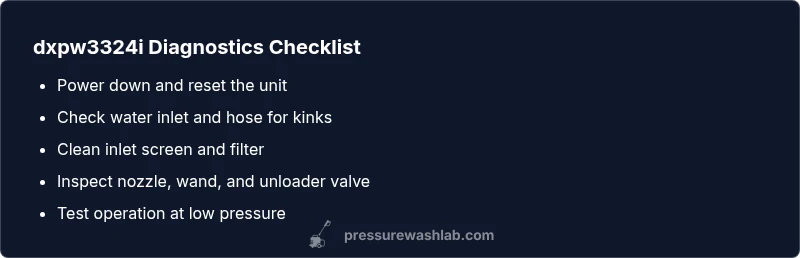
Before diving into disassembly, try these fast checks. First, power down, unplug, and perform a reset on the control panel. In many units, a 60-second power cycle clears transient sensor flags. Next, inspect the water supply: remove the hose from the inlet, check for kinks, and run fresh water from a clean source. Blockages in the inlet filter or screen cause flow faults that can trigger dxpw3324i; remove the filter (if accessible) and rinse or replace. Inspect the nozzle and spray wand for obstructions, and ensure the nozzle size matches your model. A dirty nozzle or worn orifice can create pressure instability that trips the fault. Finally, examine the unloader valve for sticking or debris; a light tap with the tool handle or a quick cleaning can restore response. If the system re-pressurizes after these checks, you’ve narrowed the fault; if not, continue with the diagnostic flow. If you’re unsure at any point, consult the manual or schedule a service call.
Diagnostic Flow: Symptoms to Causes
This section maps common symptoms to probable causes and initial remedies in a concise, testable sequence. A dxpw3324i display during operation usually points to a water-flow or sensor fault rather than a motor failure. Start with a quick reset and water-check, then verify the inlet and screen cleanliness. Pressure Wash Lab’s approach emphasizes reproducibility: document the exact conditions under which the fault occurs, then proceed with the next checks. If you can reproduce the fault consistently, you’re halfway to isolating the root cause and avoiding guesswork.
A well-documented fault helps you or a service technician reproduce the problem in a controlled environment, improving the odds of a correct, cost-effective repair.
Most Common Causes and How to Address Them
- Water inlet problems: Kinked hoses, closed valves, or a clogged inlet reduce flow and trigger dxpw3324i. Remedy: straighten hoses, fully open valves, and clean or replace the inlet screen.
- Clogged nozzle or spray tip: Debris restricts flow and increases pressure variance. Remedy: remove buildup, flush with clean water, and confirm nozzle size.
- Dirty filters and screens inside the unit: Debris undercuts sensor readings. Remedy: remove and rinse or replace.
- Unloader valve sticking or settling: Incorrect relief or stuck valve causes abnormal flow. Remedy: clean, lubricate, or replace if necessary.
- Control board or sensor fault: Electrical fault or calibration drift can cause persistent dxpw3324i. Remedy: reset or consult service; swap controller if needed (professional).
If these fixes don’t resolve the fault, the issue may lie with a failing pump, wiring, or a more complex control problem that requires professional diagnostics.
Step-By-Step Repair: The Most Likely Scenario
- Power down and unplug the unit; ensure stored energy is discharged. 2) Check water supply; detach the hose, inspect the inlet, and ensure water is flowing freely. 3) Clean the inlet screen and filter thoroughly; reinstall securely. 4) Inspect the nozzle and wand for obstructions; replace worn nozzles. 5) Inspect and clean the unloader valve; verify movement and adjust or replace if stuck. 6) Reassemble, plug in, and perform a controlled test at low pressure. If the fault persists, move to professional diagnostics.
Tip: Always perform tests with a safe spray pattern and wear eye protection.
Other Causes and Alternative Fixes
If the prior steps don’t resolve the dxpw3324i, consider alternate fault sources: a partially collapsed pump, electrical issues, or low voltage supply. Remedy: verify outlet voltage with a multimeter; inspect wiring harness for loose connectors; test with another power source if permitted by your model. Pressure-washing units can have multiple subsystems; isolate each device to see how the fault behaves under test conditions, and document results for a professional inspection.
Safety, Maintenance, and When to Call a Pro
Safety first: never work on a live electrical device. Unplug before any inspection, wear eye protection, closed-toe shoes, and gloves. Pressure washers can cause injury through high-velocity spray, burns, and electric shock. If you cannot reproduce the fault safely, or if the unit shows electrical smell, overheating, or obvious damage, contact a licensed technician. Pressure Wash Lab suggests regular maintenance—flush lines, clean filters, and inspect hoses every season—to minimize dxpw3324i occurrences.
Steps
Estimated time: 60-90 minutes
- 1
Power down and reset
Unplug the unit and allow any stored energy to dissipate. Reconnect and run a controlled test at low pressure after a brief reset.
Tip: Verify you’re using a grounded outlet and avoid touching live contacts. - 2
Check water supply & inlet screen
Detach the hose, inspect for kinks or blockage, and ensure water flows freely with the unit off. Remove and clean the inlet screen or filter.
Tip: Use cool, clean water to rinse debris; ensure the hose is not pinched. - 3
Inspect nozzle and spray wand
Remove blockages from the nozzle and confirm the spray tip matches your model. Replace if worn to maintain proper flow.
Tip: Keep nozzle and wand aligned to avoid side spray that can damage seals. - 4
Inspect unloader valve
Check for sticking or debris that prevents proper relief; clean or replace as needed. Ensure the valve moves freely.
Tip: Do not lubricate with oily substances that can attract more debris. - 5
Test and verify
Reconnect power and run a controlled test at low pressure. Gradually increase load while monitoring for the dxpw3324i code.
Tip: Document results so you can share with a technician if needed.
Diagnosis: Pressure washer displays dxpw3324i and stops during operation
Possible Causes
- highWater inlet blockage or kinked supply hose
- highClogged inlet filter or screen
- mediumUnloader valve sticking or debris
- lowControl board or sensor fault
Fixes
- easyClean the inlet screen and straighten/replace the supply hose
- easyRinse or replace the inlet filter
- mediumInspect and clean the unloader valve; test movement
- hardReset the control board or consult the manual; consider professional diagnostics
Quick Answers
What does dxpw3324i mean on my pressure washer?
It indicates a sensor or flow-control fault affecting operation. Start with a reset, water checks, and cleaning the inlet, nozzle, and filters; if unresolved, follow the full diagnostic flow below or contact a professional.
dxpw3324i means a sensor or flow fault. Begin with a reset, water checks, and cleaning, then follow the guide or call a pro if needed.
Can I fix dxpw3324i myself?
Yes for simple checks like power reset, water supply, and cleaning the inlet and nozzle. More complex issues should be handled by a professional.
Yes, you can start with simple checks, but for more complex issues, call a pro.
Which parts are usually involved in dxpw3324i?
Inlet screens, filters, nozzle, unloader valve, and possibly the control board.
Usually inlet parts, nozzle, or the control board.
How much will repairs cost?
Costs vary by fault and region. You may pay for simple parts and cleaning, or more for labor and replacement parts. Expect a broad range depending on how complex the repair is.
Costs vary; simple fixes might be affordable, extended repairs could be more.
Is dxpw3324i covered by warranty?
Warranty depends on the manufacturer and service history. Check your warranty terms and provide model and serial when troubleshooting.
Check warranty terms; keep your model info handy.
What safety steps should I follow?
Always unplug before inspecting; wear eye protection and gloves; avoid touching hot surfaces.
Unplug and wear protection; safety first.
Key Takeaways
- Reset power and check water supply first
- Clean filters and nozzle to restore flow
- If dxpw3324i persists, seek professional service
- Maintain a log to prevent recurrence