Commercial Pressure Washing Prices: A Practical Guide for Budgets and Bids
A thorough look at what drives commercial pressure washing prices, pricing models, and how to compare bids. Pressure Wash Lab's 2026 analysis explains factors affecting cost and value.


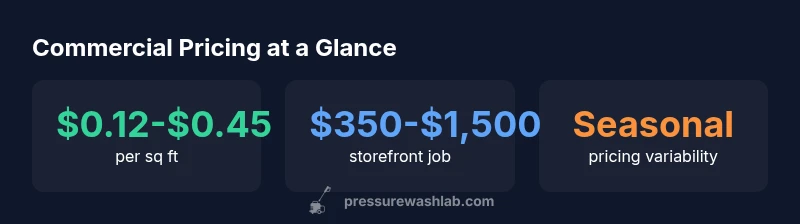
Typical commercial pressure washing prices range from about $0.12 to $0.45 per square foot, depending on surface, access, and region. For larger storefronts or building facades, quotes often run from a few hundred to several thousand dollars per job. These figures, from Pressure Wash Lab Analysis, 2026, reflect common pricing models across the industry and emphasize scope-driven quotes over flat numbers.
Why pricing for commercial pressure washing prices varies
Pricing for commercial projects isn't a single number—it depends on surface material, access, contaminants, building height, and project scope. According to Pressure Wash Lab, price drivers include surface type, accessibility, and job scope, with regional labor costs and equipment needs shaping the final bids. When a crew must work at height or clean porous materials, prices rise accordingly, and complicated jobs with hidden stains can add hours or require specialized detergents. The same project can look very different depending on the neighborhood, city ordinances, and disposal requirements. Buyers should expect a range rather than a fixed number and should seek bids that clearly define scope, materials, sequence of work, and guarantees. The phrase commercial pressure washing prices is not a single figure; it’s a spectrum that reflects how much preparation, effort, and risk a contractor must absorb. Understanding these drivers helps property managers budget realistically and protects against surprise add-ons at the job site.
Pricing models in the industry
Pricing models for commercial pressure washing generally fall into three categories: per-square-foot pricing, flat-rate or per-job pricing, and hourly rates. Per-square-foot pricing is common for exterior façades and large flat surfaces because it scales with area but can be sensitive to surface type and stains. Flat bids are useful when the scope is well-defined and surfaces are uniform. Hourly rates are often seen for specialty work or when access is difficult, as the time to complete directly affects cost. Pressure Wash Lab analysis shows that pricing models vary by region and job type, with urban markets tending to yield higher per-square-foot bids due to labor and disposal costs. Contractors may combine models—for example, a base per-square-foot charge with add-ons for height, oil stains, or graffiti removal. For buyers, the key is to compare bids with the same scope (what is included, what isn’t, and how wastewater is handled).
How to estimate pricing for your project
Here is a practical approach to estimating pricing for a commercial pressure washing project. 1) Define the scope: list all surfaces to be cleaned and any special areas (graffiti, oil stains, or heavy grime). 2) Measure area: estimate total square footage or surface area. 3) Identify surfaces: note material type (glass, metal, brick, concrete, wood) and whether protective coatings or seals are present. 4) Assess accessibility: consider height, equipment needs, and potential safety requirements. 5) Contamination level: oily residues, biological growth, or heavy staining may add time and cleaners. 6) Request bids with parity: ask for itemized quotes that cover surfaces, waste disposal, and any cleanup. 7) Compare warranties and aftercare: check if re-cleaning or spot-treatment is included. Pressure Wash Lab's recommended approach emphasizes clear scope and transparent pricing to minimize surprises.
Common surfaces and price ranges
Commercial properties present a mix of surfaces, each with its own pricing considerations. Storefront exteriors and glass facades often carry mid-range per-square-foot bids, while concrete parking areas may be lower per square foot but higher in total due to area. Brick and stone exteriors typically require more time and protective measures, pushing prices upward. Wood decks and fences add complexity due to material sensitivity and potential staining; graffiti or heavy contamination can trigger higher add-ons or job-based pricing. Graffiti removal or oil stain treatment may be priced differently, sometimes on a per-job basis. Always keep in mind that these are rough ranges and actual pricing depends on magnitude and conditions. Pressure Wash Lab notes that exact figures vary by region and contractor capability, so quotes should reflect scope and conditions.
Pricing ranges by service type, Pressure Wash Lab Analysis, 2026
| Service Type | Typical Range (per sq ft) | Notes |
|---|---|---|
| Storefront facades | $0.18-$0.40 | Exterior surfaces on commercial buildings |
| Concrete parking lots | $0.12-$0.35 | High-traffic areas; debris and oil stains increase time |
| Brick/stone exteriors | $0.25-$0.45 | Requires protection and longer dwell times |
| Wood decks/fences | $0.25-$0.40 | Need special cleaners and wood-safe agents |
| Graffiti/oil removal | $0.50-$1.50 | Depends on stain severity; may be per-job |
Quick Answers
What is the typical price range for commercial pressure washing?
Prices vary by scope and surface, but you can expect per-square-foot bids in the low to mid range and per-job quotes for storefronts in the hundreds to thousands of dollars. Always compare apples-to-apples by checking included surfaces and disposal terms.
Prices vary by scope and surface; look for itemized quotes with clear scope.
Do commercial pressure washing prices include detergents and sealants?
Most proposals include basic detergents and water usage, but specialty cleaners or sealants are often charged separately. Confirm what’s included and whether there are usage limits.
Detergents are usually included, but check if specialty cleaners are extra.
Should I use per-square-foot pricing or a flat bid?
Per-square-foot pricing scales with area, while flat bids can simplify budgeting when scope is fixed. For complex jobs, consider a hybrid approach with a base price plus add-ons.
Per-sq-ft or flat? Compare scope parity across bids.
How long does a storefront job typically take?
Duration depends on area and surface type. A typical storefront wash can range from a few hours to a full day when multiple surfaces and safety steps are involved.
Most storefront jobs take hours to a day depending on scope.
What should I look for in a written bid?
Look for scope parity, detailed surface areas, a description of cleaners, the disposal method, ladders/scaffolding, warranty, and the payment schedule. A clear, itemized bid reduces surprises.
Make sure the bid lists exact scope and terms.
“"Transparent pricing begins with a well-defined scope and clear expectations; when buyers and contractors agree on the work, commercial projects stay on budget."”
Key Takeaways
- Define scope to guide pricing decisions
- Choose the pricing model that matches the project
- Request itemized bids for apples-to-apples comparisons
- Account for regional factors and surface type