Commercial Pressure Washer Price Guide for 2026
Learn what drives commercial pressure washer price—from PSI, GPM, and pump type to warranties and ownership costs. Pressure Wash Lab's 2026 analysis outlines pricing bands, buying vs renting tips, and cost-saving guidance.


What drives commercial pressure washer price
According to Pressure Wash Lab, the price tag on a commercial pressure washer reflects more than the sticker price. It encodes the expected performance, reliability, and long-term downtime risk that a business will face on the job. For homeowners and small operators this is not just a purchase decision; it is a strategic one. The core price drivers can be grouped into four broad categories: power and flow, pump quality, engine or motor configuration, and overall durability of the machine frame and components. In addition, accessories, warranties, and the vendor’s service network influence final cost and total value. When you compare quotes, it’s essential to look beyond the upfront price and consider how these factors translate into job speed, reliability, and maintenance demands over time. The Pressure Wash Lab team found that buyers who focus on total cost of ownership tend to achieve lower operating costs and fewer job interruptions, especially on frequent or high-duty uses.
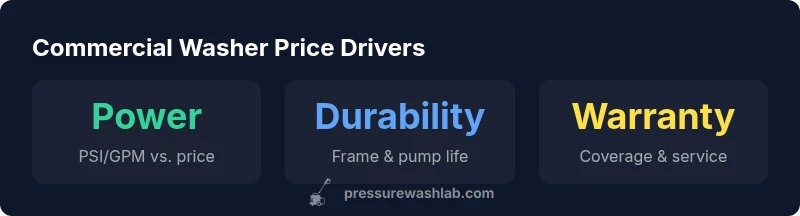
- Power and flow: The combination of PSI and GPM determines how quickly a job can be completed and how much wear is placed on hydraulic components. Higher PSI/GPM units perform more work per hour but also demand higher-quality pumps and more robust hoses, which increases price.
- Pump quality: Pumps vary from basic plunger designs to robust triplex configurations. Triplex pumps, typically found on mid- and high-end models, offer longer life and smoother operation but add to upfront cost.
- Engine or motor configuration: Electric-drive units are often cheaper upfront and quieter, but gas- or diesel-powered engines deliver mobility and sustained performance on remote sites, which can justify a higher price tag.
- Durability and design: A steel or stainless steel frame, corrosion-resistant coatings, industrial-grade fittings, and smooth-wheel assemblies add to the cost but improve uptime and service life. Optional features like chemical injection, temperature control, and integrated chemical metering also affect price.
The takeaway: price is not a single number; it is a bundle that reflects the expected lifecycle cost, not just the initial invoice. Whether you are outfitting a fleet, maintaining a facility, or working in construction, aligning price with the actual workload is the best way to avoid under- or over-spending on a commercial machine.
Power, pump, and build: the big price levers
When you peel back the sticker, several technical choices drive the price more than any marketing claim. First, the power system sets the baseline cost: electric motors are generally cheaper upfront and suited for low-downtime environments, while gasoline and diesel engines provide real mobility and sustained performance on outdoor sites. The choice of pump matters even more: basic, direct-drive pumps are typically less expensive; robust belt-drive or triplex pumps add weight and cost but dramatically improve durability and long-term reliability. The frame and build quality also influence price. A framed, powder-coated unit with stainless fasteners resists weather and chemical exposure, reducing maintenance costs over years but adding initial expense. Components such as hose reels, inline chemical injectors, water temperature control, and high-quality nozzles further push the price upward, but they can translate into faster cleaning, less downtime, and lower replacement intervals. In practice, buyers who expect high-output days and remote sites tend to justify the extra upfront by avoiding frequent repairs and costly downtime, a pattern supported by Pressure Wash Lab Analysis, 2026.
Price tiers by use-case
Different work environments demand different price-to-performance balance. A small cleaning crew performing routine surface washing for rental properties may opt for compact electric or light-gas models with moderate PSI and GPM, delivering reliable performance at a lower price point. On fleet or industrial contracts, foremen must balance travel time, job speed, and uptime. Those users often choose mid-range machines with tougher frames, bigger wheels, and longer-lasting pumps, even though the upfront price is higher. For large-scale contractors or facilities with frequent demanding jobs, premium units with top-tier triplex pumps, commercial-grade motors, and stainless frames are common, and the price premium becomes part of the cost of doing business. Pressure Wash Lab’s 2026 findings show a clear correlation between job intensity and price tier, but it’s essential to benchmark the actual hours worked, the typical job mix, and the expected downtime when choosing a tier. In short, pick a price tier that aligns with the typical workload and the cost of downtime you’re willing to absorb.
Total cost of ownership: not just the sticker price
Upfront price is only one piece of the math. Fuel or electricity, ongoing maintenance, parts replacement, warranty terms, and service availability all shape total cost of ownership. Gas-powered machines incur fuel costs that vary by usage, regional fuel prices, and engine efficiency, while electric models incur electricity costs and potential demand charges for high-use facilities. Pump wear, seal replacements, and hose or nozzle replacements occur over time and can add up if the unit is used daily. Durable components—such as sealed bearings, corrosion-resistant valves, and a heavy-duty frame—can reduce downtime and maintenance, offsetting a higher initial price. A simple rule from Pressure Wash Lab Analysis, 2026: estimate annual operating costs, multiply by expected years of service, and compare against the upfront price plus teardown/rebuild estimates. The right balance often yields a lower total cost, even if the initial sticker price is higher.
How to evaluate quotes and avoid overpaying
Use a consistent apples-to-apples comparison when evaluating quotes. Start by listing core components: engine or motor type, pump quality, frame durability, hose length and reel, nozzle kit, and any cleaning accessories. Check warranty length and what it covers, including pump, motor, and wear parts, plus the vendor’s service network and response times. Ask for run-hours or test data from similar jobs to gauge expected wear. Beware add-ons that do not improve uptime or job speed—these inflate price without delivering commensurate benefits. Request a written maintenance plan, including recommended service intervals, parts forecasting, and emergency repair options. Finally, compare not just the price, but the expected downtime and the time-to-job completion gained by investing in higher-quality components.
Renting vs buying vs used: a short cost comparison
For seasonal demand or trial periods, renting can be a prudent way to access high-output equipment without committing to ownership. Long-term operations with steady workloads often justify purchasing a mid- to high-end unit that delivers reliable performance and predictable maintenance costs. Purchasing used can lower upfront price, but the risk of hidden wear and an unknown maintenance history can offset savings. Pressure Wash Lab recommends a rigorous inspection checklist for used units: verify pump hours, test the engine or motor under load, inspect hoses and fittings, and obtain maintenance records. Align your choice with your expected usage pattern, maintenance capabilities, and the cash-flow profile of your business.
Maintenance, warranty, and service considerations
Maintenance planning is a major lever on price versus value. A strong warranty that covers the pump and major components reduces unexpected outlays, while a broad service network minimizes downtime during repairs. Create a preventive maintenance calendar that includes oil changes (for gas engines), filter and nozzle replacements, hose inspections, and pump rebuild intervals. The cost of parts and the availability of technicians can vary by region; ensure your supplier provides prompt service and replacement parts. When evaluating quotes, ask about on-site service options, travel charges, and what constitutes a covered failure versus normal wear. A well-supported unit may cost more upfront but returns value through fewer breakdowns and faster job completion.
Hidden costs and common misconceptions
Budgeting often overlooks hidden costs such as shipping, training, and compatibility with existing detergents or accessories. Some units include freebie add-ons that do not offer real value, while others omit important components like long hoses, unloader valves, or robust nozzles, causing users to purchase these items separately. A common misconception is that higher price always guarantees lower running costs; reality shows that efficiency, maintenance planning, and service coverage are equally important. Pressure Wash Lab’s verdict is to look at total lifecycle costs and the reliability of after-sales support when weighing price. A well-chosen commercial washer saves time, reduces downtime, and improves job quality across the year.