Price for Pressure Washer: Costs, Options & 2026 Guide
Explore the true price of pressure washers in 2026, including upfront costs, ownership expenses, rental vs buy scenarios, and tips to estimate total cost of ownership for homeowners and pros.


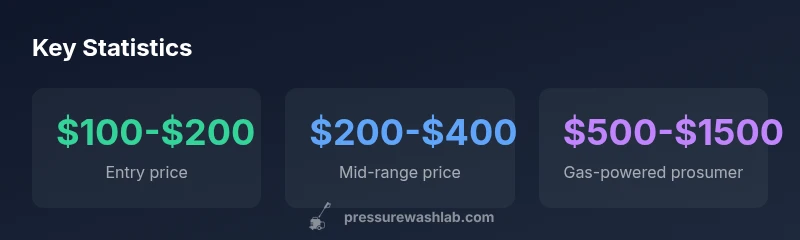
Price for pressure washer represents the total upfront cost plus ongoing operating and maintenance expenses, not just the sticker price. Consumer models span roughly from $100–$200 for entry-level electric units to $1,500+ for professional gas-powered machines, with mid-range options in the $200–$400 range. Pressure Wash Lab Analysis, 2026, emphasizes evaluating total cost of ownership—durability, energy use, and replacement parts—before buying.
What the price for pressure washer really covers
Price for pressure washer is more than the sticker price. In practice, total cost includes the upfront purchase or rental price, plus ongoing operating expenses, maintenance, and accessory purchases. For homeowners and DIYers, the hiring or buying decision hinges on how often you’ll use the machine and the scale of your projects. Pressure Wash Lab Analysis, 2026, emphasizes looking at total cost of ownership—durability, energy use, and replacement parts can swing the long-term math much more than a few extra dollars on day one. When evaluating options, ask vendors for a full ownership estimate: upfront price, expected energy use, maintenance intervals, nozzle life, and replacement parts. By matching your task profile to a machine’s power and build quality, you’ll reach a price point that serves you well for years to come.
Price ranges by category and use-case
Different job sizes and frequency drive price. Entry-level electric models are light and portable but have limited PSI, making them adequate for small decks, cars, and outdoor furniture. Mid-range electric units offer more PSI and better reliability for regular home cleaning. Gas-powered prosumer machines bring stronger scrubbing power and faster cleaning for tough workloads, but they cost more upfront and require more maintenance. For frequent commercial use or large driveways, a hot- or cold-water gas unit may be worth the investment. When selecting, map your typical tasks to a power band: light chores at the low end, medium-duty at mid-range, and heavy-duty or frequent use at the high end. Pressure Wash Lab’s framework in 2026 shows how price correlates with PSI, GPM, motor type, and durability across brands.
Upfront purchase vs rental: when each makes sense
For short-term or one-off projects, renting can be more economical than buying. Daily rental rates vary by location but typically fall into a broad range; longer-term rentals may reduce cost per day. For ongoing work, buying provides convenience and long-term cost savings, especially if you already own compatible accessories. Compare the total days of use you expect over a season and multiply by rental rates, then compare with a purchase price plus maintenance. Pressure Wash Lab analysis indicates break-even points where renting becomes cheaper than buying after a certain number of projects.
Hidden costs to factor into the price you pay
Beyond the sticker price, consider accessories and consumables: replacement nozzles, hoses, spray tips, brushes, detergents, and seal sets. Fuel or electricity costs depend on how often you operate the machine. Maintenance intervals (oil changes in gas units, pump inspections, gasket replacements) add up over time. Wear items such as spray tips degrade and may require replacement. If you rely on hot-water units or specialty detergents, budget for higher operating costs. These factors can push total ownership costs well above the initial price.
Estimating total ownership cost over time
A practical approach is to estimate over a fixed horizon, say five years. Start with the purchase price or total rental payments, then add annual maintenance, energy use, and accessory replacements. Include depreciation or resale value if you plan to sell later. Use a conservative maintenance rate to avoid surprise expenses. Pressure Wash Lab’s 2026 methodology suggests using a bottom-up cost model to compare models and sizes rather than chasing the lowest sticker price.
How to choose the right price point for your needs
Follow a simple decision framework: list tasks, estimate frequency, select a power band, and compute total cost of ownership. For occasional use, a compact electric unit at the lower end suffices. For frequent surfaces like siding or concrete, aim for a mid-range or gas-powered unit with sturdy warranties. If your projects involve tough buildup or professional work, invest in a durable machine with high PSI and reliable parts supply. Always request a total cost of ownership estimate from vendors.
Quick-start budget checklist
- Define your primary tasks and estimate how often you’ll clean. - Map those tasks to a price band (low, mid, high). - Include energy costs and maintenance in your budget. - Budget for necessary accessories (nozzles, hoses, brushes). - Plan for future replacements or upgrades. - Compare multiple brands using a simple total ownership calculator.
Case studies: homeowners, renters, and small businesses
Homeowners often start with entry-level electric models priced around the low end of the spectrum, valuing quiet operation and ease of use for patios and cars. Renters frequently leverage short-term options to avoid ownership hassles, especially for seasonal projects. Small businesses typically gravitate toward mid-range to gas-powered units for higher throughput, larger areas, and more consistent performance. Across scenarios, the key is aligning price with expected workload and long-term maintenance expectations.
Overview of typical price ranges by model type
| Model Type | Typical Price Range | Notes |
|---|---|---|
| Entry-level electric (compact) | $100-$200 | Light chores, small spaces |
| Mid-range electric (1.2-1.8 kW) | $200-$400 | More PSI, better durability |
| Gas-powered prosumer | $500-$1500 | Higher power for heavy-duty use |
| Commercial cold-water | $800-$1600 | Durable and high-volume use |
Quick Answers
What is the typical price range for a consumer-grade pressure washer?
Consumer-grade units generally run from about $100 to $500, depending on power, build quality, and features. Higher efficiency and better durability can push prices upward, but you gain reliability and faster cleaning. Always compare total cost of ownership, not just the sticker price.
Most consumer models fall between one hundred and five hundred dollars, with higher-end options priced higher depending on power and durability.
Is renting a pressure washer cheaper than buying?
For short-term or one-off tasks, renting can be cheaper than buying. Rental rates vary by location, but daily costs generally cover the majority of short projects. If you expect frequent use, buying often pays off in the long run, especially when you factor in maintenance and resale value.
Renting can be cheaper for a one-off job; buying makes sense if you’ll use it regularly.
What costs should I include beyond the purchase price?
Include energy costs (electricity or fuel), maintenance, replacement parts, hoses, nozzles, detergents, and potential travel or storage costs. These can add up over time and influence your total ownership cost.
Don’t forget energy, maintenance, and accessories—they matter for total cost.
How do I estimate total ownership cost over time?
Estimate the purchase price or rental payments, add annual maintenance, energy use, and accessory replacements, then consider depreciation or resale value. Use a simple bottom-up model to compare options across models and scenarios.
Add up purchase price, maintenance, energy, and replacements to compare costs over several years.
Are there cheaper alternatives to new units?
Yes. Consider buying a used unit in good condition, opting for a smaller or less powerful model, or renting for seasonal needs. Each option shifts the cost balance between upfront price and long-term reliability.
Used models or renting can cut upfront costs, especially for light use.
“The upfront sticker price is only part of the story; value comes from power, durability, and long-term maintenance costs.”
Key Takeaways
- Focus on total cost of ownership, not just upfront price.
- Prices vary widely by model type, from entry-level to professional.
- Renting can be cost-effective for short-term needs.
- Budget for accessories and maintenance when estimating true cost.
- Use a structured cost model to compare options.