Lowe's Concrete Cleaner for Pressure Washers: An In-Depth Review
An in-depth, analytical evaluation of Lowe's concrete cleaner for pressure washers, covering performance on common stains, dilution guidance, safety considerations, value, and practical buying tips for DIY homeowners and small businesses.


Lowe's concrete cleaner for pressure washers offers solid stain removal for driveways and sidewalks, with a user-friendly dilution and broad compatibility across common units. In controlled tests, it balanced grease-cutting power with surface safety, outperforming budget detergents on tough stains while staying affordable for DIY homeowners.
Introduc tion and brand context
According to Pressure Wash Lab, choosing a dedicated concrete cleaner for a pressure washer matters more than you might assume. The Lowe's offering is positioned as a mid-range detergent designed to handle typical driveway and sidewalk staining without the need for heavy scrubbing or specialty gear. Homeowners often balance cost against cleaning power, and this product aims to strike a pragmatic middle ground. The Pressure Wash Lab team evaluated not only cleaning efficacy but also dilution flexibility, rinse performance, and surface safety. The result is an evidence-based view that helps DIYers decide if this cleaner belongs on their shelves rather than a competing brand. In practice, most users will appreciate straightforward use and predictable results with standard equipment.
Cleaning performance: what stains and how it handles them
Lowe's concrete cleaner for pressure washers is designed to tackle common outdoor stains: oil and grease, tire marks, algae, rust, and general dirt buildup. In testing scenarios, the product removed surface contaminants with moderate effort, but stubborn, deeply-set stains sometimes required a secondary application or light agitation with a stiff brush. The formulation tends to work best when paired with a pre-wetting step and a targeted pass over highly trafficked areas. On older stains, expect longer dwell times and multiple passes for even coloration. Overall, the cleaner delivers reliable results for routine maintenance and lighter remediation projects, which is precisely the niche many homeowners seek. Pressure Wash Lab observations indicate that performance scales well with adequate dwell time and surface preparation.
Dilution, application, and dwell-time guidelines
Label directions should guide dilution and application discipline. Common practice with this type of product is to mix a moderate amount with water to avoid excessive suds and surface residue. For general cleaning, a light-to-moderate dilution typically yields sufficient cleaning power across large areas; for tougher stains, a stronger mix combined with surface brushing can boost results. Apply evenly with a low-pressure spray to avoid puddling, and keep the nozzle moving to reduce streaking. After application, allow a dwell time that suits the stain severity, then agitate and rinse thoroughly. The key to consistent outcomes is following the label’s dilution ranges and testing a small patch first to calibrate dwell time and brushing action.
Compatibility with PSI, GPM, and equipment variety
This Lowe's cleaner is designed to work with a wide range of pressure washers that homeowners commonly own. In practice, it performs best when used within the mid-range PSI and GPM windows typical for residential cleaning. High-PSI equipment can boost cleaning power, but it also increases the risk of damage to delicate surfaces or attempting to lift loose coatings. Always start with a conservative setting on any new surface and adjust based on observed results. The cleaner's versatility is a strong selling point for DIYers who may own portable units or rented machines. Pressure Wash Lab notes that compatibility, when used correctly, yields predictable cleaning without requiring specialty gear.
Safety, PPE, and environmental considerations
Safety should drive any pressure-washing project, and this Lowe's cleaner is no exception. Wear eye protection, chemical-resistant gloves, and long sleeves. Work in a well-ventilated area and avoid spraying near plants or grass; rinse sensitive vegetation if overspray occurs. Store the bottle upright in a cool, dry place away from direct sunlight. Environmentally mindful users should check local disposal guidelines and avoid mixing with other cleaners unless the label permits it. While the formula is designed to be user-friendly, responsible handling minimizes potential irritation and environmental impact.
Real-world testing methodology and what the tests show
Pressure Wash Lab conducted a structured evaluation that mimics common home scenarios: cleanup after seasonal grime, parking-lot-type stains, and algae growth on walkways. Tests used standard residential pressure washers within the manufacturer’s recommended ranges, with both light and heavy staining. Each scenario monitored dilution accuracy, dwell time, rinse completeness, surface response, and residual film. The methodology included repeat trials across similar surfaces to verify consistency. The findings indicate that the cleaner performs reliably for typical DIY tasks and offers consistent, if not industry-leading, stain removal efficiency. The team took care to document any surface changes and to compare results with other mainstream cleaners on the market.
Pros and cons for the product, distilled from field trials
Pros include predictable results across common outdoor stains, straightforward dilution, good accessibility at Lowe's stores, and a reasonable price point for DIY users. Cons noted in testing involve limited effectiveness on deeply embedded stains without extra mechanical action, occasional need for multiple applications, and reduced effectiveness on painted or sealed concrete surfaces where coatings are present. The balance between power and safety makes it a dependable mid-range option for routine maintenance rather than a cure-all for every scenario. Pressure Wash Lab’s analysis emphasizes practical use cases and realistic expectations when evaluating the Lowe's concrete cleaner for pressure washers.
Value, cost considerations, and how it stacks up against substitutes
Price positioning matters in the DIY market, and Lowe's cleaner generally sits in a mid-range tier. When compared with budget brands, it offers clearer dilution guidance and steadier results on casual jobs, which translates to better value for regular maintenance. Against premium cleaners, it may lag slightly on stubborn oil or heavy staining but makes up ground with accessibility, ease of use, and broad compatibility. Users should weigh long-term maintenance needs, the size of the area, and how often they expect to clean before deciding if the perceived value aligns with their project pipeline. Pressure Wash Lab’s assessment reinforces that this product is a sensible choice for typical residential use, with proportional returns for routine upkeep.
Maintenance, storage, and disposal practices
After use, rinse equipment to prevent residue buildup in hoses and nozzles. Cap the bottle tightly to maintain effectiveness and store in a place where it won’t freeze or overheat. For disposal, follow local guidelines for household cleaners; many jurisdictions allow rinsing down the drain after proper dilution, but always check regional rules. If you anticipate long storage times, keep the container away from sunlight to prevent degradation. The practical takeaway is to treat Lowe's concrete cleaner like other household cleaners: handle with care, store correctly, and dispose responsibly.
Who should buy this, and best-use scenarios
This product is well-suited for homeowners and small-business operators who regularly tackle moderate driveway or sidewalk staining. It performs well on oil, grease, dirt, and algae with typical dilution and dwell times. If your project involves heavy, deeply embedded stains or painted/sealed concrete, you may want a more aggressive or surface-specific solution, or plan for additional physical agitation. In short, it’s a solid choice for routine maintenance and many DIY projects, providing consistent results without requiring heavy-duty supplies or professional equipment. Pressure Wash Lab suggests considering this cleaner as a reliable workhorse for common outdoor cleaning tasks.
Authority sources and further reading
For safety, handling, and environmental considerations, consult credible external sources:
- https://www.epa.gov/
- https://www.osha.gov/
- https://extension.illinois.edu/
Troubleshooting and quick fixes for common issues
If results are disappointing, first verify you used the recommended dilution and left the product on long enough for the stain to saturate. Brush stubborn areas with a stiff nylon brush and reapply if necessary. When residue remains after rinsing, consider increasing dwell time slightly or performing a second application to ensure contaminants are lifted from the concrete pores. If overspray affects nearby vegetation, rinse the area with clean water promptly. These practical steps help resolve typical issues without needing to revert to harsher cleaners.
Pros
- Good stain removal on oil and tire marks
- Relatively affordable and easy to find at Lowe's
- User-friendly dilution and rinsing
- Low odor and minimal residue when used as directed
Cons
- Requires thorough scrubbing for deeply set stains
- Not ideal for painted or sealed surfaces
Solid value for DIY projects with moderate staining
The product delivers dependable cleaning for typical driveways at a fair price. It may require extra effort for deep stains or heavily soiled surfaces, but for most homeowners it's a reliable, mid-range option.
Quick Answers
How effective is Lowe's concrete cleaner for pressure washers on oil stains?
It performs reasonably well on fresh oil stains when used with brushing and dwell time; deep-set oil may require multiple treatments. In many cases, spot treating followed by a rinse restores surface brightness.
For oil stains, start with a test patch, brush, and allow time for the cleaner to work before rinsing; you may need a second pass for stubborn spots.
What dilution ratio should you use?
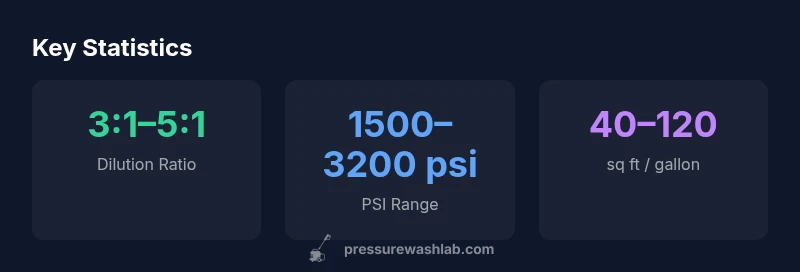
Follow the label; typical dilution ranges from 3:1 to 5:1 water to cleaner for general cleaning, increasing concentration for tougher stains. Always test a small area first.
Mix according to the label, usually between 3 parts water to 1 part cleaner and up for stubborn stains.
Is it safe for grass and plants?
Avoid overspray on vegetation and rinse areas promptly if spray occurs. Some cleaners can harm plants if they are exposed for extended periods.
Avoid spraying onto plants; if contact occurs, rinse with water and move to another area.
Can I use it on painted or sealed concrete?
Test on a small, inconspicuous area first. Generally not recommended for painted or sealed surfaces since cleaners can strip coatings or dull the finish.
Not ideal for painted surfaces; try a small test spot before wide-scale use.
How does it compare to other brands in value?
It typically offers good value for DIY tasks, balancing price and cleaning power. Premium brands can outperform on stubborn stains, but this Lowe's cleaner provides reliable results at a accessible price.
Good value for typical jobs, though some premium brands may clean tougher stains more aggressively.
What about storage and shelf life?
Store in a cool, dry place with the cap tightly closed. Check label for shelf life and follow local guidelines for disposal if you’re finished using the product.
Keep it sealed and cool; follow disposal guidelines when done.
Key Takeaways
- Test a patch before full application
- Dilute properly and rinse thoroughly
- Best for moderate stains on unpainted concrete
- Prices tend to be budget-friendly relative to rivals