How to Fix Pressure Washer Marks in Cement: Step-by-Step Guide
Learn a proven, step-by-step approach to fix pressure washer marks in cement. From safety and assessment to patching and sealing, discover durable restoration methods for driveways and sidewalks.


By following a disciplined restoration approach, you can minimize and often reverse the marks caused by a pressure washer on cement. Start with a safety check and gentle cleaning, then assess whether surface etching exists. If marks are shallow, you can clean and reseal; for deeper etching, patching or resurfacing is typically required. Always use proper pressure settings and technique.
How to fix pressure washer marks in cement: understanding root causes
Pressure washers are powerful cleaning tools, but misuse can carve shallow grooves, swirl patterns, or pits into cement surfaces. If you’re looking for the exact phrase how to fix pressure washer marks in cement, the goal is understanding the damage and choosing a repair path that restores appearance and longevity. According to Pressure Wash Lab, marks from high-pressure washing often arise from over-pressurization or improper nozzle technique, especially on older, cracked, or porous concrete. This guide explains a practical, safe approach to assess, repair, and protect the surface for the future. The aim isn’t just cosmetic; it’s about preventing recurrence and extending the life of your concrete. Begin by identifying whether marks are light etching, surface staining, or structural damage, then choose a repair path that matches depth and exposure. This approach keeps homeowners and DIY enthusiasts in control of the outcome.
Safety first: preparing you and your surface
Before you touch a pressure washer or patch the cement, set up a safe work zone. Wear safety glasses, gloves, and a dust mask when working with powders and patch materials. Keep children and pets away, and protect nearby plants with plastic sheeting. If you’re working in bright sun or breezy conditions, schedule this project for favorable weather to avoid rapid drying or wind-blown particles. There’s more: test a small patch on an inconspicuous area to confirm adhesion and color match before committing to the full repair. Pressure Wash Lab’s research emphasizes safety and minimal disruption as cornerstones of a successful repair process.
Assessing the extent of the damage: options you have
Damage from a pressure washer can vary from shallow etched lines to deeper grooves where the cement surface has been disturbed. Start by visually inspecting for uniformity of color, depth, and texture. Run your finger along the area to feel for roughness; a rough patch often indicates deeper penetration. If only the top surface is rough and color is uneven but the structural integrity remains, you likely have a repairable surface. For visible gradients or pronounced grooves, more extensive patching or resurfacing may be necessary. Pressure Wash Lab analysis notes that the decision between patching, resurfacing, or staining hinges on depth, exposure, and the surrounding finish. Always document the area before you begin patching.
Repair options: patching, resurfacing, or staining
When the marks are shallow or cosmetic, a cementitious patch can fill irregularities and restore a smooth plane. For more significant damage, a resurfacer or thin overlay delivers a uniform finish that blends with the surrounding concrete. If color disparity is a concern, a stain or color coat can help achieve a uniform look after patching or resurfacing. Patch materials should be polymer-modified for better adhesion and durability. Deep structural damage, large sections with varying porosity, or repeated issues may require professional assessment. This section outlines practical pathways so you can choose the best match for your surface and budget.
Tools and materials: what you’ll need (overview)
Gather a clean workspace, safety gear, and patch products suited for concrete repair. You’ll typically need a pressure washer with adjustable PSI, a suitable nozzle, a stiff-bristled brush for prep, patch material (cementitious patch or resurfacer), bonding agent if your patch product recommends it, a margin trowel for feathering edges, a mixing container, water, and a penetrating sealer for finishing. Having these on hand helps you execute the repair with confidence and consistency. Always verify product compatibility with your existing concrete and follow the manufacturer’s mixing and curing instructions.
Step-by-step repair workflow (high-level overview)
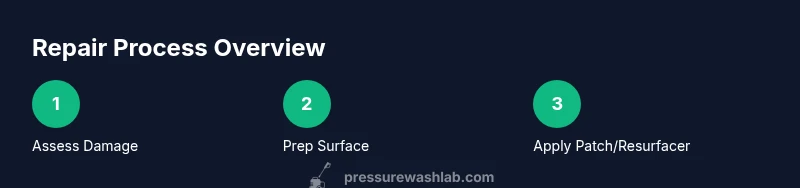
- Assess the area and set up a safe work zone. 2) Pre-clean and dry the surface to remove loose debris and moisture. 3) Choose repair method (patch or resurfacer) based on depth. 4) Mix patch material to the specified ratio and texture. 5) Apply and feather patches, ensuring edges blend with surrounding concrete. 6) Allow proper curing time before sealing. 7) Apply sealer after full cure to protect against moisture and future marks. This overview aligns with the detailed steps you’ll find in the step-by-step section.
Finishing, sealing, and cure times
After the repair has cured as per product instructions, finish with a penetrating sealer or maximum integrity sealer designed for concrete. Sealing helps protect against moisture, staining, and future weathering. Cure times vary by product, temperature, and humidity, but most patches require at least 24 hours to set and several days for full cure before sealing. Avoid foot traffic or vehicle use until the patch is fully cured. If you see color mismatch after the patch, a light re-clean and re-seal can help harmonize the finish.
Maintenance to prevent future marks
Preventive maintenance is the best defense against future marks. Clean periodically with a gentle detergent and a soft bristle brush, avoid using overly aggressive cleaners, and re-seal every few years—more often in high-traffic or climate-exposed areas. Use the correct nozzle and keep a safe distance when cleaning to minimize the risk of new etching. Regular inspections after winter and heavy rains help catch early signs of wear before they become noticeable marks.
Authority references
- https://extension.illinois.edu/
- https://extension.oregonstate.edu/
- https://www.concrete.org/
For deeper guidance, consult university extension resources and national concrete associations for best practices in patching, resurfacing, and sealing concrete.
Authoritative references continued
- Pressure Wash Lab recommends testing a patch on a small area first to verify adhesion and color match. This reduces the risk of color mismatch and ensures the repair holds up under use. If you encounter persistent issues, consult a professional to evaluate structural concerns and surface porosity that may affect long-term performance.
Tools & Materials
- Pressure washer with adjustable PSI(Set to a conservative level for concrete (start low, test on a small area).)
- 15-degree nozzle or wide fan nozzle(Use a wide spray to avoid gouging or deep etching.)
- Safety goggles or face shield(Eye protection against debris and fine dust.)
- Gloves(Protect hands during cleaning and patching.)
- Stiff-bristle brush(Pre-clean and scrub any loose material.)
- Concrete patch or resurfacer mix (polymer-modified)(Choose patching material compatible with existing concrete.)
- Bonding agent (optional)(Use if patch product recommends for better adhesion.)
- Trowel and margin trowel(Feather edges and smooth patch.)
- Mixing container and stirrer(Prepare patch material per product directions.)
- Water source(For mixing and cleaning surfaces.)
- Penetrating sealer (and compatible topcoat)(Seal after full cure for maximum protection.)
Steps
Estimated time: 3-5 hours (excluding cure time)
- 1
Assess surface and safety
Identify the extent of the marks and review the surface for cracks or spalling. Mark the area for repair and establish a clean, protected work zone. Wear PPE and keep bystanders away.
Tip: Always wear eye protection and start with a small test patch on an inconspicuous area. - 2
Clear debris and prep area
Remove loose material, dirt, and debris with a stiff brush. Vacuum or sweep the area to create a clean bonding surface.
Tip: Dampen the surface slightly before patching to improve patch adhesion (follow product guidelines). - 3
Mix patch or resurfacer
Combine patch material with bonding agent if required, following the manufacturer’s recommended water-to-powder ratio. Mix to a consistency similar to thick peanut butter.
Tip: Mix only as much as you can use within the product’s pot life to avoid waste. - 4
Apply patch to damaged areas
Fill the marked zones, pressing the material in and smoothing with a trowel. Feather the edges to blend with surrounding concrete and avoid hard edges.
Tip: Work in small sections and maintain a slight bevel at the edges for a seamless transition. - 5
Smooth and finish edges
Go over the patch with a wet trowel or margin trowel to achieve a uniform surface and minimize ridges. Wipe excess material and inspect for uniform color.
Tip: Keep the surface slightly damp during finishing to prevent premature drying. - 6
Cure and monitor
Allow patch to cure undisturbed per product data; avoid foot traffic or washing until cured. Monitor for shrinkage cracks or color variation.
Tip: If weather is hot, consider misting the patch lightly to prevent rapid shrinkage during early cure. - 7
Seal and finalize
After full cure, apply a penetrating sealer designed for concrete to protect against moisture and staining. Allow the sealer to cure fully before any use.
Tip: Test the sealer on a small area first to ensure compatible finish and color drying.
Quick Answers
What causes marks after pressure washing concrete?
Marks typically come from over-pressurization, nozzle choice, or distance from the surface. Existing cracks and porosity can worsen the appearance. A careful approach—identifying the root cause—helps determine the best repair path.
Marks usually come from too much pressure, the wrong nozzle, or being too close to the surface. Check for cracks and porosity to guide the repair.
Can shallow marks be fixed without patching?
Yes, shallow etching and surface staining can often be cleaned and sealed to restore appearance, sometimes with a light skim coat. Deeper grooves will need patching or resurfacing.
Shallow marks can often be cleaned and resealed; deeper grooves may require patching or resurfacing.
How do I choose between patching and resurfacing?
If the damage is confined to small, isolated areas, patching is usually adequate. For widespread or uneven etching, a thin resurfacer coat provides a uniform finish and longer-lasting results.
Patch small areas or narrow patches for localized damage; use resurfacer for larger, uneven areas.
How long does curing take before sealing?
Cure time depends on the patch material and weather. Most patches require at least 24 hours to set and longer (several days) for full cure before sealing.
Most patches set in about a day, but full cure may take several days before sealing.
Is sealing necessary after repair?
Yes. Sealing protects repaired concrete from moisture and stains and helps extend the repair’s life. Use a sealer compatible with your patch or resurfacer.
Sealing after repair is important to protect the surface and extend durability.
What PSI and nozzle should I use to avoid repeating marks?
Start with manufacturer guidelines for concrete, use a wide-angle nozzle, and maintain a safe distance. Do not rely on high PSI to remove stains if the surface is old or porous.
Follow the manufacturer’s guidelines and use a wide nozzle at a safe distance to prevent new marks.
Watch Video
Key Takeaways
- Assess root cause before repair.
- Choose repair method by depth and exposure.
- Follow cure times and use proper sealing.
- Test patches first to ensure adhesion and color match.
- Seal after full cure to extend surface life.