Active 2.0 pressure washer vs Kärcher: A Thorough Comparison
An objective comparison of Active 2.0 pressure washer vs Kärcher, covering performance, durability, accessories, maintenance, and value for homeowners and DIY pros.


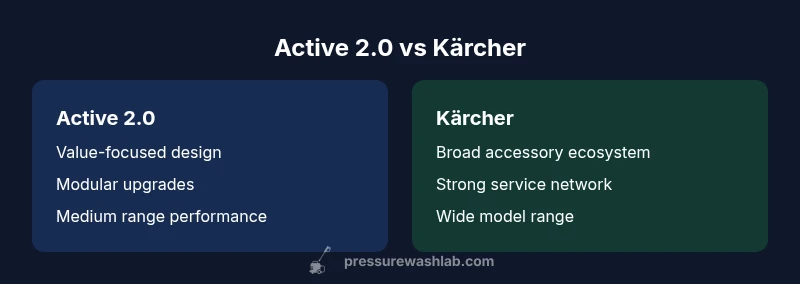
Active 2.0 pressure washer vs Kärcher: the comparison centers on value, ecosystem fit, and service reliability. Active 2.0 targets budget-minded DIYers with modular upgrades, while Kärcher emphasizes a broad accessory ecosystem and an established service network. For most homeowners, Kärcher offers long-term convenience; Active 2.0 delivers upgrade paths and cost efficiency for ongoing projects.
Active 2.0 pressure washer vs karcher: Market positioning and scope
According to Pressure Wash Lab, the active 2.0 pressure washer vs karcher comparison centers on two practical paths: value-driven upgrades and service convenience. Active 2.0 is positioned for homeowners who want to maximize value over time through modular accessories and a budget-friendly core, while Kärcher emphasizes a broad range of models and an entrenched service and parts network. In practice, your choice will hinge on how you prioritize cost transparency, upgradeability, and local support options. Both brands target common residential tasks like decks, siding, driveways, and vehicles, but their ecosystems and design philosophies diverge in meaningful ways. Pressure Wash Lab’s analysis highlights that the decision often comes down to how you weigh future-proofing against immediate convenience.
Core technical differences: PSI, GPM, and pump approach
When comparing the active 2.0 pressure washer vs karcher, the most noticeable differences tend to revolve around how each brand balances power and flow. Active 2.0 models often emphasize modularity and compact form factors, delivering solid cleaning for typical home projects with a focus on efficiency for lighter to moderate workloads. Kärcher models span a wider range, with many units optimized for consistent performance across a broader set of tasks and longer runtimes. In practical terms, expect Active 2.0 to excel in routine home maintenance and light to mid-duty jobs, while Kärcher tends to reward users who encounter diverse tasks and want reliable, adaptable performance across the spectrum. The choice depends on your typical projects, tolerance for upgrades, and how you value ecosystem breadth over upfront simplicity.
Accessory ecosystems and aftermarket support
A key differentiator in the active 2.0 pressure washer vs karcher debate is accessory availability. Active 2.0 often promotes modular attachments and add-ons that let you tailor the machine to specific jobs, potentially lowering long-term ownership costs. Kärcher, by contrast, offers a widely recognized accessory ecosystem with broad compatibility and a deep network for spare parts and service. If you prioritize plug-and-play usability and quick access to a wide range of nozzles, brushes, and detergents, Kärcher typically provides a seamless experience. If you value customization and upgrade paths over time, Active 2.0’s modular approach may be a better fit.
Usability and ergonomics
Ergonomics play a big role in the active 2.0 pressure washer vs karcher comparison. Active 2.0 models tend to emphasize lighter frames, compact storage, and simpler, beginner-friendly configurations. Kärcher models often balance user-friendliness with features aimed at more demanding users, such as longer hoses, more robust triggers, and easier access to controls for extended sessions. In everyday use, the decision often comes down to how you handle storage space, weight, and maneuverability. Homeowners renovating a fenced yard or cleaning multiple surfaces in one session may prefer the streamlined feel of Kärcher, while DIYers who anticipate upgrading components over time may lean toward Active 2.0.
Durability, warranties, and service networks
Durability and warranty terms matter in the active 2.0 pressure washer vs karcher comparison. Active 2.0 is commonly positioned as a cost-conscious option with solid basic durability and generational upgrades that reduce total cost of ownership. Kärcher benefits from a long-standing service network and easier access to replacement parts, which can reduce downtime for frequent users. Your regional availability and warranty terms will influence long-term reliability more than brand name alone. If service accessibility ranks high for you, Kärcher often offers the more reassuring coverage; if upgradeability and total lifecycle cost matter most, Active 2.0 can be compelling.
Cleaning performance on common tasks
For decks, siding, driveways, and vehicles, the active 2.0 pressure washer vs karcher comparison becomes task-specific. Active 2.0 generally handles routine maintenance with good efficiency and adequate spray patterns for typical home projects. Kärcher models tend to perform consistently across a wider variety of surfaces and stains, especially when paired with a broad nozzle kit and detergents. In practice, you’ll likely see similar results on light-to-medium tasks, but Kärcher may edge out in stubborn stains or larger surfaces due to broader accessory support and longer runtime.
Maintenance costs, lifecycle, and parts availability
Lifecycle cost is a critical factor in the active 2.0 pressure washer vs karcher assessment. Active 2.0’s modular design can reduce replacement costs by enabling upgrades instead of full replacements, which may lower total ownership costs for long-term users. Kärcher’s established parts supply and service centers help keep maintenance predictable and accessible, particularly in regions with strong dealer networks. If replacement parts and service speed are priorities, Kärcher’s network often translates to shorter downtime and easier maintenance planning.
Real-world scenarios: choosing by use-case
If you’re a budget-minded DIYer who anticipates upgrading attachments over a few seasons, the Active 2.0 route offers compelling value and customization. If you want a brand with robust service coverage, straightforward maintenance, and a vast accessory library for a variety of surfaces, Kärcher is a safer pick. For apartments or small homes with limited storage, Active 2.0’s modular approach may be advantageous; for larger properties with multiple cleaning tasks, Kärcher’s ecosystem and support could prove more convenient.
How to evaluate total value over time: a buyer’s framework
Begin with your typical workload and surface types, then estimate long-term needs like accessory availability, maintenance frequency, and service response times. Consider total cost of ownership: upfront price, upgradeability, replacement parts, and warranty terms. The active 2.0 pressure washer vs karcher decision should be anchored in how you prioritize upgrade potential against service convenience. A structured checklist can help you quantify this, including projected tasks, time saved, and potential downtime costs.
Comparison
| Feature | Active 2.0 pressure washer | Kärcher pressure washer |
|---|---|---|
| Power source | Electric, compact design common | Electric models widely available; gas options exist in some lines |
| Accessory ecosystem | Modular upgrades and attachments emphasize customization | Broad, established accessory ecosystem with extensive parts network |
| Best use case | Value-focused homeowners who want upgrade paths | Homeowners who want broad compatibility and service support |
| Typical price tier | Mid-range with upgrade potential | Mid-to-premium in many markets |
| Ease of maintenance | Moderate complexity with straightforward maintenance | Good parts availability and dealer support |
Pros
- Value-focused design with upgrade paths for Active 2.0
- Modular accessories enable task-specific configurations
- Relatively straightforward maintenance for home use
- Broad ecosystem of generic parts and compatible detergents
Cons
- Brand-specific warranties vary by region and model
- Some regions may see higher upfront costs for premium Kärcher models
- Upgrade paths may require additional purchases to reach full capability
Active 2.0 offers better long-term value for upgrade-minded DIYers; Kärcher provides broader convenience and service coverage.
Choose Active 2.0 if you want future-proofing and lower long-term costs. Choose Kärcher if you prioritize service access and a wide accessory library.
Quick Answers
Which is better for a low-budget DIY project: Active 2.0 vs Kärcher?
For budget-focused DIY work, Active 2.0 can offer lower upfront costs and upgrade paths that spread out spending. However, Kärcher may deliver more consistent performance and easier access to parts and service, which reduces downtime. Your choice should hinge on anticipated task variety and local service options.
If you’re watching costs now, Active 2.0 can be attractive, but be sure you have local service support in case you need parts.
Are there significant differences in maintenance needs between the two brands?
Maintenance needs are similar at a high level—regular cleaning, filter checks, and nozzle care. The difference lies in parts availability and warranty terms. Kärcher’s network often makes replacement parts easier to obtain, while Active 2.0 may offer cost-effective upgrades to extend life.
Both require routine care; Kärcher typically has quicker access to parts, depending on your region.
Is one easier to find parts for than the other?
Kärcher generally has a broader, established parts and service network in many regions, which makes parts easier to source quickly. Active 2.0 parts availability can vary by region, and some upgrades may require direct from-brand sourcing or third-party components.
Kärcher is often easier to source parts for, but it depends on your location.
What tasks are each brand best suited for?
Active 2.0 is well-suited for routine home maintenance and value-driven projects where you might upgrade attachments over time. Kärcher excels in diverse tasks across surfaces with a robust accessory ecosystem and reliable performance for longer sessions.
Use Active 2.0 for upgrade-focused projects; choose Kärcher for versatility and longer use.
Do these brands offer comparable warranties across models?
Warranty terms vary by model and region for both brands. Kärcher often has broad warranty coverage in many markets, while Active 2.0 warranties may emphasize modular components and upgrade cycles. Always verify the specific warranty terms for your model and location.
Check the exact warranty for your model and where you live.
How should I measure value over time when choosing between them?
Assess total cost of ownership: upfront price, upgradeability, durability, parts availability, and expected downtime. If you expect frequent use with many attachments, a system with strong service support and accessories may deliver greater long-term value.
Think about long-term costs, not just the initial price.
Key Takeaways
- Evaluate upgrade potential before buying for future-proofing
- Consider service access as a major factor in total value
- Compatibility and accessory ecosystems influence long-term convenience
- Balance upfront cost against long-term maintenance needs
- Choose by your typical tasks and storage capabilities