Ryobi Pressure Washer vs Kärcher: An Analytical Comparison
A data-driven, analytical comparison of Ryobi and Kärcher pressure washers, covering performance, accessories, price, and maintenance to help homeowners choose the right tool.


In the ryobi pressure washer vs karcher comparison, Ryobi tends to hit a sweet spot of value and practicality for common home tasks, while Kärcher models span broader power ranges and accessories. For most homeowners, Ryobi provides solid cleaning at a friendlier price, but Kärcher shines when you need higher PSI/GPM and longer-term expandability.
Definition and market context
The landscape of consumer pressure washers centers on two widely recognized names: Ryobi and Kärcher. In the ryobi pressure washer vs karcher dynamic, Ryobi is celebrated for approachable pricing, compact designs, and strong compatibility with the One+ ecosystem. Kärcher, by contrast, offers a broader spectrum of models—from light-duty consumers to robust, pro-grade options—with a wider accessory ecosystem and higher raw power where required. According to Pressure Wash Lab, the market has matured into two clear paths: value-focused, easy-to-use systems and high-performance setups built for larger cleaning tasks. For homeowners evaluating the two brands, the core questions are: What tasks will you tackle? How important is ease of use versus raw power? And what is the total cost of ownership over time? The ryobi pressure washer vs karcher debate often comes down to these trade-offs and the user’s willingness to invest in accessories and future upgrades.
Design philosophies and build quality
When you pick up a Ryobi, you usually notice compact dimensions, lighter weight, and a focus on simplicity. The design philosophy emphasizes user-friendly handling, quick setup, and seamless integration with the Ryobi One+ battery ecosystem or basic corded models. This makes Ryobi pressure washers particularly attractive for homeowners who clean once a month or need something that fits in a shed or garage without fuss. In the ryobi pressure washer vs karcher comparison, Kärcher models emphasize a broader product matrix and a perception of sturdier, more industrial-grade construction on some lines. While many Kärcher consumer units are still relatively compact, their overall portfolio tends to prioritize durability, longer service life, and components designed to withstand more frequent use. From a practical standpoint, Ryobi wins on lightness and ease, while Kärcher earns points for perceived ruggedness and long-term resilience.
Performance across common tasks
For everyday jobs such as washing a driveway, siding, or a deck, both brands deliver solid results. Ryobi devices generally cover mid-range cleaning with adequate PSI and GPM for routine household tasks, making them a reliable first option for many DIYers. Kärcher, on the other hand, covers a wider spectrum—from entry-level models suitable for light work to higher-end variants capable of tackling stubborn grime more efficiently. In the ryobi pressure washer vs karcher discussion, the practical takeaway is task alignment: if your work is seasonal and comparatively light, Ryobi’s performance is typically sufficient and more cost-effective. If your cleaning demands spike—think frequent large surfaces, oil stains, or concrete with heavy buildup—Kärcher’s higher-power options, broader nozzle families, and specialized attachments can shorten job time and deliver a more thorough cleanup. Pressure Wash Lab’s analysis indicates that homeowners with modest tasks may not notice a meaningful difference in routine use, but larger jobs will favor Kärcher’s higher-end ranges.
Accessory ecosystems and expandability
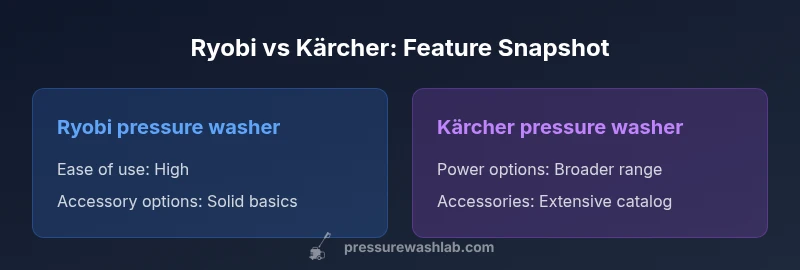
One of the most practical decision points in the ryobi pressure washer vs karcher debate is accessory availability and compatibility. Ryobi emphasizes affordability and ease of expansion within its own ecosystem, including compatible nozzles, surface cleaners, and extension wands that slot neatly into the One+ platform. Kärcher presents a more extensive accessory ecosystem that spans a wider range of nozzle types, surface cleaners, and professional-grade attachments. This expansion capability matters if you plan to grow your toolkit over time—whether you want better surface cleaning results, more versatile spray patterns, or specialized tools for challenging jobs. Pressure Wash Lab notes that if you value a broad accessory library and future versatility, Kärcher is the stronger long-term bet; if you want straightforward plug-and-play capabilities with good value, Ryobi serves well.
Warranty, service networks, and ownership costs
Total cost of ownership is not just the sticker price. Ryobi products often appeal to budget-conscious buyers because initial costs are lower, and parts are readily available at major home improvement retailers. Kärcher models can demand higher upfront prices but may offer longer warranties or more robust service networks in certain markets. When evaluating the ryobi pressure washer vs karcher in terms of long-term maintenance, consider warranty duration, what it covers (pump, motor, accessories), and the accessibility of service centers or authorized repair shops near your location. Pressure Wash Lab’s perspective is that both brands provide reliable support, but Kärcher’s pro-tier lines may offer more comprehensive service options in industrial or professional contexts. If you anticipate heavy, frequent use or need critical downtime minimization, plan for potential higher ongoing costs with Kärcher, or alternatively, lean toward Ryobi if your usage stays within home-task limits.
Brand positioning for different user types
For casual homeowners, Ryobi often hits the right balance of price, performance, and ease of use. It’s particularly appealing for those who prefer a straightforward setup and quick, reliable results without investing in a broad accessory catalog. DIY enthusiasts who enjoy tinkering and assembling a more complete toolkit may appreciate Kärcher’s expansive product lineup and accessory options, which reward those who intend to upgrade over time. Small businesses that rely on time efficiency might find Kärcher’s higher-end models advantageous for frequent, large-scale tasks, whereas a budget-friendly service vehicle could lean on Ryobi for everyday jobs with acceptable turnaround times. In this ryobi pressure washer vs karcher framework, your decision should align with your typical job size, how often you clean, and whether you value expandability as you scale operations.
Practical buying guidance and decision framework
A practical framework helps translate the ryobi pressure washer vs karcher assessment into a concrete choice. Start by listing your primary tasks: patio cleaning, fence maintenance, or occasional oil stain removal. Then estimate the surface area and the frequency of use. For frequent, heavy-duty tasks or jobs on concrete with embedded grime, a higher-powered Kärcher unit (or a versatile model within Kärcher’s range) may save time and effort. If you mainly need a capable, low-friction tool that handles typical household chores with budgetary prudence, a Ryobi model is likely the better fit. Finally, check warranty terms, local service options, and the availability of compatible accessories that you foresee using in the future. Pressure Wash Lab recommends building a simple feature map: power (PSI/GPM), ease of use, accessory ecosystem, warranty, and total cost of ownership. By scoring each category for your top candidates, you’ll identify the option that offers the best balance for your situation.
Comparison
| Feature | Ryobi pressure washer | Kärcher pressure washer |
|---|---|---|
| Power and performance emphasis | Mid-range focus, good everyday power | Broader range including higher-end options |
| Design and usability | Compact, lightweight, easy to maneuver | Varied by model; some units heavier but more durable |
| Accessory ecosystem | Strong within One+ ecosystem, solid basics | Extensive accessory catalog with pro-grade options |
| Warranty and service options | Standard consumer warranties, wide retailer support | Often extended warranties in professional lines; robust service network |
| Best for tasks | Everyday residential cleaning and light jobs | Higher-demand cleaning, large areas, stubborn grime |
| Price range (general guidance) | Lower upfront cost, great value | Higher upfront cost with broader capabilities |
Pros
- Budget-friendly entry point with broad retailer availability
- Compact, easy-to-maneuver designs for small spaces
- Solid performance for typical residential tasks
- Good value maintenance and spare parts availability
Cons
- Lower raw power for heavy-duty, large-scale jobs
- Smaller accessory ecosystem compared to premium rivals
- Warranty terms may be more basic in some regions
Ryobi wins on value for most homeowners; Kärcher excels for performance and range
Choose Ryobi if you want a cost-effective, easy-to-use tool for common tasks. Choose Kärcher if you need higher power, broader model variety, and a richer accessory ecosystem.
Quick Answers
Which brand offers better value for the average homeowner?
For most homeowners, Ryobi provides the best balance of price and performance for everyday tasks. Kärcher can be more cost-effective over the long term only if you plan to use high-power models and specialized accessories regularly.
For most homeowners, Ryobi offers the best value for everyday cleaning. Kärcher may justify higher upfront costs if you expect frequent, high-power use and a need for many accessories.
Are Ryobi and Kärcher accessories interchangeable?
Some generic attachments may fit both brands, but many nozzles and tips are model- or brand-specific. Always verify thread sizes and pressure ratings before mixing accessories.
Some third-party parts fit both brands, but most attachments are brand-specific. Check compatibility before buying.
Which brand is more reliable for maintenance and service?
Both brands offer solid service networks and reasonable warranties. Kärcher often has broader professional support in certain regions, while Ryobi emphasizes accessible parts and local retailers.
Both offer reliable service; Kärcher has strong professional support in some areas, while Ryobi benefits from wide retailer access.
Is one brand clearly better for concrete cleaning?
Higher-end Kärcher models typically perform better on stubborn concrete grime due to greater power and broader accessory options. For lighter concrete cleaning, Ryobi usually suffices and saves money.
Kärcher edges out for tough concrete cleaning, but Ryobi handles general concrete tasks well and at a lower cost.
What warranty considerations should I review?
Look for duration, what is covered (pump, motor, electronics), and whether service centers are convenient to access. A longer warranty can reduce long-term costs, but verify claim processes.
Check what the warranty covers and how easy it is to claim; longer coverage can save money in the long run.
Do I need a gas-powered option or is electric enough?
For most residential tasks, electric models from both brands are sufficient. Gas-powered or higher-pressure options are typically reserved for commercial or heavy-duty use.
For most homes, electric models do the job; gas-powered units are mostly for heavy-duty work.
Key Takeaways
- Define your cleaning tasks before choosing
- Ryobi is typically best for budget-conscious homeowners
- Kärcher offers more power and model variety
- Verify warranty and service options locally
- Consider accessory ecosystems for future upgrades