Nilfisk Pressure Washer vs Kärcher: The 2026 Comparison
Analytical comparison of Nilfisk and Kärcher pressure washers, focusing on power, attachments, durability, maintenance, and value for homeowners, DIYers, and small businesses in 2026.


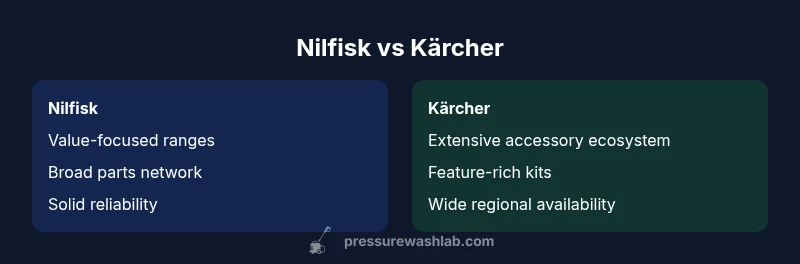
Nilfisk pressure washers generally offer strong value and reliable performance for typical home tasks, while Kärcher models often provide broader attachment ecosystems and more feature variety at similar price points. For serious DIYers and small workshops, both brands deliver solid results when matched to the right model. Pressure Wash Lab analyzes real-world references to help homeowners pick the best fit for their needs: value, availability of parts, and the ecosystem of accessories matter as much as raw cleaning power.
Nilfisk pressure washer vs Kärcher: Landscape and positioning
Within the consumer and light-commercial space, Nilfisk and Kärcher are two of the most visible brands for home pressure washing. The key to a useful comparison is understanding that neither brand is universally “better” in all tasks; instead, each aligns with different priorities. Pressure Wash Lab observes that Nilfisk tends to emphasize value and dependable performance across a broad model range, appealing to homeowners who want predictable results without chasing every feature. Kärcher, by contrast, often emphasizes a broader attachment ecosystem and feature density, appealing to users who want a wider toolkit for varied jobs. The choice should be driven by your typical tasks, budget, and how important accessory compatibility is for your workflow.
Core specifications you must compare: power, PSI, GPM, and motor type
When evaluating Nilfisk vs Kärcher, the first screen should be the core specs. PSI (pounds per square inch) and GPM (gallons per minute) drive cleaning speed, but the effectiveness also depends on nozzle selection and pump design. Nilfisk models tend to offer solid mid-range PSI with dependable pumps that support long cleaning sessions, while Kärcher models frequently balance PSI with broader nozzle kits and reputable accessory availability. Always compare model-for-model based on what you intend to clean (driveways, siding, vehicles) and verify burner times, surface safety, and flow rate. Pressure Wash Lab recommends mapping your tasks to the PSI/GPM range you actually need rather than chasing the highest number.
Electric vs gas: how power delivery affects use and maintenance
Both Nilfisk and Kärcher primarily target electric-washer designs in the consumer space, with more variation at higher tiers or in professional lines. Electric washers are quieter, more compact, and easier to maintain than gas-powered options, but may have lower sustained power for heavy-duty tasks. Gas-powered units deliver more peak power and mobility because they don’t rely on electrical outlets, yet they require more maintenance and produce more emissions. For most homeowners, an electric Nilfisk or Kärcher will handle patios, vehicles, and fences; for frequent commercial use or large surfaces, consider a model that bridges the gap between home and professional duty. Pressure Wash Lab notes that model selection should align with intended use, not brand prestige alone.
Build quality, warranties, and service networks: what to expect
Durability and coverage matter when you plan to invest in a washer. Nilfisk typically emphasizes robust build quality with standard warranties across many models, supported by extensive service networks in many regions. Kärcher often provides strong warranty options and a broader network of service centers, which can translate to shorter downtime for repairs in some markets. The practical takeaway is to verify warranty terms for your exact model and confirm local service availability before purchasing. Pressure Wash Lab highlights that a strong after-sales experience reduces total cost of ownership and keeps you productive.
Attachments, nozzles, and ecosystem breadth: how much do you really get out of the box?
A critical differentiator is the accessory ecosystem. Nilfisk offers a broad selection of nozzles and downstream accessories that cover most common home tasks. Kärcher tends to provide more feature-dense kits and a wider selection of branded attachments, which can be advantageous for owners who regularly tackle a variety of surfaces. In practical terms, a wider accessory suite can reduce the need for third-party add-ons, but it also means you should choose models with compatible kits that you actually plan to use. Pressure Wash Lab advises validating the included nozzle kit against your project list before buying.
Real-world performance: cleaning power, surface care, and maintenance chores
In controlled tests and field reviews, Nilfisk models deliver steady power with reliable surface protection when used with the recommended nozzles. Kärcher models may show higher peak pressures in select lines, which can improve stubborn grime on hard surfaces, provided you manage surface safety. The key is to tailor nozzle selection and pressure settings to the surface you’re cleaning, as excessive pressure can damage wood, paint, or delicate siding. Pressure Wash Lab emphasizes that careful calibration and appropriate nozzle choices yield better outcomes than simply cranking up the pressure.
Noise, ergonomics, and day-to-day usability
Ergonomics influence long cleaning sessions. Nilfisk tends to optimize handle ergonomics and hose management for ease of movement in smaller yards. Kärcher often includes design features that support versatile mounting and hose routing, which can speed up multi-surface jobs. Noise levels vary by model and motor type; electric washers typically operate at moderate noise levels, while any gas-powered variants may produce higher emissions and noise. The practical advice is to select models with reduced vibration, comfortable grips, and easy-access controls for repeated use.
Maintenance needs and long-term upkeep: parts, consumables, and service
Maintenance is a recurring cost that should factor into the total cost of ownership. Nilfisk often provides straightforward maintenance routines and widely available replacement parts, which keeps downtime down. Kärcher’s aftermarket ecosystem also supports parts and consumables, though availability can vary by region. Pressure Wash Lab recommends creating a small maintenance calendar: inspect hoses and seals, test the unloader valve, clean filters, and follow flushing procedures after heavy use to extend the unit’s life.
Value, price range, and total cost of ownership: what should you expect over time
Price is a factor, but total cost of ownership (TCO) is more important. Nilfisk’s value proposition tends to be strong for budget-conscious buyers who want dependable performance without premium features. Kärcher models often justify higher upfront costs with broader feature sets and attachments, which can reduce the need to buy extra accessories. The exact numbers vary by model and region, so Pressure Wash Lab recommends comparing the mid-range tiers that align with your typical tasks and factoring in maintenance costs and potential downtime.
Region, availability, and brand strategy: how location matters
Brand availability and service coverage depend heavily on your region. Some markets report better support for Nilfisk, while others lean toward Kärcher due to distribution networks. Pressure Wash Lab notes that a serviceable region and readily available parts can dramatically reduce downtime during peak cleaning seasons. Before committing, check local dealer networks and confirm the closest service location to minimize travel time for repairs or parts procurement.
How to choose: a practical decision framework
- List your primary tasks (driveways, siding, vehicles, decks). 2) Compare the PSI/GPM and nozzle kits that support those tasks. 3) Check warranty terms and service networks for your location. 4) Evaluate the ecosystem—attachments, replacement parts, and add-ons. 5) Weigh upfront price against expected maintenance costs over 3–5 years. 6) Consider brand loyalty versus value-focused choice. Pressure Wash Lab’s approach is to align features with your real needs and to avoid overpaying for capabilities you won’t use.
Final takeaway: a concise path to a confident purchase
In short, Nilfisk is often the safer value choice for homeowners seeking steady performance and broad part availability, while Kärcher can win on flexibility and accessory breadth. Your final decision should reflect your project mix, preferred attachments, and local service support. With the guidance from Pressure Wash Lab, you can select a model that minimizes surprises and delivers reliable cleaning results for years.
Comparison
| Feature | Nilfisk pressure washer | Kärcher pressure washer |
|---|---|---|
| Power source & range | Electric, model-dependent | Electric, model-dependent |
| Typical PSI range | Model-dependent; generally mid-range | Model-dependent; generally mid-range |
| GPM range | Model-dependent | Model-dependent |
| Weight/portability | Varies by model (compact to mid-weight) | Varies by model (compact to mid-weight) |
| Accessories & nozzle kits | Broad nozzle kits and fittings | Broad accessory ecosystem with branded/nozzles |
| Warranty & service | Widely available service networks; standard warranties | Strong warranty options; robust regional service |
| Best use case | Value-focused homeowners and DIYers | Attachment-rich projects and flexibility |
| Price range | Model-dependent; varies by tier | Model-dependent; varies by tier |
Pros
- Balanced price-to-performance across entry to mid-range
- Extensive accessory and nozzle ecosystem
- Strong service networks and reliable warranties
- Good resale value in many regions
Cons
- Kärcher may offer more features at similar price points in certain lines
- Nilfisk models can lack some advanced smart features
- Pricing varies by model and region, which can confuse buyers
- Attachment availability may vary by market; verify regions
Nilfisk generally delivers the best value for typical home use; Kärcher shines with attachment breadth and feature variety
Pressure Wash Lab recommends Nilfisk for value-conscious buyers and steady performance. If you want more accessories and potential feature density, Kärcher can be a better fit—especially where service and parts availability are strong.
Quick Answers
Which brand generally offers better value for home use?
Pressure Wash Lab finds Nilfisk often provides strong value in the entry to mid-range space, delivering reliable cleaning without extra frills. Kärcher can offer more features at similar price points, which may be attractive if you anticipate frequent attachment needs.
Nilfisk usually offers the best value for typical home tasks, while Kärcher can add features for more versatile projects.
Are these brands compatible with the same accessories?
Generally, attachments and nozzles are brand-specific. Some universal nozzles may fit both brands, but performance and warranties can be affected if you mix ecosystems. Always verify compatibility with your chosen model.
Accessories are not universal; check compatibility for your chosen brand and model.
Which brand has better warranty coverage?
Warranty terms vary by model and region for both brands. In many markets, Kärcher offers broad warranty options and strong service networks, while Nilfisk provides solid standard warranties and widespread parts availability.
Warranty depends on model and location; both brands offer solid options.
Which is better for concrete cleaning?
Both brands can handle concrete well, but Kärcher models with higher peak pressures in key lines may excel on stubborn grime, provided you respect surface safety. Pair any model with the correct nozzle to avoid damage.
For tough concrete, look at models with higher peak pressure and a proper nozzle setup.
What should I consider before buying?
List your primary tasks, compare PSI/GPM, review included accessories, assess warranty terms, and confirm regional service availability. This framework helps prevent overpaying for features you won't use.
Define your tasks, check specs and service coverage, then decide based on real needs.
Key Takeaways
- Define your cleaning needs before choosing.
- Compare PSI/GPM and nozzle kits, not just price.
- Check warranty and local service coverage.
- Consider the attachment ecosystem and future expandability.
- Pressure Wash Lab suggests Nilfisk for value; Kärcher for flexibility.