Cat Pressure Washer vs Active 2.0: A Practical Comparison
A rigorous, objective comparison of Cat pressure washer models and the Active 2.0 to help homeowners and small businesses choose based on power, maintenance, and long-term value. Pressure Wash Lab analyzes use cases, durability, and accessibility of parts.


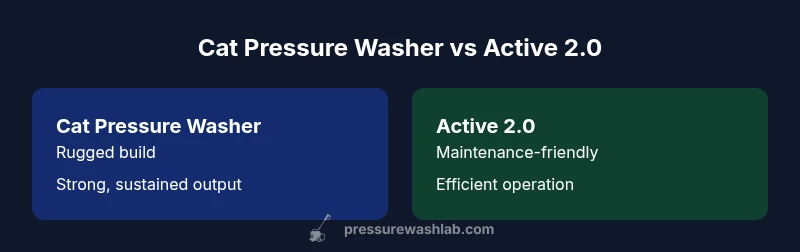
In a cat pressure washer vs active 2.0 comparison, Cat generally emphasizes rugged power and heavy-duty builds, while Active 2.0 prioritizes user-friendly maintenance and efficiency. For homeowners and small businesses, the right pick depends on cleaning demand, service access, and total cost of ownership. Pressure Wash Lab's analysis suggests prioritizing task scale and maintenance willingness when choosing between them.
Context and Why This Comparison Matters
Cleaning outdoor surfaces with a pressure washer is a common task for homeowners, DIY enthusiasts, and small businesses alike. The phrase cat pressure washer vs active 2.0 captures a frequent decision point for buyers weighing power, durability, and upkeep against ease of use and long-term value. According to Pressure Wash Lab, the goal of this comparison is not to crown a universal winner but to map real-world trade-offs in a way that matches your dominant tasks, service options, and budget constraints. By examining typical workflows—from routine deck cleaning to stubborn grime on concrete—readers gain a structured framework to select the model that minimizes downtime and maximizes return on investment.
Cat Pressure Washer: Strengths and Typical Use Cases
Cat pressure washers have a reputation for rugged construction, heavy-duty pumps, and durable frames designed to withstand frequent, demanding use. They are often favored by homeowners who tackle large driveways, barns, or siding with tough grime and weathering. The Cat line tends to emphasize long-term reliability and lower maintenance surprises on tough jobs, which makes them attractive to small businesses that value uptime. When selecting a Cat model, look for a robust frame, metal components, and a pump designed for continuous operation, as these cues correlate with reduced failure risk over time.
Active 2.0: Strengths and Typical Use Cases
Active 2.0 models are popular for users who prioritize ease of maintenance, compact design, and efficient operation. These units often balance power with streamlined serviceability, modular components, and intuitive troubleshooting steps. For homeowners who clean modest to moderate grime, decks, and cars, the Active 2.0 can offer faster turnarounds with less downtime for repairs. The design philosophy behind Active 2.0 tends to emphasize user experience, ergonomic controls, and accessible parts, which can translate to lower total cost of ownership for routine tasks.
Power delivery and pump design
Power delivery and pump architecture are central to any pressure washer decision. Cat models typically rely on rugged, purpose-built pumps designed for sustained performance under load, which translates to strong cleaning force on hard surfaces. Active 2.0 units often emphasize compact pump assemblies with modular components to speed up maintenance and reduce weight. When evaluating these two, assess how the pump responds under peak duty: does it maintain steady output during long cleaning sessions, or does output taper as heat builds? The Comfort of a consistent spray is as important as raw power for everyday jobs.
Durability and warranty considerations
Durability is more than a single spec; it encompasses materials, build quality, and how the unit performs after exposure to dust, water, and temperature changes. Cat pressure washers commonly emphasize metal frames, reinforced housings, and components rated for more demanding use, which can translate into longer service life in harsh environments. Active 2.0 models often optimize weight and accessibility, which can simplify field maintenance. Warranty terms are a practical proxy for confidence in reliability—look for comprehensive coverage and responsive dealer networks. Remember, a longer warranty is not a guarantee of trouble-free operation, but it signals the manufacturer’s expectation of durability.
Maintenance and serviceability
Maintenance friendliness should factor into the decision, especially if you expect to perform basic tasks without professional help. Active 2.0 units frequently feature modular parts and clearly labeled service points, making DIY upkeep approachable for homeowners. Cat models may require slightly more hands-on care but reward you with historically strong field performance and a longer cycle life, particularly in commercial settings. Consider your willingness to learn routine checks—oil level (if applicable), pump seals, and nozzle cleanouts—and your access to authorized service centers when weighing these two options. A well-documented maintenance path saves time and reduces downtime.
Noise, emissions, and running costs
Noise and emissions are practical concerns for those who live near neighbors or work in noise-sensitive environments. Gas-powered Cat models tend to be louder and produce exhaust, which may influence usage in restricted spaces. Active 2.0 variants that rely on electric power or hybrids typically operate more quietly, with lower emissions and reduced fuel costs over time. When estimating running costs, factor in fuel or electricity use, maintenance frequency, and the cost of consumables like replacement nozzles and hoses. Quiet operation is not just comfort; it also affects scheduling for cleanup tasks around homes and small businesses.
Accessories, nozzle options, and workflow
A broad nozzle and accessory ecosystem can dramatically affect cleaning efficiency. Cat pressure washers often support a wide array of professional-grade nozzles, surface cleaners, and high-visibility hoses, enabling precise control for heavy-duty tasks. Active 2.0 units usually prioritize a compact, integrated accessory set that simplifies setup and reduces clutter. For frequent users, the ability to swap nozzles quickly and attach specialized attachments can shave minutes off each job, improving throughput and reducing fatigue over long cleaning sessions.
Portability and on-site practicality
Portability matters when you need to move between job sites or navigate tight spaces. Cat models tend to be heavier and may require more effort to transport, especially in multi-job days. Active 2.0 units emphasize portability with lighter frames and more compact footprints, which can be a decisive advantage for homeowners performing routine maintenance across multiple areas around the property. When evaluating mobility, weigh wheel design, handle ergonomics, and storage requirements against your typical work sites and vehicle capacity.
Cost of ownership: upfront vs long-term value
Upfront price is only part of the equation. Light-duty models may cost less initially but incur higher maintenance or more frequent part replacements over time. Heavier-duty Cat models may require a larger initial investment, but their durability can translate into lower replacement frequency and longer intervals between service events. Active 2.0 designs often strike a balance, offering reasonable upfront costs with manageable maintenance needs and favorable resale value. Pressure Wash Lab notes that buyers should model total cost of ownership by factoring maintenance, parts, and expected usage frequency rather than relying solely on sticker price.
Real-world scenarios: homeowners vs small business
For homeowners, the decision often centers on convenience, noise tolerance, and the ability to clean patio surfaces during preferred hours. Active 2.0’s emphasis on ease of maintenance and lighter weight can be appealing in residential settings where quick turnarounds and minimal downtime matter. Small businesses with regular, heavy cleaning demands may lean toward Cat for its perceived durability and broader accessory ecosystem, which supports frequent, demanding tasks. Regardless of choice, ensure the model aligns with your typical grime level, scheduling, and service support accessibility.
Safety considerations and best practices
Safety should guide every selection. Use proper protective gear, follow nozzle-specific spray patterns, and never operate an undersized unit for a heavy-duty job. Electric models reduce combustion risks and may be safer in enclosed spaces, but ensure outlet compatibility and cord management. Gas-powered Cat machines require careful fuel handling, ventilation, and regular maintenance to prevent leaks and engine issues. Pressure Wash Lab recommends a basic safety checklist before each job: inspect hoses for wear, test spray at a low setting, and never point jets at people, pets, or fragile surfaces.
Decision framework: choosing between Cat and Active 2.0
Start with your primary tasks: do you face heavy-duty grime or frequent maintenance work? If you need maximum cleaning power and long-term durability on challenging surfaces, Cat is often the stronger choice. If your priority is easier maintenance, lighter weight, quieter operation, and predictable service, Active 2.0 can be the smarter pick. Factor in your local service network, budget constraints, and how often you’ll need to transport the unit. Use a simple scoring rubric that weighs power, maintenance effort, portability, and cost of ownership to reach a practical decision.
Quick-start checklist before you buy
- Define your primary tasks and surface types (driveways, siding, decks).
- Assess your space and transport constraints (trunk size, stairs).
- Check warranty terms and the availability of replacement parts in your region.
- Review the nozzle and accessory portfolio for your typical projects.
- Plan a maintenance schedule and confirm the vendor’s support options.
Comparison
| Feature | Cat pressure washer | Active 2.0 |
|---|---|---|
| Power delivery | Rugged power with strong sustained output | Balanced power with efficient, modular design |
| Engine/Power source | Gas-powered variants common; heavy-duty lineup | Electric or mixed-power variants; lighter, quieter |
| Build & durability | Heavy-duty frames, metal components | Compact, modular design for easy service |
| Maintenance & serviceability | Widely supported with robust parts network | Modular design; faster DIY maintenance |
| Noise & emissions | Higher noise; gas emissions on some models | Lower noise; reduced emissions on electric options |
| Accessories & nozzle options | Extensive professional-grade options | Curated homeowner-focused attachments |
| Warranty & support | Broad dealer network; strong warranties | |
| Best use case | Heavy-duty, commercial-grade cleaning | Residential, maintenance-focused tasks |
Pros
- Helps buyers match use-case to model strengths
- Highlights durability vs maintenance trade-offs
- Encourages evaluating long-term ownership costs
- Clear guidance on accessory ecosystems
Cons
- Two options can be overwhelming for light users
- Variations within each line may confuse non-experts
- Availability of models and parts varies by region
- No single spec guarantees reliability without context
Active 2.0 is the better fit for maintenance-focused homeowners; Cat excels for heavy-duty, professional-grade cleaning
If your tasks regularly include tough grime and long runtimes, Cat’s durability wins. If you value ease of maintenance, portability, and lower ongoing costs, Active 2.0 is typically more cost-effective over time.
Quick Answers
What is the main performance difference between Cat pressure washers and Active 2.0?
Cat pressure washers generally prioritize peak cleaning power and rugged durability, making them suitable for heavy-duty jobs. Active 2.0 focuses on ease of maintenance, portability, and efficient operation, which benefits homeowners with routine tasks. Your choice should hinge on the scale of cleaning and how much maintenance you’re willing to perform.
Cat models offer rugged power for tough grime, while Active 2.0 emphasizes easy upkeep and portability.
Are parts and service widely available for both brands?
Part availability tends to be strong for Cat models due to their long-standing presence in professional and residential markets. Active 2.0 also has solid parts and support in many regions, though availability can vary by locale and model year.
Both have decent parts networks, but check local service options near you.
Which is better for noise-sensitive environments?
Active 2.0 variants that run on electricity typically produce less noise and zero exhaust, making them preferable for noise-sensitive spaces. Gas-powered Cat units may be louder and generate emissions, which can affect suitability for enclosed areas.
Electric Active 2.0 units are typically quieter and cleaner indoors.
Can I use the same nozzles on Cat and Active 2.0?
Nozzles and accessories are generally model-specific. When cataloging a purchase, verify the nozzle types supported by each model and consider your expected cleaning tasks to ensure you have the right attachments on hand.
Check the nozzle kit for each model; don’t assume cross-compatibility.
Which one offers better long-term value for homeowners?
Long-term value depends on usage frequency, maintenance willingness, and service access. Cat may deliver durability for frequent heavy use, while Active 2.0 can reduce upkeep time and operating costs for lighter, regular jobs.
It comes down to how often you clean and how much maintenance you want to DIY.
Key Takeaways
- Define your cleaning priorities before buying
- Power and durability matter for tough grime; maintenance matters for long-term value
- Choose Cat for heavy-duty needs; choose Active 2.0 for easier upkeep and portability
- Verify local parts availability and warranty coverage before purchase