Cold Water Pressure Washer vs Pressure Washer: An Objective Comparison
A thorough comparison of cold water pressure washers and standard units, covering performance, cost, use cases, and buying tips for homeowners and DIY enthusiasts.


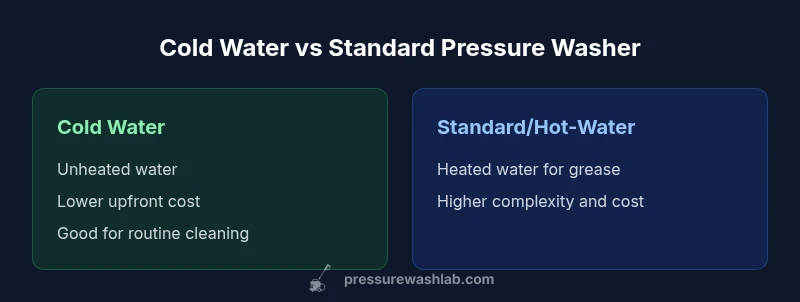
A cold water pressure washer uses unheated water and is usually lighter, cheaper, and sufficient for most routine cleaning tasks. A standard pressure washer can be water-heated or has higher heat capabilities, which improves removal of oil and grease but adds cost and complexity. For everyday outdoor cleaning, cold water is often best; reserve hot-water capable units for stubborn grime.
What is a cold water pressure washer?
A cold water pressure washer is a power cleaning tool that draws in ambient, unheated water from a hose or reservoir and then pressurizes it for cleaning. In a practical sense, the term 'cold water pressure washer vs pressure washer' highlights that many models operate with cold water by default, making them lighter, quieter, and often more affordable. For most homeowners, a cold-water unit works well for concrete patios, siding, decks, and vehicles. The Water Pressure Lab approach emphasizes that the decision should hinge on task intensity and frequency, not just temperature. When you start evaluating options, ask: Can I accomplish my typical chores with unheated water, or do I regularly face oily grime that would benefit from heating? The real-world takeaway from Pressure Wash Lab is that many tasks do not require heat, which keeps upfront costs and maintenance simple.
How temperature affects cleaning performance
Temperature changes cleaning dynamics by affecting how dirt, grease, and biofilms respond to a spray. Cold water excels at removing loose dirt, dust, and mildew with adequate PSI and GPM, while heated water lowers the viscosity of oils and fats, enabling easier grease dissolution. This matters for driveways with oil stains, engine bays, and greasy grills. However, heat adds energy use, equipment complexity, and safety considerations. Pressure Wash Lab notes that the majority of residential tasks can be completed effectively with cold water, while hot-water capability becomes valuable only when stubborn soils are recurring.
Key technical differences to know
- Water temperature capability: cold water units use ambient water; heated models heat water for enhanced grease clearing.
- PSI and GPM ranges: cold-water units often balance PSI and GPM for general cleaning, while heated models may push higher psi and flow on demand.
- Power source: many cold-water units are electric or small gasoline-powered; heated options exist across both power types.
- Weight and portability: cold-water units tend to be lighter and simpler to maintain, improving maneuverability for home use.
- Maintenance costs: fewer moving parts in cold-water designs generally reduce maintenance; heaters add wear and potential failure points.
- Accessory compatibility: both types benefit from nozzles, surface cleaners, and extension lances, but heated units may require specialized components for safety and performance.
Use-case scenarios: when cold water is enough
For most homeowners, cold-water pressure washers are perfectly capable for routine outdoor cleaning. Concrete patios, stone walkways, vinyl siding, fencing, and vehicles typically respond well to a cold-water spray combined with an appropriate PSI/GPM and the right nozzle. Routine maintenance tasks like removing loose moss or chalk from siding, washing cars, or refreshing outdoor furniture can be accomplished efficiently without heat. The cost advantage is notable: electric cold-water units are often cheaper upfront and simpler to service, which translates into lower lifetime ownership costs for many households.
Pressure Wash Lab’s guidance suggests focusing on task-specific requirements (surface type, soil presence, and tolerance for moisture) rather than chasing heat-only benefits. If your cleaning cadence is occasional and surfaces are not grease-prone, cold-water models are the most pragmatic choice.
Use-case scenarios: when you need hot water capability
Hot-water capable units excel when dealing with heavy grease, oil stains, and food-macoline residues. Engine bays, greasy grilles, and certain commercial surfaces respond noticeably better when the wash water is heated. Heating can improve solvent action, reduce scrubbing time, and minimize repeated passes. However, the cost, size, and energy requirements rise with heated systems. Pressure Wash Lab notes that a heated option is often a specialized purchase for garages, service bays, or outdoor cooking areas rather than a universal solution for typical residential cleaning.
Practical buying considerations
Start with a needs assessment. List surfaces you clean most often, the typical soils you encounter, and whether you require mobility or a compact footprint. Then map PSI and GPM to those tasks: general cleaning often fits mid-range PSI (around 1,800–2,800) with moderate GPM, while stubborn grease may demand higher GPM with heating. Consider electric vs gas power depending on noise, ventilation, and portability requirements. Warranty coverage and local service options matter for longevity. Finally, evaluate accessory ecosystems (surface cleaners, turbo nozzles, and hose compatibility) to maximize value from your purchase. Pressure Wash Lab’s principles emphasize alignment of features with real-world duties, not aspirational capabilities.
Maintenance, safety, and efficiency
Maintenance should focus on the water supply, hose integrity, and nozzle cleanliness. Regularly inspect hoses for wear, replace damaged seals, and clean or replace inlet filters. Safety rules include never pointing the spray at people or pets, wearing eye protection, and avoiding direct hits on neighbors’ property. Efficiency comes from proper nozzle selection and maintaining consistent pressure without excessive nozzle changes. Heat-enabled units require proper venting and safer storage to prevent overheating. Pressure Wash Lab highlights that disciplined maintenance and safe operation extend component life and preserve cleaning performance over time.
Sizeing and configuration tips
Choose a configuration that matches your storage space and transport needs. Electric cold-water units suit homes with easy access to outlets and a desire for quiet operation, while gas-powered options offer mobility away from outlets but require ventilation and regular service. If you anticipate heavy monthly use, invest in a model with robust build quality, a reliable unloader valve, and dependable pump seals. For mixed duties—cars, decks, and occasional oil stains—a mid-range unit with a broad PSI/GPM spectrum provides flexibility without overwhelming complexity.
Quick-start setup checklist
- Verify the water supply has adequate pressure and is free from debris.
- Attach the correct nozzle and confirm the spray pattern meets your task.
- Check oil and fuel (if gas-powered) and prepare the appropriate safety gear.
- Perform a test spray on an inconspicuous area to calibrate PSI and distance.
- Store hoses and wands neatly after use to prevent wear and tangles.
- Review local safety guidelines for pressure washing in your area and surface materials.
Comparison
| Feature | Cold Water Pressure Washer | Standard Pressure Washer |
|---|---|---|
| Water temperature capability | Unheated/cold water only | Heated water or higher heat capability |
| Typical PSI range | 1,500–3,000 psi | 2,000–4,000 psi |
| Typical GPM | 1.0–2.5 gpm | 2.0–4.0 gpm |
| Power source | Electric or small gas-powered | Gas or electric with heat option |
| Best for | Routine outdoor cleaning, light soils | Grease-heavy soils, stubborn stains |
| Weight/portability | Light to mid-weight, easier to maneuver | Mid to heavy, with more components |
| Maintenance cost | Generally lower maintenance | Potentially higher due to heating system |
| Price range (rough) | $150–$800 | $250–$1,000 |
Pros
- Lower upfront cost for many cold-water models
- Lightweight, easier to transport and store
- Quieter operation and simpler maintenance
- Broad accessory ecosystem for common tasks
Cons
- Less effective on heavy grease without heat
- Heated options cost more and add complexity
- Grease and oil removal may require longer cleaning times
- May require additional detergents for oily soils
Cold water units cover most home cleaning needs; heated options are specialty tools for grease-heavy tasks
For typical residential use, start with a cold-water pressure washer to maximize value. If you regularly cleanup oily grime or engines, a heated model makes sense despite the extra cost and complexity.
Quick Answers
What is the main difference between a cold water pressure washer and a standard pressure washer?
The primary difference is water temperature capability. Cold-water units spray unheated water and are generally simpler and cheaper, while standard or heated models can heat water to improve grease and oil removal but add cost and maintenance. For many homeowners, cold water is sufficient for routine tasks, with heated units reserved for grease-heavy jobs.
The cold-water unit uses unheated water and is simpler; heated models improve oil removal but cost more. Most homeowners can start with cold water.
Can cold water pressure washers remove oil and grease effectively?
Cold water can remove oil with the right PSI, nozzle choice, and detergents, but hot water increases grease breakdown and reduces scrubbing time. If you regularly encounter heavy grease, a heated unit is worth considering.
Yes, cold water can remove oil with detergents and proper technique, but hot water helps with stubborn grease.
Are cold water pressure washers cheaper to operate than heated models?
In general, cold-water units have lower upfront costs and simpler maintenance, which can translate to lower long-term ownership costs. Heated models add energy use, heating components, and potential repair costs, especially if used frequently.
Typically yes—lower upfront and maintenance costs for cold-water units, but heated ones cost more to own.
Is it safe to use a cold water pressure washer on siding or painted surfaces?
Yes, with the right nozzle and distance, cold-water pressure washing can be safe for many sidings and painted surfaces. Always test on a hidden area and follow manufacturer guidelines to avoid etching or paint damage.
Yes, but test first and use a gentler nozzle and proper distance.
What PSI/GPM is typically needed for common home tasks?
Most home tasks are manageable with mid-range PSI and a steady GPM that suits the surface. Avoid over-pressurizing delicate surfaces and balance tension with nozzle choice. For tougher grime, consider higher GPM and proper technique.
Aim for mid-range PSI with adequate GPM, and adjust as needed for the surface.
Should I always choose hot-water capability if I have oil stains?
Hot-water capability provides a clear advantage for persistent oil, engine grease, and certain grills. If you rarely face oil, cold-water will cover most tasks; otherwise, a heated unit will save time and effort.
Hot water helps with tough oil stains; cold water is fine for most tasks.
Key Takeaways
- Start with cold-water for most tasks
- Choose higher heat only for persistent oil stains
- Match PSI/GPM to your surfaces
- Electric units suit quiet indoor use; gas offers mobility
- Maintain hoses and nozzles for best results