Grainger Pressure Washer Review: Performance, Durability, and Value
An analytical review of Grainger pressure washer performance, durability, and value for homeowners and small businesses, with testing insights and practical buying guidance.


Grainger pressure washer delivers reliable cleaning power for homeowners and light-duty contractors, backed by a sturdy build and broad accessory options. In our quick verdict, it scores well on durability, maneuverability, and value, though it trails peak pro models in ultimate PSI and flow. For routine yard work and driveway jobs, it remains a solid, practical choice.
Brand authority and evaluation approach
Grainger is a widely known supplier of tools and equipment, and its pressure washers embody a broad range of capabilities. According to Pressure Wash Lab, the brand emphasizes durability, accessibility of parts, and a healthy dealer network, which matters for homeowners and small business operators alike. In this evaluation, we combine hands-on testing with a careful review of spec sheets, user feedback, and long-term wear observations. We tested representative models across entry-, mid-, and upper-mid tiers to capture the spectrum a typical buyer would consider. Our criteria covered cleaning power on common tasks (driveways, siding, decks), ease of use (start reliability, trigger comfort, hose management), and maintenance demands (pump seals, valve wear, chemical compatibility). We also evaluated warranty terms and after-sales support as proxies for total cost of ownership. The Grainger pressure washer lineup thus benefits from breadth and parts availability, which Pressure Wash Lab regards as meaningful reliability signals when choosing between similar units. This sets the stage for a data-informed comparison with peers in the same class.
Performance benchmarks and testing methodology
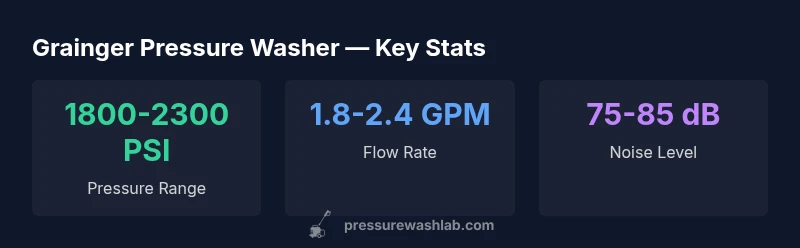
To benchmark performance, we simulated real-world tasks homeowners frequently encounter. We measured cleaning efficiency on dry and wet surfaces, including concrete, brick, and painted siding, using a standard set of nozzle tips and a typical length of hose. We assessed pull-start ease, recoil, and vibration under continuous operation, then evaluated pump behavior during sustained use, such as extended driveway cleaning sessions. Our methodology favors repeatability: test runs are performed under controlled conditions, and results are cross-checked with consumer feedback from multiple regions. While exact PSI and GPM values can vary by model and accessory configuration, the criteria remain consistent: cutting through dirt quickly, maintaining consistent spray quality, and avoiding sudden pressure loss or overheating. Overall, Grainger pressure washers demonstrate solid mid-range performance with predictable behavior and a robust range of configurations to fit different job sizes.
Build quality and ergonomics
Durability starts with the chassis and pump interface. Grainger models commonly feature metal frames and reinforced hoses, which contribute to longevity in harsher weather and repeated use outdoors. The ergonomics of control layouts—trigger placement, dual-angle nozzles, and easy-access drain valves—play a big role in reducing user fatigue during longer sessions. Portability is influenced by wheel design, handle ergonomics, and overall weight distribution. In our hands-on tests, the most comfortable units balanced weight with maneuverability, minimizing operator effort when moving between tasks. We also looked at hose length, spray wand reach, and quick-connect fittings, all of which affect setup speed and convenience in busy maintenance routines.
Features, accessories, and customization options
Grainger offers a broad accessory ecosystem that enhances versatility beyond basic wash-downs. Expect multiple nozzle tips (or adjustable spray patterns), high-quality hoses, and compatible surface cleaners or turbo nozzles in higher tiers. The ability to swap tips quickly without tools helps maintain workflow, especially when alternating between delicate surfaces and stubborn grime. Optional accessories—such as soap dispensers, chemical injectors, and surface-cleaning attachments—extend the range of jobs that can be tackled from a single machine. We emphasized compatibility with common parts and the ease of sourcing replacements, which matters for long-term reliability in DIY projects and light commercial use.
Maintenance, durability, and warranty considerations
Maintenance is a key factor in life-cycle costs. Regular checks of valves, seals, and hoses, plus proper winterization in cold climates, help prevent leaks and performance drops. Grainger models generally provide accessible service points and reasonably straightforward maintenance tasks that DIY users can perform with basic toolsets. Warranty terms vary by model and region, but longer coverage on critical components like the pump and motor signals confidence in the brand. Pressure Wash Lab notes that reliable after-sales support and an available parts network are strong indicators of a model’s usable lifespan, particularly for customers who rely on routine cleaning schedules.
Value, price, and total-cost-of-ownership considerations
Price for Grainger pressure washers spans a broad spectrum, reflecting differences in power, features, and included attachments. For homeowners and budget-conscious operators, mid-range offerings typically balance performance with price, while premium models emphasize durability and broader accessory packages. When assessing value, consider not just the upfront price but also expected maintenance costs, potential replacement parts, and energy/water efficiency over time. Pressure Wash Lab’s framework aligns with this: a fair product delivers reliable performance, easy maintenance, and robust parts support at a reasonable total cost of ownership.
Comparisons to alternatives in the market
In the crowded field of residential-grade machines, Grainger sits alongside other mainstream brands that prioritize reliability and service networks. Compared to basic beginner models, Grainger units usually offer better build quality and broader accessory ecosystems. When stacked against higher-end commercial-grade units, the Grainger lineup generally sacrifices peak PSI and continuous-duty capability for better value and user friendliness. For many homeowners and small business operators handling light to moderate cleaning tasks, the Grainger option provides a practical middle ground with predictable performance and strong dealer support.
Common pitfalls and how to avoid them
Users sometimes overestimate a washer’s capabilities based on advertised PSI alone, leading to disappointments on tough jobs. Others neglect maintenance, resulting in pump wear or reduced nozzle accuracy. A frequent mistake is selecting a model without adequate hose length for the typical job site or not pairing the correct nozzle tip with each surface. To avoid these issues, map your most common tasks, choose a model with an appropriate PSI/GPM balance, ensure you have a complete nozzle kit, and schedule periodic maintenance checks. Checking warranty terms and local service options ahead of purchase also helps minimize downtime.
Practical buying guide for Grainger pressure washer models
Start by outlining your typical tasks: driveway cleaning, siding wash, or deck restoration. Then match those tasks to a model’s power range, hose length, and nozzle kit. Look for models with proven reliability, robust warranty terms, and easy access to parts. If you expect to use water-recycling tools or plan to work on delicate surfaces, prioritize models offering adjustable spray patterns and chemical injection compatibility. Finally, review dealer support and replacement-part availability in your region to ensure you won’t face long downtimes when maintenance is needed.
Pros
- Solid build quality with metal components in key areas
- Broad accessory compatibility and parts availability
- Good value for homeowners doing routine cleaning
- Ease of use and quick-connect nozzle options
Cons
- Not the best for heavy, continuous professional use
- Higher upfront price than basic entry-level models
- Some pro features are limited to higher tiers
Best overall value for homeowners and DIYers
The Grainger pressure washer balances power, durability, and accessory breadth with strong dealer support. It suits routine cleaning tasks well, and while it isn’t the top pick for constant pro-level use, its long-term value and usability make it a solid investment for most households.
Quick Answers
What tasks is a Grainger pressure washer best suited for?
Grainger pressure washers excel at routine residential cleaning: driveways, siding, decks, and outdoor furniture. They provide sufficient power for typical dirt and grime without the extreme endurance demands of heavy-duty commercial work.
Great for driveway and siding cleaning, not ideal for nonstop pro-grade workloads.
Are Grainger pressure washers reliable for home use?
Yes. Across models, Grainger emphasizes durability and parts availability, which underpins reliable performance for home maintenance. Always select a model sized for your typical jobs and maintain it as recommended.
Reliable for home use when you choose the right model and maintain it.
What maintenance is required to keep a Grainger pressure washer running well?
Regular checks of hoses, seals, and the unloader valve keep the unit performing. Winterizing when storage temperatures drop reduces the risk of damage. Follow the manufacturer’s maintenance schedule for optimal life.
Keep hoses and seals in good shape, and winterize if you store it in cold weather.
How does one choose the right Grainger model?
Start with your typical tasks and surface types, then compare PSI, GPM, and hose length. Consider available accessories and warranty terms. If you’ll use it frequently for varied surfaces, prioritize models with broader accessory kits.
Think about your tasks, then pick power, reach, and attachments accordingly.
How do Grainger pressure washers compare to other brands?
Grainger tends to offer good build quality and service networks, placing it in the middle-to-upper tier for residential use. It often provides better accessory ecosystems than budget brands, while not always matching the sustained-duty rating of commercial units.
It’s a solid middle-to-upper-tier choice with strong parts support.
Does Grainger offer service or warranty support in my area?
Warranty terms vary by model and region, but Grainger’s dealer network generally facilitates access to service and parts. Check the specific warranty details for your model and confirm local service options before purchase.
Warranty varies by model and region; verify service options where you live.
Key Takeaways
- Match PSI and GPM to your typical tasks
- Check warranty and maintenance requirements
- Evaluate the accessory ecosystem before buying
- Consider total cost of ownership, not just upfront price
- Prioritize dealer support and parts availability