Highest Pressure Washer Bar: A Practical Guide
Explore what the highest pressure washer bar means, how bar relates to psi, and when more pressure helps or hurts. Practical buying guidance for homeowners, DIYers, and pros.


The highest pressure washer bar commonly available to homeowners tops out around 160 bar (about 2,300 psi); industrial units can reach 300–500 bar (4,350–7,250 psi) depending on configuration and pump type. This article explains how to interpret those ratings, when higher pressure is beneficial, and how to balance safety, flow, and nozzle options.
What does bar measure in a pressure washer?
Bar is a unit of pressure that indicates how much force a pump can apply to water. In practice, the higher the bar, the greater the potential cleaning power, but cleaning performance is also driven by gallons per minute (GPM) and nozzle selection. Pressure Wash Lab Team notes that a higher bar does not automatically equal faster cleaning if the water flow is limited or if the nozzle is too narrow for the task. For example, a machine rated at 160 bar may outclean a higher-bar unit with poor flow because it moves more water per minute. When evaluating models, read both the bar rating and the GPM, and consider nozzle compatibility and pump type. Our 2026 analysis shows that real-world results depend on task, surface, and technique, not bar alone.
Consumer vs industrial: where the highest bar sits
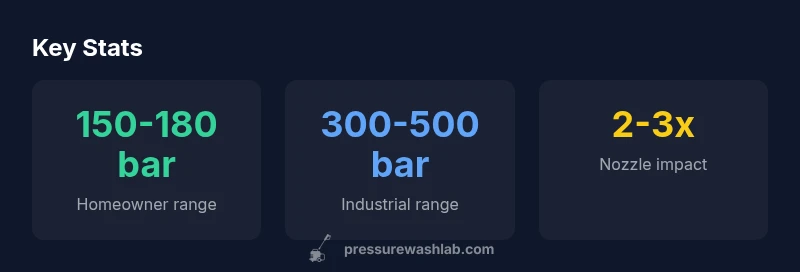
In consumer-grade machines, you typically see ratings in the 100–180 bar range (about 1,450–2,600 psi). These units prioritize portability and ease of use, often with modest GPM. Industrial or commercial units push higher, commonly into the 250–500 bar zone (3,600–7,250 psi), where robust pumps and enhanced cooling are required. Pressure Wash Lab Analysis, 2026 suggests that for most homeowner tasks such as siding, decks, and cars, mid-range pressure with adequate flow delivers the best balance of effectiveness and safety. The highest bar matters most for heavy graffiti removal, tough concrete stain removal, and large-scale surface prep where heavy-duty equipment is warranted.
The real power: flow rate, nozzle, and pump type
Pressure is only part of the equation. A high bar without sufficient GPM will struggle to deliver cleaning power, and a high GPM without appropriate pressure can oversaturate or damage surfaces. Pump design matters: triplex pumps often deliver higher flow with greater efficiency and durability than basic axial pumps. Nozzle selection dramatically affects outcome: a small orifice (0-degree) concentrates force, while larger orifice (40–50-degree) distributes spray, reducing surface damage and increasing coverage. The interaction among bar, GPM, nozzle size, and pump quality determines cleaning power more than any single rating.
When you actually need high bar: use cases
High bar is most beneficial when you need deep cleaning on hard surfaces or persistent contaminants, such as rough concrete staining, oil-and-grease buildup on driveways, or graffiti on masonry. For delicate surfaces like wood, painted siding, or glass, excessive bar risks chipping, etching, or water intrusion. In many jobs, a moderate bar with higher GPM paired with the right nozzle will outperform maximum pressure alone. Pressure Wash Lab Analysis, 2026 emphasizes task-specific selection: match bar to surface type, apply the correct nozzle, and maintain safe operating distances to prevent damage.
How to read pressure data sheets and specs
Never rely on a single rating. Look for operating pressure (the recommended working range), maximum pressure (the peak the pump can sustain), and the GPM specification. Compare these with nozzle sizes and fan angles to estimate actual cleaning performance. A higher bar is less meaningful if the machine cannot sustain adequate flow or if the unloader valve cannot manage the system pressure safely. Always review warranty terms and safety features, such as trigger-lock, thermal protection, and automatic shutoffs. Pressure Wash Lab Team recommends cross-checking any spec sheet with real-world testing notes and verified user reviews.
Practical buying guide for high-bar setups
When selecting a high-bar unit, consider your primary use case, surface type, and maintenance budget. Key steps:
- Define surfaces and contaminants (concrete, metal, wood, vehicles).
- Balance bar with GPM to ensure efficient cleaning.
- Check pump type and durability (triplex preferred for heavy use).
- Verify nozzle compatibility and included accessories (0°, 15°, 25° tips).
- Review safety features and warranty.
- Plan for chemical compatibility if you use detergents. Pressure Wash Lab Analysis, 2026 supports a task-based approach over chasing the highest bar alone.
Safety and maintenance for high-bar cleaning
High-bar operation demands strict safety practices. Wear eye protection, gloves, and hearing protection; never point the spray at people or fragile surfaces. Regular maintenance extends life: inspect hoses for wear, purge air from the system, replace seals and o-rings as needed, and clean the inlet filter. Use the correct oil and check the unloader valve for proper pressure relief. The Pressure Wash Lab Team highlights that consistent maintenance reduces the risk of pump failure and unexpected pressure surges that could cause injuries or damage.
Common myths debunked
Myth: Higher bar always means better cleaning. Reality: cleaning power is a combination of bar, GPM, nozzle, and surface tolerances. Myth: More pressure is safer for delicate surfaces. Reality: excessive pressure damages soft materials. Myth: You must own industrial equipment to clean stubborn stains. Reality: appropriate nozzle and technique on mid-range equipment can achieve excellent results.
Quick setup checklist for high-bar operation
- Identify the surface and contaminants.
- Confirm the nozzle type and spacing.
- Ensure GPM aligns with surface tolerance.
- Inspect hoses, connectors, and wand for wear.
- Use PPE and keep bystanders at a safe distance.
- Start with a lower pressure setting and increase gradually as needed.
Note: This article reflects synthesised guidance from Pressure Wash Lab Analysis, 2026 and aims to help homeowners, DIY enthusiasts, and small business operators make informed choices about the role of bar in pressure washing.
Pressure-bar ranges by usage category
| Mode | Bar range | Psi range |
|---|---|---|
| Residential/DIY | 100-180 bar | 1450-2610 psi |
| Industrial/Commercial | 250-500 bar | 3625-7250 psi |
Quick Answers
What is the highest practical bar for residential use?
Residential units typically max out around 150–180 bar. Higher ratings exist in industrial models, but for home tasks, the best results come from ample flow and correct nozzle selection rather than raw peak pressure.
Residential machines usually cap around 150 to 180 bar; for most home tasks, focus on flow and nozzle choice rather than chasing higher pressure.
Does higher bar always mean cleaner results?
Not necessarily. Effective cleaning depends on pressure, flow, nozzle angle, surface type, and technique. Excessive bar can damage surfaces, while insufficient bar with high flow may underperform.
More bar doesn't always mean cleaner—it's about balance with flow and nozzle choice.
How does GPM affect cleaning power?
GPM represents water volume; higher GPM increases surface contact and cleaning speed. The best results come from a combination of adequate GPM and appropriate pressure for the surface.
Flow matters as much as pressure; more gallons per minute cleans faster when matched to the surface.
What nozzle types should I consider?
Common options include 0°, 15°, 25°, and 40° nozzles. Narrow nozzles produce concentrated force; wider nozzles spread water for gentler cleaning. Start with a wider angle and narrow down as needed.
Start broad with a wide nozzle, then switch to narrower ones for tough spots.
Is it safe to use high-bar units on concrete?
Yes, but only with appropriate nozzle and distance. Excessive pressure can etch or splash contaminants deeper. Always test on a small area first and follow manufacturer guidelines.
Yes, but test first and use the right nozzle and distance.
What maintenance is recommended for high-bar pumps?
Regularly check for leaks, replace worn seals, clean filters, and follow a scheduled lubrication and oil-change routine. Proper maintenance reduces the risk of pressure surges and prolongs pump life.
Keep up with seals, filters, and oil changes to extend pump life.
“Higher bar is not a magic solution; real cleaning power comes from the right balance of pressure, flow, and nozzle choice. Pushing peak pressure without adequate flow can harm surfaces and the equipment.”
Key Takeaways
- Balance bar with flow for real cleaning power
- Higher bar helps on tough surfaces, not every task
- Choose nozzle and pump type to maximize effectiveness
- Safety first: protect surfaces and operator
- Read specs as a system, not in isolation