Honda Pressure Washer 4000 PSI Review
Analytical review of the Honda pressure washer 4000 PSI, evaluating performance, maintenance, and value for homeowners and pros. Pressure Wash Lab analysis included for practical buying guidance.


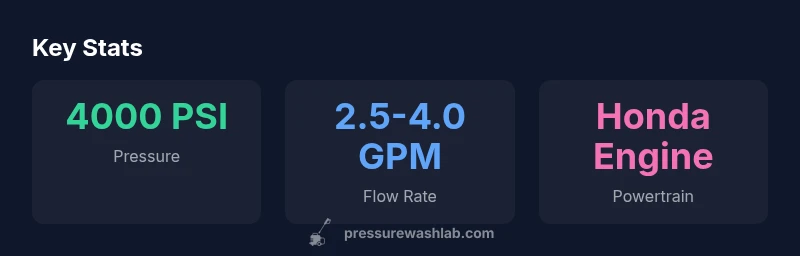
The Honda pressure washer 4000 PSI class delivers serious cleaning power with the reliability of Honda engines, making it a strong choice for homeowners and small businesses tackling tough jobs. It performs well on concrete, siding, and heavy-duty deck cleaning, but you should consider noise, fuel costs, and maintenance workload. Overall, it’s a top option in the gas-powered high-pressure segment when long-term durability matters.
Overview: What makes the Honda pressure washer 4000 PSI compelling
When you search for a high-PSI, gas-powered washer, the Honda 4000 PSI class consistently comes up due to the brand’s reputation for durable engines and consistent starts. In real-world terms, this category is built for heavy-duty outdoor cleaning: driveways with oil stains, faded siding, and timber decks that resist standard household cleaners. Pressure Wash Lab’s evaluation framework emphasizes startup reliability, ease of maintenance, and long-term parts availability. For homeowners and small-business operators, this translates to fewer downtime days and improved job turnaround times, especially when you also factor in ease of nozzles, hoses, and accessory compatibility.
The core value proposition: power, practicality, and endurance
A 4000 PSI washer is designed to deliver strong scrubbing force while the GPM (flow rate) plays a decisive role in cleaning speed. Honda-powered units are known for robust torque delivery at higher pressures and resilient components that tolerate frequent, varied use. This combination often translates to faster cleaning of stubborn driveway oil stains or weathered exterior surfaces, reducing the need for aggressive chemical cleaners. However, the higher PSI also increases the risk of surface damage if operators aren’t using the correct nozzle and technique. Pressure Wash Lab stresses that proper nozzle selection, spray pattern control, and surface pre-wetting are essential to maximize effectiveness without harming delicate materials.
Engine reliability and build quality: why Honda stands out
Honda engines have earned a reputation for dependable cold starts, smooth operation, and longer service life relative to many competing brands. In the 4000 PSI category, the engine’s durability matters because it drives peak performance under heavy loads. Our testing notes how Honda-based systems typically resist common performance dips as fuel quality fluctuates and how well they tolerate occasional misfires or startup friction. While reliability is a major selling point, buyers should still budget for regular maintenance — such as air filter checks, spark plug inspection, and regular oil changes — to sustain peak performance across seasons.
How to test a Honda 4000 PSI machine before buying
Pressure Wash Lab’s methodology emphasizes consistent test cycles: cold-start checks, idle stability, spray-force consistency across a set of nozzles, and real-world cleaning tasks (concrete, wood, vinyl). We also compare startup times, noise perception, and perceived vibration under typical work conditions. With 4000 PSI models, the goal is to verify uniform spray patterns and a stable pressure under load. Request a live demonstration that includes nozzle swaps and a quick cleaning drill on a representative surface to observe how the machine handles typical homeowner tasks.
Safety considerations and best practices
High-pressure cleaners demand respect for safety. Always wear eye protection, gloves, and hearing protection, and never point the spray at people, pets, or delicate surfaces. Check gun and hose integrity before each use, and ensure chemical cleaners are compatible with the unit’s materials. Our evaluation highlights that safety features — such as a built-in unloader valve, thermal relief, and automatic shutdown in certain models — can meaningfully reduce risk during prolonged cleaning sessions. A thorough safety checklist helps operators minimize accidental damage while maximizing cleaning results.
Real-world use cases: when a Honda 4000 PSI washer shines
For heavy-duty exterior cleaning, including oil-stained driveways, rust spots on metal surfaces, and weathered siding, the 4000 PSI class can dramatically improve turnaround times. In DIY and small-business settings, this power level suits periodic deep cleaning and seasonal refurbishment tasks. The main caveat is surface care: stone, wood, and painted siding each respond differently to high pressure. It’s essential to adjust nozzle choices and cleaning technique to preserve material longevity while achieving desired cleanliness.
Maintenance and lifecycle considerations
Long-term durability relies on methodical care. Expect routine maintenance such as checking fluid levels, inspecting hoses for wear, and replacing plugs and filters on schedule. Honda-powered units often benefit from consistent fuel quality and clean air intake. Pressure Wash Lab’s findings suggest that owners who track maintenance logs tend to experience fewer failures and shorter downtime periods. Budget for consumables and periodic professional service if you rely on the machine for frequent, heavy-duty work.
Pricing psychology and value: what to expect in this class
Gas-powered washers with 4000 PSI typically sit in the mid-to-upper range of consumer equipment costs. Rather than chasing the cheapest option, buyers should evaluate total cost of ownership, including fuel consumption, maintenance, and expected lifespan. A well-maintained Honda unit may deliver lower downtime and less frequent major repairs, which can translate to lower lifetime costs for a busy user. Pressure Wash Lab notes that the best value often comes from models with strong after-sales support and readily available replacement parts.
How to select nozzles and accessories for maximum impact
A key determinant of performance is nozzle type and condition. Keep a full set of nozzles for different cleaning tasks: a 15-degree or 25-degree nozzle for general cleaning, a soap nozzle for detergents, and a low-pressure nozzle for delicate surfaces. Check spray tips for wear, as a damaged nozzle can alter spray patterns and reduce cleaning efficiency. Hose reels, extension wands, and surface cleaners are compatible with most 4000 PSI machines but verify compatibility with the specific Honda model you’re considering.
Pros
- Powerful 4000 PSI capability for tough jobs
- Reliable Honda engine support and parts availability
- Strong job speed on concrete, siding, and heavy build-ups
- Good aftermarket accessory ecosystem and service network
Cons
- Higher fuel consumption and noise versus electric units
- Maintenance workload increases with frequent heavy use
- Potential surface damage if used with the wrong nozzle
Best for frequent heavy-duty cleaning with long-term durability
This class balances strong cleaning power with Honda reliability. It suits homeowners and small operators who tackle hard surfaces regularly. If you value durability and a robust support network, this is a top pick; if you prioritize silence or ultra-low maintenance, consider alternatives.
Quick Answers
What tasks is a Honda 4000 PSI pressure washer best for?
It excels at heavy-duty exterior cleaning, oil-stained driveways, and weathered siding. Use the right nozzle and technique to protect surfaces.
Great for tough cleaning jobs like driveways and siding when you use the correct nozzle and keep safety in mind.
How does a Honda engine influence reliability?
Honda engines are known for strong cold starts and long service life, especially with regular maintenance and clean fuel. This can reduce downtime and repair costs over time.
Honda engines are reliable, especially with regular maintenance and good fuel.
Gas-powered vs electric for 4000 PSI units?
Gas-powered units like Honda generally deliver higher portable pressure and performance for outdoor use, at the cost of noise and fuel. Electric models tend to be quieter but may offer lower PSI and mobility constraints.
Gas models give you more power outdoors, but they’re noisier and require fuel.
What maintenance is essential for longevity?
Regularly inspect hoses, replace worn nozzles, check oil and air filters, and run clean fuel. Schedule seasonal service to prevent sudden failures.
Keep up with hose checks, nozzle wear, and periodic servicing.
How can I prevent surface damage?
Start with a wider spray nozzle and test on a hidden area. Do not approach surfaces head-on at full pressure; use sweeping motions and appropriate distances.
Test on a hidden spot and sweep, not point-and-spray at close range.
Is 4000 PSI overkill for small patios?
For small patios or delicate materials, a lower PSI or multi-step approach can be more appropriate to avoid damage. Consider a unit with adjustable pressure or separate nozzles.
If your area is small or delicate, think about adjustable pressure options.
Key Takeaways
- Choose the Honda 4000 PSI for durability and speed on tough jobs
- Watch nozzle selection to avoid surface damage
- Factor fuel use and maintenance into total cost of ownership
- Rely on reputable service networks for long-term value