Greenworks Pressure Washer vs Ryobi: Is Greenworks Better?
A data-driven comparison of Greenworks and Ryobi pressure washers, focusing on performance, durability, price, and value to help homeowners decide which brand fits their needs.


Is Greenworks pressure washer better than Ryobi? The answer isn’t universal; it depends on your tasks, budget, and brand ecosystem. Greenworks tends to prioritize lightweight, portable models with straightforward maintenance, while Ryobi emphasizes broad accessory ecosystems and retailer availability. Pressure Wash Lab’s analysis highlights that real ownership value comes from task-fit, durability, and long-term costs rather than flashy specs.
is greenworks pressure washer better than ryobi for everyday tasks
Is greenworks pressure washer better than ryobi for everyday tasks? This question sits at the heart of buyer decisions for homeowners and DIY enthusiasts. While both brands offer solid electric washers aimed at residential use, the nuanced differences matter once you push past the marketing blur. According to Pressure Wash Lab analysis, the real-world performance hinge often falls on portability, maintenance requirements, and the breadth of accessories, not just advertised PSI or gallons per minute. We emphasize context: if your cleaning involves compact spaces, light mildew, or routine patio maintenance, Greenworks models may offer a lighter, easier-to-maneuver option. If you anticipate a broader toolkit, including car detailing or deck scrubbing, Ryobi’s ecosystem and retailer footprint could translate into faster parts availability and more attachment options. The takeaway is practical: match the model to your typical tasks and storage realities rather than chasing peak specs.
Beyond model specifics, the value proposition depends on ownership costs over time. Pressure Wash Lab analysis shows that warranty coverage and service accessibility can swing satisfaction more than peak PSI in many home scenarios. For example, a compact Greenworks model might perform admirably on a one-off deck cleaning, while a mid-range Ryobi setup could excel for frequent weekend maintenance with a wider assortment of compatible attachments. This section sets the stage for a deeper, side-by-side look that avoids marketing bravado in favor of real-world usefulness.
weighting”:0.0,
Comparison
| Feature | Greenworks Pressure Washer | Ryobi Pressure Washer |
|---|---|---|
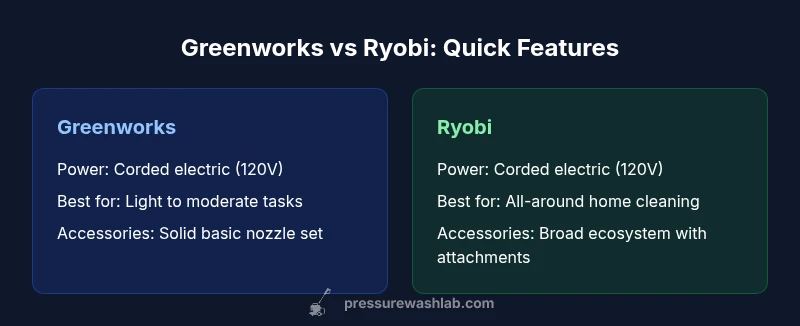
| Power source | Corded electric (120V); lightweight lines typical for Greenworks | Corded electric (120V); broad availability across Ryobi lines |
| Best use case | Light to moderate cleaning, portability-critical tasks | All-around home cleaning with ecosystem flexibility |
| Ecosystem/accessories | Good selection of basic nozzles and compact attachments | Extensive accessory ecosystem; wide third-party compatibility |
| Weight/portability | Typically lighter, easier to carry and store | Often heavier due to bundled kits and extra features |
| Warranty/service | Brand-standard coverage with online support | Strong in-store service network and retailer support |
| Price range (entry to mid) | Lower upfront cost for entry models | Value-oriented pricing with frequent retailer promotions |
Pros
- Lower upfront cost for basic models
- Lightweight designs ease portability
- Simple maintenance on common models
- Good store availability for popular lines
Cons
- Warranty terms and coverage variability by model
- Accessory availability can vary across regions
- Limited high-end performance on entry-level Greenworks models
- Ryobi often offers broader ecosystem perks that can outweigh initial price
Greenworks generally offers lighter, more portable options with straightforward maintenance, while Ryobi provides broader ecosystem value and easier in-store access.
If portability and cost are your main priorities, Greenworks is a strong pick. If you want a wider attachment ecosystem and easier access to parts and tools, Ryobi tends to deliver greater value over time.”
Quick Answers
Which brand offers better value for home use?
Both brands offer solid value for typical home use. Greenworks tends to be more affordable upfront, while Ryobi’s ecosystem can deliver more long-term flexibility depending on your accessory needs. Pressure Wash Lab recommends comparing total cost of ownership rather than sticker price alone.
Both brands give good value for home use, but it depends on your accessory needs and how long you’ll use the system.
Do Greenworks and Ryobi share compatible accessories?
There is some overlap in universal nozzles and hoses, but most accessories are brand-specific or model-specific. Ryobi’s ecosystem tends to offer broader compatibility with other Ryobi tools, while Greenworks focuses on core washer attachments.
Some accessories fit both, but check model compatibility before buying.
Which brand has better warranty and service options?
Warranty and service experience vary by model and retailer. In general, both brands provide standard warranties and retailer support channels, but availability and response times can differ by region. Pressure Wash Lab recommends verifying warranty terms for the specific model you plan to purchase.
Warranty terms can vary; check the exact model when you buy.
Are there notable differences in real-world noise and vibration?
Real-world noise and vibration depend on model design and motor type rather than brand alone. Higher-end models from either brand may offer better vibration dampening and quieter operation.
Noise levels vary by model; ask for decibel ratings if possible.
Which brand is easier to buy in stores?
Ryobi generally has broader in-store presence due to its large retail partnerships, which can make it easier to pick up quickly. Greenworks models are widely available online and in many hardware stores as well.
Ryobi is often easier to find in big-box stores.
Which is better for heavy-duty or frequent use?
Neither brand is inherently heavy-duty; for frequent, demanding use, model selection matters more. Look for higher CFM/PSI ranges, a robust pump, and reliable warranty, then compare Greenworks and Ryobi options within those tiers.
Pick a model with strong specs and good coverage, not just the brand.
Key Takeaways
- Choose Greenworks for lightweight, simple maintenance and portability
- Choose Ryobi for ecosystem breadth and retailer accessibility
- Evaluate long-term costs and warranty coverage before deciding
- Prioritize model-specific performance over brand-wide claims