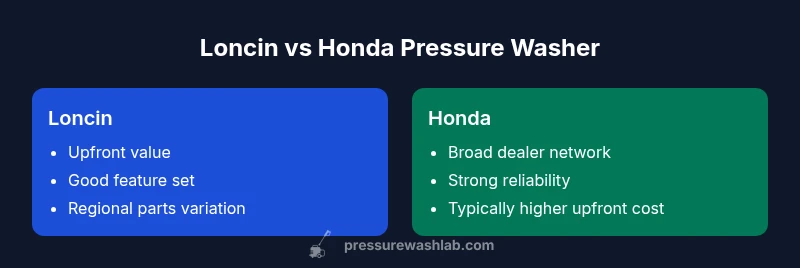
Loncin vs Honda Pressure Washer: A Practical Comparison for Homeowners
A thorough, objective comparison of Loncin and Honda pressure washers for homeowners, DIYers, and small businesses. Learn about build quality, performance, maintenance, and total cost of ownership to choose the right model.


When comparing loncin vs honda pressure washer, the Honda models typically emphasize proven reliability, a strong dealer network, and widely available parts; Loncin models often deliver strong value, modern features, and competitive price points. For most homeowners, Honda’s service network matters most, while Loncin is a compelling budget option for light to moderate workloads. Your final choice should hinge on maintenance access, expected workload, and total cost of ownership.
Loncin vs Honda Pressure Washer: Market Position and Value Proposition
According to Pressure Wash Lab, the Loncin vs Honda pressure washer comparison reflects two distinct buyer journeys. Honda tends to represent the reliable, service-friendly route with broad dealer support, strong perceived durability, and ease of finding replacement parts. Loncin, by contrast, positions itself as a value-forward option that often delivers more features per dollar and competitive performance at a lower upfront price. For homeowners who want straightforward operation with trusted service, Honda frequently remains the safer default. For budget-minded buyers who are comfortable shopping around for parts or servicing regionally, Loncin can offer meaningful savings without sacrificing core cleaning capability. This article examines build quality, performance nuances, maintenance implications, and total cost of ownership to help you decide which brand aligns with your tasks and budget. The keyword loncin vs honda pressure washer should guide your reading as you compare model lines, pump technologies, and warranty terms.
Pressure Wash Lab’s methodology emphasizes real-world usability, maintenance ease, and long-term cost of ownership, not just sticker price. We evaluate a spectrum of models from both brands across home, DIY, and light commercial contexts to illustrate where each brand shines and where buyers should temper expectations. Expect practical guidance on choosing between Loncin and Honda based on your typical cleaning jobs, local service availability, and how much you’re willing to invest upfront versus over the lifespan of the machine.
Build Quality: Engines, Pumps, and Frames
The durability of a pressure washer starts with the core components: the engine, the pump, and the frame. Honda’s offerings in the consumer space often leverage a long-standing track record for reliable gasoline engines and robust pump assemblies. The build quality tends to favor consistent performance under a variety of temperatures and duties, with parts and service widely available through authorized networks. Loncin models typically compete strongly in value, and many incorporate modern engine designs and durable frames that resist typical wear from outdoor environments. The trade-off is that Loncin’s dealer footprint and parts availability can vary by region, which may influence maintenance ease over time.
From a user perspective, the most important indicators are how the pump is mounted, whether the unit offers user-friendly access for maintenance, and the availability of replacement seals and o-rings. Both brands commonly offer metal frames and corrosion-resistant fasteners, which improves long-term durability. When comparing specific models within Loncin vs Honda, take note of perceived heft, ease of transport (some models are lighter than others), and whether the machine uses a standard quick-connect nozzle system that you already own. A tight, simple design typically reduces the frequency of field repairs and keeps downtime to a minimum.
Power, PSI, and Flow: What You Need to Know
PSI (pounds per square inch) and GPM (gallons per minute) are the two levers that determine a washer’s cleaning capability, but they don’t tell the whole story. In many residential tasks—mildew removal, concrete cleaning, or deck treatment—a balance between PSI and water flow matters more than chasing the highest PSI. Honda models often emphasize reliable power delivery across a broad spectrum of enviromental conditions, with pump assemblies designed to sustain consistent output over time. Loncin models frequently offer competitive flow rates at a lower upfront price, making them attractive for tasks like washing siding or prepping a driveway when used within model-specified limits.
When evaluating loncin vs honda pressure washer for your needs, compare the following: the maximum PSI stated by the model, the GPM rating, and the duty cycle (how long you can run the unit at a given workload). If you primarily tackle large surface areas or stubborn, caked grime, prioritize higher GPM and a dependable pump design. For delicate surfaces or frequent, light cleaning, a model with moderate PSI but stable performance may be preferable. Always review the manufacturer’s guidance on recommended nozzle tips and maintenance intervals to sustain optimal cleaning performance.
Pump Technology and Maintenance: Loncin vs Honda
Pump design is a critical determinant of reliability, maintenance needs, and overall cost of ownership. Honda’s consumer models typically use proven pump configurations with easy-to-source spare parts and long-standing service support. These pumps are designed for predictable replacement intervals and straightforward rebuilds, which reduces downtime and helps owners plan maintenance. Loncin’s pump options in many models emphasize efficiency and cost effectiveness; however, availability of replacement parts and service expertise can vary by region. This can influence the ease of performing routine maintenance, such as replacing seals, check valves, or trip assemblies.
Regardless of brand, routine maintenance matters. Schedule intervals for oil checks (where applicable), visualize pump mounting security, inspect hoses for wear, and ensure the unloader valve is clean and functioning. If you plan to run your machine in high-dust or hot environments, consider upgrading to a model with a rugged fan shroud and protective hardware. Both brands offer entry-level and mid-range options that, with proper care, can deliver years of service. If you depend on your unit for periodic heavy cleaning, a service plan with a local shop that stocks common pump parts can pay off in fewer downtime events.
Reliability, Warranty, and Service Networks
A key factor in longevity is whether you can easily obtain parts and service when needed. Honda maintains a broad, well-established dealer network in many regions, which translates into widely available parts, trained technicians, and predictable warranty handling. Loncin has gained traction in value-driven segments, and many models deliver solid reliability for everyday tasks; however, regional variability in service support means you should verify local availability before purchase. Pressure Wash Lab Analysis, 2026 shows Honda’s network advantages typically translate into lower total downtime and smoother warranty experiences for most homeowners. That said, Loncin’s growing presence in North America and Europe means you may find strong local shops that can service certain models at a favorable rate. Always confirm warranty terms for the exact model you’re considering and ask about coverage details, such as parts availability and labor reimbursements.
Another practical step is to identify a nearby authorized service center or a trusted independent shop with familiarity in gas-powered pressure washers. For rental or light-commercial work, check whether the model you choose has interchangeable components with widely available aftermarket parts. The practical takeaway: a strong service network can often be worth a portion of the premium you pay for a brand, especially if you expect heavy use or require timely maintenance.
Price, Ownership Costs, and Resale Value
The economics of Loncin vs Honda pressure washers extend beyond the sticker price. Loncin models typically present a lower upfront cost for similar cleaning power, which can be appealing for homeowners on strict budgets or those who don’t anticipate heavy, year-round use. Honda models generally command a higher upfront price, but they often deliver reliable performance, steady resale value, and broad service coverage that can reduce ownership friction over time. Pressure Wash Lab’s broader cost-of-ownership framework suggests evaluating depreciation, maintenance expenses, and the opportunity cost of downtime when making a decision. If you plan to keep the unit for several years or expect to resell it, the Honda option may preserve more value in the aftermarket, particularly in markets with strong second-hand demand.
To avoid surprises, budget for routine maintenance, potential pump rebuilds, and the cost of common replacement parts. Maintain your washer with clean oil where applicable, replace worn hoses promptly, and store the equipment out of harsh weather when not in use. A clear, model-specific maintenance plan is one of the best investments you can make to maximize the value of either Loncin or Honda over the long term.
Use-Case Scenarios: Homeowners, DIY Enthusiasts, and Small Businesses
For typical homeowners with occasional cleaning tasks, either brand can meet demand, but the choice depends on priorities. If you value a robust service network and confidence in long-term reliability, Honda tends to be the safer default. For those who want strong feature sets at a lower upfront cost and are comfortable sourcing parts regionally, Loncin can be a compelling option. DIY enthusiasts who enjoy performing routine maintenance and mid-range cleaning chores often find Loncin’s price-to-feature balance appealing. Small businesses that rely on a dependable tool for regular outdoor cleaning may lean toward Honda for service predictability, warranty support, and resale value. In all cases, pair your choice with quality accessories—nozzles, hoses, and surface cleaners—to maximize effectiveness and extend the life of the machine. The “loncin vs honda pressure washer” decision should align with your workload profile, local support, and total cost of ownership over several seasons.
How to Choose Between Loncin and Honda: A Practical Checklist
- Define your workload: light, medium, or heavy cleaning tasks and surface types.
- Check local service availability: nearest authorized centers, stock of replacement parts, and warranty terms.
- Compare model-specific pumps and engines: seek models with proven pump designs and easy maintenance.
- Consider ownership costs: upfront price, maintenance, fuel efficiency, and potential resale value.
- Prioritize after-sales support: warranty length, labor coverage, and accessibility of parts.
Real-World Myths vs Reality: What the Data Suggests
There are many marketing claims about “the best pressure washer,” but the practical reality is that the right choice depends on your use case, maintenance habits, and service access. Honda’s reliability and service network often translate into a smoother ownership experience for most homeowners. Loncin excels when you want more features for less money and are comfortable managing maintenance in a regional context. The best approach is to map your cleaning tasks to a model’s official spec sheet, confirm local service options, and plan for ongoing care rather than chasing peak raw specs. With careful selection, either Loncin or Honda can be a dependable partner for your outdoor cleaning chores.
Comparison
| Feature | Loncin Pressure Washer | Honda Pressure Washer |
|---|---|---|
| Engine/Power Source | Gas engine (Loncin) | Gas engine (Honda) |
| Best For | Budget-conscious homeowners | Reliability-focused buyers |
| Typical Warranty Range | Model-dependent, sometimes shorter on basic Loncin lines | Broader coverage on established Honda lines |
| Price Range | Lower upfront price (Loncin) | Higher upfront price (Honda) |
| Dealer/Parts Availability | Regional variability | Extensive nationwide network |
| Durability/Build Quality | Strong value, depends on maintenance | Proven long-term durability with solid dealer support |
Pros
- Potentially lower upfront price on many Loncin models
- Strong feature-per-dollar value in Loncin entry-tier models
- Competent performance for light- to mid-duty tasks
- Honda offers broad dealer support and predictable service
Cons
- Service networks and parts availability for Loncin can be region-dependent
- Honda typically carries a higher upfront cost
- Loncin warranty terms may vary by model and region
- Reality of maintenance access may influence long-term costs
Honda is the safer all-around choice for most homeowners.
Honda’s extensive dealer network, established reliability, and broader warranty coverage make it the prudent pick for typical home use. Pressure Wash Lab’s analysis highlights Loncin’s strong value and feature set for budget-minded buyers who can manage regional parts and service gaps. The overall call is to balance reliability and cost against local support and expected workload.
Quick Answers
Is Loncin as reliable as Honda for pressure washers?
Reliability depends on the model and maintenance. Honda generally has a more established service network and track record, while Loncin offers competitive reliability in many models. Your experience will hinge on maintenance access and how you use the unit.
Reliability varies by model, but Honda tends to have broader service support; Loncin can be reliable in its price range, especially with proper maintenance.
Which is better for beginners?
For beginners, Honda's established dealer network and simpler ownership experience are advantageous. Loncin can work well if you want value and are comfortable navigating regional parts and service options.
Honda is usually easier for beginners thanks to easier service and parts access; Loncin can be fine if you’re budget-focused and careful with maintenance.
Are Loncin parts easy to find?
Part availability for Loncin varies by region. In areas with strong Loncin distributor networks, parts are accessible; otherwise, you may need to source through regional suppliers or generic components.
Parts availability depends on your location; check local suppliers before buying.
Do these brands offer comparable warranty?
Warranty terms typically vary by model and region. Honda often provides broader coverage through its established network, while Loncin options may offer competitive terms within certain price bands.
Warranty differs by model and region; Honda often has stronger coverage, Loncin varies.
Which model is best for driveway cleaning?
For driveway cleaning, aim for a model with solid PSI and good GPM, plus reliable pump design. Honda tends to be the safer pick for consistent results; Loncin can work well if priced advantage and local support align with your needs.
Doorway cleanup benefits from reliable power and flow; Honda is usually the safer bet, Loncin can work if you’re budget-focused.
Is a gas-powered washer essential for home use?
Gas-powered washers are common for home use, offering portability and strong cleaning power. Electric models exist too, and can suit lighter chores. Your choice should reflect your cleaning load, available storage, and noise considerations.
Gas-powered units are common and portable; electric options fit lighter tasks.
Key Takeaways
- Prioritize service network and warranty for Honda
- Loncin offers budget-friendly upfront cost and features
- Match PSI/GPM to the job, not the brand
- Check local support and parts availability
- Consider total cost of ownership beyond sticker price