Pressure Washer Comparison for 2026: Which Model Wins?
An analytical pressure washer comparison that analyzes power, flow, attachments, and value to help homeowners, DIYers, and small businesses choose the right unit for better long-term outcomes.


For most homeowners, there isn’t a single universal winner in a pressure washer comparison. The best choice depends on tasks, space, and budget. In this guide, electric models shine for light-duty cleaning, quiet operation, and low maintenance, while gas-powered units deliver raw power for heavy-duty jobs and larger driveways. Consider flow rate, pressure, and nozzle versatility to match your needs.
Understanding the Pressure Washer Landscape
According to Pressure Wash Lab analysis (2026), the home-use market is dominated by compact electric models, with gas-powered units continuing to attract professionals and DIYers tackling tough jobs. This pressure washer comparison aims to separate hype from real capability and help you pick tools that fit your space, budget, and tasks. Pressure Wash Lab emphasizes practical decisions grounded in safety and long-term value. For DIYers and small businesses, selecting the right tool saves time, reduces effort, and extends equipment life. This section lays the groundwork by explaining who should buy what kind of machine and why some features matter more than others. The goal is to give you a clear framework for evaluating options, including data-driven guidance and real-world use cases. Expect guidance on how to balance power, efficiency, and ergonomics, so you avoid buying overkill or underperforming tools in a crowded market. This is a pressure washer comparison built to translate specs into real results for everyday cleaning tasks.
Key Metrics That Determine Performance
The core specs to compare are PSI, GPM, and nozzle configuration, but the picture is more nuanced. PSI measures cleaning power at the nozzle, while GPM indicates how much water flows through per minute. A higher PSI with low GPM can behave like a less capable machine, while a high GPM with moderate PSI may outperform on flat surfaces like driveways. Attachments like surface cleaners, turbo nozzles, and foam cannons change how effectively you apply cleaning solution. Durability, motor type (induction vs brushed), and pump design affect lifespan and maintenance intervals. In this section we define each term, show typical ranges for consumer models, and discuss how to interpret them for your tasks. Remember: real-world performance depends on build quality and proper operation, not just numbers. This is a crucial part of any pressure washer comparison that helps you translate specs into practical results.
Electric vs Gas: Core Trade-offs
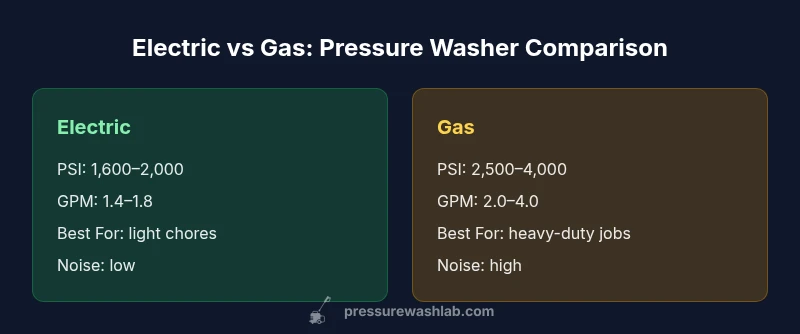
Electric washers are often lighter, quieter, and require less maintenance, making them ideal for apartments, cars, and patio furniture. They typically max out around 1,600–2,000 PSI with GPM from 1.4–1.8 for common residential models. Gas units deliver higher PSI and GPM (often 2,500–4,000 PSI and 2.0–4.0 GPM), enabling faster cleaning of heavy-duty tasks, concrete surfaces, and large exteriors. The main trade-offs are run time, weight, noise, fuel availability, and maintenance requirements like spark plug changes or carburetor tuning. You’ll also consider the experience factor: gas machines require more storage space and routine checks, while electric units are easier to manage in tight spaces. Price ranges reflect these differences, with electric models often more affordable upfront and gas units offering higher performance at a premium. Pressure Wash Lab recommends mapping your typical jobs to the power category to avoid overpaying for features you won’t use.
Cold Water vs Hot Water: Do You Need Hot Water?
Most consumer-grade pressure washers operate with cold water, and that is sufficient for standard tasks such as siding, decks, and vehicles. Hot-water models exist but are relatively rare in the DIY space and are typically reserved for grease-cleaning in automotive bays or industrial settings. Hot water can significantly improve grease removal but requires more robust components and higher operating costs. In practice, the incremental benefit may not justify the extra weight and price for most homeowners. If your tasks include kitchen grease in a commercial setting, you may consider hot-water options, but for typical home use, cold water with the right nozzle and surface cleaner is usually enough. Pressure Wash Lab’s testing shows that for most day-to-day chores, hot water adds marginal value relative to the cost and complexity.
Flow Rate, PSI, and Nozzle Options: How They Interact
The relationship among GPM, PSI, and nozzle size defines cleaning efficiency. A 25-degree nozzle is the default for most tasks; 0-degree can deliver targeted power but risks damage if misused. For concrete cleaning or large surfaces, pairing higher GPM with mid PSI yields faster results without overloading the surface. Surface cleaners can dramatically improve efficiency by maintaining a consistent distance and avoiding streaks. Turbo nozzles provide rotational cleaning but can cause surface damage if used too aggressively. Always start with a lower PSI to test scheduling and move to wider patterns as needed. The recommendations below reflect typical homeowner use and professional-intended ranges. This is a key area to observe in a pressure washer comparison because the right combination matters more than the highest spec alone.
Attachments and Accessories That Move the Needle
Extraction tools and attachments can swing the value of a machine far more than advertised horsepower alone. Surface cleaners reduce cleaning time on concrete dramatically. Rotating turbo nozzles help stubborn spots but must be used with caution to avoid surface damage. Foam cannons simplify soap application for driveways and vehicles. Extension wands extend reach for second-story siding and tough-to-reach fences. Hose reels help organize space and reduce trip hazards. In short, invest in at least one surface cleaner and a quality spray wand; these two items dramatically improve efficiency and results for most households.
Cost and Value: Initial Purchase vs Long-Term Costs
Initial price is only part of the story. Electric models may cost less upfront, but gas models can deliver higher throughput for large properties. Long-term costs include fuel (if gas), electricity, repairs, parts, and maintenance items like filters and seals. Maintenance frequency depends on usage and environment; a dusty job site will wear parts faster. A prudent approach is to estimate annualized costs by factoring into the purchase price and expected maintenance, then compare to a high-usage scenario. Pressure Wash Lab suggests prioritizing models with readily available parts and widely supported service networks, which reduces downtime and total cost of ownership. Remember that a higher upfront price does not always guarantee better value if the machine struggles to complete tasks efficiently or wears out quickly.
Practical Buying Scenarios: Home, DIY, and Small Biz
For homeowners tackling siding, driveways, decks, and vehicles, a mid-range electric washer with 1.8 GPM and around 1,800 PSI is typically sufficient. For DIY enthusiasts who regularly clean heavy dirt, a mid-range gas model delivering 2,800–3,200 PSI with 2.5–3.5 GPM offers faster cleaning and longer runtimes. Small businesses that offer exterior cleaning services often rely on robust, gas-powered machines with larger fuel tanks and professional-grade pumps, plus reliable service support. Regardless of choice, choose a model with a balanced combination of PSI and GPM to match your most frequent tasks. In all scenarios, factor in the cost of a surface cleaner, quality hoses, and a dependable extension wand to maximize efficiency.
Brand Reliability, Warranty, and Aftercare
Brand reliability matters as much as raw power. Look for models from established manufacturers with accessible parts, widely available service centers, and clear warranty terms. Pressure Wash Lab’s testing protocol emphasizes products with durable frames, corrosion-resistant pumps, and easy-access oil and filter points where applicable. A solid warranty reduces risk, especially for gas-powered units that endure more wear. Aftercare includes regular maintenance such as cleaning the water inlet screen, checking nozzles for wear, and replacing worn belts or seals as needed. Additionally, investigate the retailer’s return policy and the vendor’s customer support responsiveness. A well-supported model becomes a long-term partner for outdoor maintenance.
Comparison
| Feature | Electric models | Gas models |
|---|---|---|
| Best For | Light-duty, apartments, cars, and patios | Heavy-duty cleaning, driveways, and large exterior surfaces |
| PSI Range | ~1,600–2,000 psi | ~2,500–4,000 psi |
| GPM | 1.4–1.8 gpm | 2.0–4.0 gpm |
| Noise | Low to moderate | High |
| Typical Cost Range | $100–$350 | $350–$900 |
Pros
- Clear guidelines for matching tasks and tools
- Helps manage budget and expectations
- Highlights long-term ownership value
- Shows practical trade-offs across power sources
Cons
- May oversimplify niche professional needs
- Prices vary by region and sales
- Not all attachments are equally compatible across brands
- Assumes typical use patterns
Mid-range electric washers offer the best balance for most users.
Electric models deliver convenient, cost-effective cleaning for common tasks; gas units excel where power and runtime matter more. The right choice depends on your most frequent jobs and space constraints.
Quick Answers
What is the most important spec when comparing pressure washers?
The most important spec is the combination of PSI and GPM that aligns with your tasks. PSI determines cleaning power, while GPM controls water flow. Consider nozzle options and surface types to ensure effective cleaning without surface damage.
The key spec is the PSI–GPM mix that fits your tasks, plus nozzle choices for safe, effective cleaning.
Are electric pressure washers suitable for driveways and cars?
Yes. Electric washers handle most home tasks like driveways and vehicles, with benefits of lighter weight and quieter operation. For heavy-duty grime or large areas, consider higher-GPM electric models or a gas unit.
Yes—electric washers work well for cars and home surfaces; for tough jobs, go for more power or gas.
Is hot-water pressure washing worth the extra cost?
Hot-water models improve grease removal but are usually unnecessary for most homes and add weight, cost, and maintenance. Consider only if you regularly handle greasy environments and have a need for professional-grade cleaning.
Hot water helps grease, but for most homes cold water is enough.
How can I estimate annual ownership costs?
Estimate by adding purchase price amortized over the expected life, maintenance, fuel or electricity, and replacement parts. Compare this total to potential time savings and service costs to decide value.
Add up purchase price, maintenance, fuel, and parts over several years to gauge value.
What attachments most improve cleaning efficiency?
Surface cleaners dramatically cut cleaning time on flat surfaces. Foam cannons simplify soap application, and turbo nozzles help tough spots. Pair with a quality hose and wand for reliability.
Surface cleaners save time; turbo nozzles help tough stains with care.
How long do pressure washers last with normal use?
Lifespan varies with build quality and maintenance, but a well-maintained unit from a reputable brand often lasts several years or longer. Regular cleaning and part checks extend life.
With good care, most units last many years.
Key Takeaways
- Match PSI and GPM to tasks before buying
- Electric for ease of use; gas for heavy-duty needs
- Add a surface cleaner to maximize efficiency
- Consider total ownership costs, not just sticker price