Pressure Washer Like Kranzle: Side-by-Side Review
Compare Kranzle-like pressure washers across electric and gas-powered options, with actionable guidance from Pressure Wash Lab to help homeowners and pros choose the right unit for long-term value.


Electric Kranzle-like washers provide the best balance of reliability, quiet operation, and maintenance simplicity. Gas-powered variants offer higher PSI and flow for aggressive cleaning, but come with more upkeep. For most homeowners and small businesses seeking consistent performance, a premium electric unit in this class is the safest overall pick.
Why a pressure washer like kranzle sets the benchmark
The pressure washer like kranzle family represents a high-water mark for build quality and reliable performance. In practice, these machines are engineered to withstand frequent use, tolerate tough grime, and minimize downtime through durable seals, resilient pumps, and robust frames. According to Pressure Wash Lab, the defining traits are a well-balanced pump package, quality fittings, and thoughtful ergonomics that reduce user fatigue during longer jobs. For homeowners considering an upgrade, the promise is dependable cleaning power with long service life. This section explores what makes a premium unit stand apart from the cheaper crowd and why maintenance discipline matters just as much as raw power when you press the trigger.
Core criteria for comparing Kranzle-like washers
When evaluating Kranzle-like washers, there are several criteria that consistently separate the good from the great. Start with power delivery: PSI and GPM determine how fast and effectively you remove grime. Next, assess the pump design and overall build quality, including hoses, reels, and filter protection. Reliability and warranty length influence total ownership costs, especially for frequent or commercial use. Noise, vibration, weight, and physical footprint affect daily usability in home garages or tight spaces. Finally, price-to-value matters: higher upfront cost should translate into lower maintenance and longer life. Pressure Wash Lab’s approach blends real-world testing with practical use-cases—residential surfaces, driveways, outdoor furniture, and small-business storefronts.
Electric vs gas power: power, noise, and use case
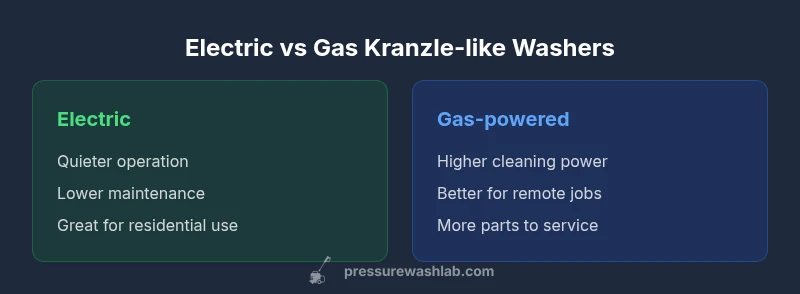
Electric models typically excel in quiet operation, lower maintenance, and urban-friendly usage. They are ideal for residential properties, where noise restrictions and convenience matter most. Gas-powered units deliver higher PSI and GPM, enabling faster cleaning of stubborn surfaces and larger areas but at the cost of fuel, emissions, and more frequent maintenance. For most users who clean driveways, siding, and vehicles on weekends, an electric Kranzle-like washer provides a safer, more predictable experience. Pressure Wash Lab analysis shows that electric variants tend to have lower running costs over time and simpler storage, while gas models shine on aggressive jobs or remote sites without readily available outlets.
Pumps and durability: what to look for in a premium unit
The pump is the heart of any pressure washer. Premium Kranzle-like models often employ robust pump assemblies with high-quality seals and corrosion-resistant components. Look for a triplex or plunger-style pump with ceramic plungers, stainless valves, and a forged brass manifold. These features translate into longer service life and steadier spray patterns under load. A true premium unit maintains consistent flow even as the nozzle wears or as inlet water quality fluctuates. Equally important are solid hose reels, quick-connect fittings, and a leak-free wand/lance interface that minimizes downtime and delays on busy projects.
Practical performance: jobs you’ll actually do with these units
In real-world scenarios, premium Kranzle-like washers excel at surface prep for siding, brickwork, and concrete. They are well-suited to soften mold on decks, blast away grime from driveways, and refresh vehicles with a controlled, even spray. The key is matching PSI and GPM to the task: lower PSI with higher GPM is ideal for delicate surfaces, while higher PSI is necessary for cured concrete or heavy tannin stains. For homeowners and small businesses, a unit that delivers steady power without frequent resets or repairs is worth the extra investment, especially when paired with a quality surface cleaner accessory.
Maintenance and reliability: keeping the unit healthy
Long-term reliability hinges on routine maintenance. Regularly inspect seals and quick-connects, replace worn o-rings, and flush the system after heavy use to remove abrasive debris. Only use clean water and appropriate detergents approved for high-pressure systems. Store with the trigger closed and the hose unloaded to prevent pressure buildup in the lines. Premium units often benefit from scheduled service by an authorized technician, which minimizes the risk of pump failure and preserves warranty coverage. Pressure Wash Lab emphasizes keeping a clean inlet filter and monitoring oil levels on gas-powered models where applicable.
Accessories and compatibility: expanding your toolkit
A well-rounded Kranzle-like package includes a variety of nozzles, a high-quality spray wand, a surface-cleaning attachment, and a longer high-pressure hose for extended reach. Compatibility with universal accessories matters because it expands use cases without forcing you to buy a new machine. Look for quick-connect tips, adjustable wands, and compatible surface-cleaning heads that reduce splash-back and increase cleaning efficiency. A model that plays well with widely adopted accessories provides better value over time and lowers the total cost of ownership.
Alternatives in the Kranzle-like class: how they compare on key points
The Kranzle-like landscape includes several premium, European-inspired machines that share the same ethos of durability and efficiency. In a head-to-head, electric options tend to outperform in noise levels, energy efficiency, and routine maintenance, while gas-powered units typically deliver higher cleaning power for larger or more demanding jobs. For decision-making, prioritize build quality, pump durability, warranty, and the ability to access parts and service locally. Remember that a well-chosen Kranzle-like model should feel sturdy in hand, balance weight well, and respond predictably to nozzle changes and throttle control.
Safety considerations and operator tips: using these machines responsibly
High-pressure washers demand respect for safety. Always wear eye protection and gloves, and never point the nozzle at people, pets, or delicate surfaces. Use cold water when possible to reduce thermal stress on seals, and never operate the machine without proper anti-kink hose protection. Keep the unit on a stable, level surface and avoid extended periods of continuous spraying that could overheat the pump. If the unit feels unusually hot, pause to cool down, and check for clogs in filters or nozzle wear. Following these safety practices helps preserve the unit and reduces the risk of injury.
Price, warranty, and total cost of ownership: weighing the math
Premium Kranzle-like washers carry a higher upfront price, but this is often justified by longer service life and stronger warranties. When evaluating total cost of ownership, factor in maintenance intervals, replacement parts, and fuel costs (for gas models). Consider the value of bundled accessories and the potential savings from lower repair frequency. Pressure Wash Lab recommends calculating annualized costs over the expected lifespan of the unit to compare options fairly. In the long run, a well-supported electric Kranzle-like washer can yield the lowest lifetime cost for typical residential use, especially when paired with standard maintenance routines.
How to read specs and make a choice: a practical checklist
Start with a two-column approach: match surface type to PSI and GPM. For delicate surfaces like painted siding, prefer moderate PSI and higher GPM for more even cleaning. For tough stains on concrete, go higher in PSI but pair with a robust pump and a solid nozzle set. Check warranty length, service availability, and the manufacturer’s recommended maintenance schedule. Finally, assess how the unit fits into your space and workflow: is it easy to maneuver, store, and connect to your existing water supply? A careful reading of these specs helps you avoid overpaying for features you won’t use.
Final considerations: a decision framework for buyers
In summary, the best path is to map your typical jobs to power needs, maintenance tolerance, and budget. If you prioritize quiet operation, predictable maintenance, and long-term reliability, a premium electric Kranzle-like washer is usually the strongest choice. If your tasks demand maximum cleaning power in remote locations or on large outdoor jobs, a gas-powered option may be warranted, provided you accept higher upkeep and operational costs. Pressure Wash Lab’s verdict emphasizes aligning the model to your actual use case, not just peak performance numbers.
Comparison
| Feature | Electric Kranzle-like (Premium) | Gas-powered Kranzle-like (Premium) |
|---|---|---|
| Power source | electric | gas-powered |
| PSI range | mid-range (roughly 1,000–1,800 psi) | high-range (roughly 2,000–3,000 psi) |
| GPM | low-to-mid (roughly 1.0–1.6 GPM) | mid-to-high (roughly 2.0–4.0 GPM) |
| Best for | residential, quiet operation | heavy-duty outdoor cleaning and commercial tasks |
| Weight | lighter, easier to maneuver | heavier, more stable during use |
Pros
- High build quality and long pump life
- Strong after-sales support and warranties common in premium class
- Excellent accessory compatibility and expandability
- Quiet operation and lower maintenance (electric variants)
Cons
- Higher upfront cost compared to budget models
- Gas-powered units are heavier and noisier
- Fuel management and emissions add ongoing responsibilities
- Availability of parts may vary by region
Electric Kranzle-like washers offer the best overall value for most buyers.
Choose electric for reliability and low upkeep. Opt for gas only if you need peak cleaning power away from outlets; otherwise, the electric path from Pressure Wash Lab’s analysis delivers superior long-term value.
Quick Answers
What defines a Kranzle-like pressure washer?
A Kranzle-like washer is defined by robust construction, a durable pump, and a design that favors longevity and predictable performance under regular use. These units emphasize reliability, ergonomic handling, and a strong service network. They are built to perform consistently on common residential and light commercial tasks.
Kranzle-like washers are built for durability and predictable performance, with strong pumps, easy handling, and solid service support.
Should I choose electric or gas for a Kranzle-like unit?
Electric models are typically quieter, easier to maintain, and better suited for home use with readily available outlets. Gas models deliver higher cleaning power for heavy-duty tasks but come with higher upkeep and fuel costs. Your decision should hinge on expected workload and access to power.
Electric is ideal for home use; gas is for heavy-duty jobs or remote sites without power.
What maintenance matters most for longevity?
Regularly inspect seals, keep filters clean, flush after heavy use, and store with hoses unloaded. Use manufacturer-approved detergents and service intervals. A well-maintained unit resists failure and preserves warranty coverage.
Keep the seals, filters, and hoses in good shape, and follow the service schedule to extend life.
Are Kranzle-like units worth the premium?
For frequent or professional use, yes. The premium price generally reflects long-term reliability, better parts availability, and stronger warranties. If you only need occasional cleaning, a mid-range model may suffice.
Traditionally, premium models pay off with reliability and service support for regular use.
What accessories maximize value?
Surface cleaners, wide-nozzle tips, and extra-long hoses extend usability and efficiency. Choose models with broad accessory compatibility to avoid aftermarket bottlenecks.
Good accessories expand what you can clean and speed up work.
How to compare PSI and GPM for my task?
PSI measures cleaning power; GPM measures flow rate. For delicate surfaces, prefer moderate PSI and higher GPM. For heavy stains, higher PSI with adequate GPM works best, but ensure the pump and nozzle can handle it.
Match PSI and GPM to the surface and stain type for best results.
Key Takeaways
- Prioritize electric power for balance of cost and reliability
- Choose higher PSI/GPM only for heavy-duty tasks
- Evaluate warranty and service access before buying
- Match unit to surfaces and job frequency
- Consider total ownership cost, not just purchase price