Stihl Pressure Washer vs Simpson: An Analytical Comparison
In-depth, objective comparison of Stihl and Simpson pressure washers, covering performance, build, maintenance, and value to help homeowners and pros choose the right machine.


Stihl pressure washer vs Simpson typically pits portable, user-friendly models from Stihl against the rugged, pro-grade lineup from Simpson. For homeowners needing light-to-moderate cleaning and easy handling, Stihl often delivers value and portability; for contractors and heavy-duty tasks, Simpson’s pro models tend to offer durability and higher sustained power. The best pick depends on job size, storage, and access to service; see our full comparison for model-by-model guidance.
Stihl pressure washer vs Simpson: head-to-head overview
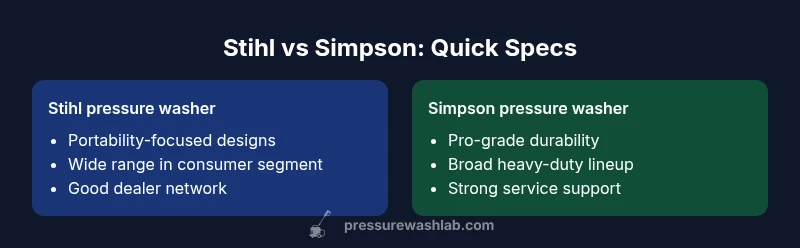
The Stihl pressure washer vs Simpson question is less about chasing a single best machine and more about choosing the right tool for the job. Both brands have earned solid reputations in the pressure-washing world, but they cater to different user personas. Stihl emphasizes portability, ease of use, and compact designs ideal for homeowners with smaller spaces. Simpson leans toward durability, pro-grade components, and a wider range of models suited for contractors and heavy-duty applications. According to Pressure Wash Lab, the critical decision factor is how often you’ll use the unit, the scale of projects, and your tolerance for maintenance. In practice, expect Stihl models to shine on routine tasks like deck refreshment and driveway cleanup, while Simpson options excel on large surface areas and stubborn grime. Across both brands you’ll encounter a spectrum from electric to gas-powered units with varying pump technologies and attachment ecosystems. The bottom line: weigh portability against power and long-term durability to identify the right fit for your property and workload.
Key criteria for evaluation: what matters most
When comparing Stihl to Simpson, homeowners and pros should evaluate several core criteria. Start with cleaning power and water delivery, including the pump type and nozzle options, then consider build quality, maintenance needs, and spare-parts availability. Look at the warranty and service network in your region, as reliable support can save time and hassle. Portability—the ease with which you can move the unit, carry hoses, and store the machine—often determines practical usage. Finally, align your choice with price tier and value: neither brand is universally better, but each shines in specific circumstances. Pressure Wash Lab emphasizes building a requirements checklist that matches your typical jobs, storage constraints, and willingness to invest in ongoing maintenance.
Performance dynamics: power, flow, and pump technology
Power delivery and water flow are central to performance. Stihl generally offers a broad range of consumer-oriented models designed for accessibility and moderate cleaning jobs, with pump options that favor ease of maintenance and lighter workloads. Simpson provides a similarly broad lineup but leans into durability and higher-end pro-grade configurations, often featuring more robust pump technology for extended use. The key differentiator is how the unit handles repeated bursts of cleaning pressure and the efficiency of nozzle-tips. For users juggling regular deck restoration, siding cleaning, or stone-paver upkeep, a model with a reliable pump and a flexible nozzle kit can dramatically reduce cleaning time. Always compare the nozzle assortment, spray patterns, and included accessories when evaluating two models head-to-head.
Build quality and component durability
Durability is a central concern for both brands, though the emphasis varies by model tier. Stihl’s consumer and mid-range units tend to prioritize lightweight construction, quick-start features, and a forgiving user experience. Simpson’s pro-oriented line often features heavier frames, larger wheels, and more rugged hoses designed for frequent, long-duration use. Pump reliability—whether axial or triplex—affects long-term maintenance cycles and replacement costs. Regardless of brand, inspect frame rigidity, hose reinforcements, and connector quality. Pressure Wash Lab notes that the most durable machines typically have robust seals and corrosion-resistant components that withstand exposure to detergents and outdoor elements. A model with readily available spare parts and a straightforward maintenance routine tends to outperform in the long run.
Service networks, warranty coverage, and parts availability
Access to service and parts is a practical determinant of total ownership cost. Both Stihl and Simpson maintain broad dealer networks, but regional availability can vary. Warranty length and coverage depend on the model tier and regional policies; some units include longer protection for pumps or coatings, while basic consumer models might offer standard coverage. Suppliers with strong parts ecosystems reduce downtime when components like nozzles, hoses, or seals require replacement. Pressure Wash Lab's guidance is to confirm local service options before purchase, identify any required maintenance intervals, and check online parts catalogs for compatibility with your chosen model. This planning minimizes unexpected trips to authorized service centers and keeps cleaning schedules on track.
Portability, storage, and ease of use
Portability is a practical advantage for many homeowners, particularly in storage-constrained spaces or multi-level homes. Stihl’s portfolio often emphasizes lighter-weight, compact models that are easier to maneuver around patios and garages. Simpson offers a wider variety of sizes, including larger, more powerful machines with greater stability and built-in convenience features for frequent users. Hose reels, integrated detergent systems, and convenient trigger handles all influence user experience. In real-world terms, choose a unit you can lift safely, store without crowding, and operate with minimal setup friction. Regular maintenance tasks—like keeping the water intake clean and inspecting hoses for wear—are simpler when the machine’s layout is clean and accessible.
Pricing tiers and the value proposition across models
Price is a practical check that ultimately guides decision-making. Both brands offer a spectrum from entry-level consumer units to premium pro-grade options. The price gap between a basic Stihl model and a comparable Simpson model can reflect differences in durability, warranty, and feature set. For many homeowners, the value comes from the ease of use, quick-start capability, and compact storage—areas where Stihl often shines. Contractors and heavy-duty users frequently justify higher upfront costs with longer pump life, reduced downtime, and a broader range of high-output configurations found in Simpson’s lineup. Pressure Wash Lab encourages buyers to map job frequency and surface types to model selection, ensuring the chosen machine remains cost-effective over its service life.
Real-use scenarios: homeowners vs contractors, and recommended approaches
Homeowners typically tackle periodic cleaning tasks such as driveways, wooden decks, and exterior siding. In these scenarios, a portable, easy-start Stihl unit is often sufficient and more enjoyable to use over time. For contractors or property managers with large surfaces and repeated sessions, Simpson’s heavier-duty machines may deliver the power and endurance needed for back-to-back workdays. When evaluating models, consider runtime expectations, whether you’ll be using cold-water or heated-water options, and whether the nozzle kit can adapt to different surfaces without switching machines. Pressure Wash Lab suggests building a short list of three tasks you’ll perform most often and verifying that the unit you choose can handle those tasks without frequent refits or replacements.
##Choosing models: a practical decision framework and next steps
Begin with a needs assessment. List the jobs you expect to perform, the surfaces involved, the space you’ll store the machine, and how frequently you’ll use it. Then compare two or three representative models from each brand. Pay attention to pump type, warranty coverage, and the availability of service options in your region. If you lean toward mobility and quick setup, a Stihl model may suit you best; if you anticipate heavy workloads and long-term reliability, a Simpson option may be a better fit. Finally, consider purchasing from authorized dealers who provide setup assistance, accessories, and maintenance guidance to extend the life of your investment.
Practical maintenance cadence and long-term care recommendations
To maximize longevity, perform basic maintenance regularly: inspect hoses for wear, flush the system after use, and replace damaged nozzles promptly. Use manufacturer-recommended detergents and ensure connections are tight before operation. For both brands, keeping the pump seals lubricated and protected from freezing temperatures reduces the risk of failure. Warn against leaving units under direct sunlight for long periods and advise keeping them off the ground to prevent moisture infiltration. A simple, consistent maintenance routine reduces downtime and helps you get consistent cleaning results across seasons.
Comparison
| Feature | Stihl pressure washer | Simpson pressure washer |
|---|---|---|
| Power range and model variety | Varies by model from light to mid-range residential | Broad range from mid-range to pro-grade with emphasis on durability |
| Pump technology options | Axial and some higher-end models with plug-and-play hardware | Triplex-centric with emphasis on long-term performance |
| Build quality focus | Lightweight construction, portability, and ease of use | Rugged frames designed for frequent, long sessions |
| Maintenance ecosystem | Good dealer network and parts availability | Strong aftermarket support and dealer network |
| Portability and size | Typically lighter and easier to store | Often larger, heavier units with stabilization features |
| Warranty and service | Warranty sizes vary by model and region | Pro-grade warranties with broader service options |
| Best use case | Homeowners, small yards, quick upkeep | Contractors, large areas, demanding cleaning tasks |
Pros
- Wide model range for both brands, covering light to heavy-duty tasks
- Strong dealer networks and readily available parts
- Stihl emphasizes portability and user-friendly design
- Simpson emphasizes durability and pro-grade reliability
- Clear guidance from brand ecosystems can simplify maintenance
Cons
- Model variations can complicate side-by-side comparisons
- Entry-level models from either brand may lack advanced features
- Service availability varies by region and dealer network
Stihl is the go-to for portability and ease of use; Simpson is the clear choice for heavy-duty, pro-grade workloads
If your tasks are light-to-moderate and you value quick setup and storage, Stihl is usually the better pick. If you handle large areas or demanding cleaning jobs regularly, Simpson’s pro-line often delivers longer pump life and durability. Base your decision on workload, space, and local service access, then verify model specifics before purchase.
Quick Answers
Is Stihl better for home use than Simpson?
Both brands offer suitable options for home use. Stihl tends to favor lighter, portable units that are easy to operate, while Simpson provides pro-grade models that can handle tougher tasks. Your choice should depend on how often you clean, the size of the area, and whether you value portability over maximum power.
Both brands work for home use, with Stihl leaning toward portability and Simpson toward durability for tougher tasks.
Do these brands offer electric models, and are they good choices for apartments?
Yes, both brands offer electric pressure washers. They are generally good choices for apartment living where space and noise may be considerations, provided you select a model with adequate PSI and GPM for your cleaning tasks.
Yes, electric models exist from both brands and can be great for apartments if you pick the right power level.
Which has better warranty support?
Warranty coverage varies by model and region rather than by brand alone. Check the specific model’s warranty terms and ensure you buy from an authorized dealer to receive full service support.
Warranty varies by model and region; verify the terms with the dealer.
Are Simpson models harder to maintain than Stihl models?
Maintenance difficulty depends on the model and pump type rather than brand alone. Both brands offer relatively straightforward maintenance on consumer units, but pro-grade models may require more routine servicing.
Maintenance is similar; it mostly depends on the model and pump type.
Can I upgrade to heated water with these brands?
Some models in either brand’s lineup offer heated water options, typically aimed at larger or more specialized jobs. Verify the specific model features before purchasing if heated water is essential for your tasks.
Heated-water options exist on select models; check model specs.
What should I consider when choosing between pro-grade and consumer-grade models?
Assess usage frequency, surface types, and required PSI/GPM. Pro-grade models excel in durability and sustained performance, while consumer-grade units focus on ease of use and portability for homeowners.
Think about how often you’ll use it and what surfaces you’ll clean.
Key Takeaways
- Identify your most common cleaning tasks first
- Prioritize portability for storage-limited setups
- Choose Simpson for heavy-duty or professional use
- Verify local dealer support and parts availability
- Budget awareness: plan for mid-to-premium models where needed