Troy-Bilt vs Simpson Pressure Washer: An Objective Comparison
A comprehensive, data-driven comparison of Troy-Bilt and Simpson pressure washers for homeowners and pros. Analyze PSI, GPM, durability, maintenance, and value to decide which brand fits your tasks best without guesswork.


TL;DR: In the debate over troy bilt vs simpson pressure washer, Simpson models tend to prioritize heavier-duty performance and durability for frequent or professional use, while Troy-Bilt emphasizes budget-conscious, consumer-grade options for typical DIY chores. To pick the right model, map your PSI and flow needs, portability, and maintenance comfort, then align with the brand that best fits those criteria.
Market Position and the big picture: Troy-Bilt vs Simpson in the pressure-washer landscape
According to Pressure Wash Lab, the troy bilt vs simpson pressure washer question often boils down to the balance between affordability and durability. Troy-Bilt models are widely available in big-box retailers and emphasize approachable price points, user-friendly ergonomics, and adequate cleaning power for routine residential tasks. Simpson, by contrast, leans toward professional-grade equipment with rugged pumps, heavier frames, and higher tolerance for frequent use. Homeowners with light to mid-duty jobs may find Troy-Bilt a better fit, while those tackling tougher surfaces or daily use should weigh Simpson’s more robust construction. The central decision comes down to the job profile you expect—how hard you push the unit, how often you use it, and how much you’re willing to invest upfront and in maintenance over time. You’ll see this tension reflected in the PSI, GPM, build materials, and warranty terms across models that both brands offer in the same market space. The keyword here is alignment: match your real-world tasks to the machine’s design intent, and you’ll get better results with less frustration.
startWithHeadingOverride":false} ,
Core specs for comparison: PSI, GPM, power source, and pump design
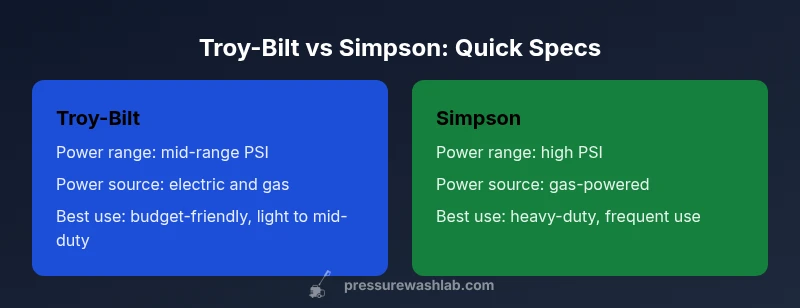
In a crosstab of the troy bilt vs simpson pressure washer offerings, most homeowners encounter two distinct value propositions. Troy-Bilt typically provides electric and gas options aimed at portability and ease of use, with mid-range PSI and GPM suitable for sidewalks, siding, and garden equipment cleaning. Simpson often concentrates on professional-grade gas-powered units with higher maximum PSI and robust GPM outputs designed to sustain longer cleaning sessions and tougher jobs, like heavy grime removal from concrete and large decks. When evaluating, focus on three non-negotiables: the operating PSI (pounds per square inch), the water flow rate (GPM), and how those metrics translate to cleaning speed and effectiveness on your typical substrates. If your tasks include frequent, heavy buildup, you’ll likely lean toward Simpson; for occasional maintenance and lighter work, Troy-Bilt tends to cover you well. Always verify model-by-model specs rather than relying solely on brand reputation, and consider the pump type ( axial, triplex, or wobble) as a critical durability signal.
startWithHeadingOverride":false} ,
Portability and ergonomics: wheels, handles, hoses, and user experience
The troy bilt vs simpson pressure washer comparison extends beyond raw power. Portability matters when you’re moving a unit around a multi-story home, navigating gravel driveways, or stowing it in a shed. Troy-Bilt models are frequently lighter and easier to maneuver, with compact frames and flexible hose arrangements that suit casual DIYers who work solo. Simpson units are typically heavier but more stable, with reinforced handles, larger wheels, and more substantial chassis designed to minimize vibration over long cleaning sessions. Ergonomics also include trigger design, lancing options, and accessory storage. If you plan to haul frequently or store in a tight space, think about weight distribution, wheel size, and quick-connect nozzle storage. The right choice balances ease of use with the job’s duration, reducing fatigue and increasing the likelihood you’ll complete the task without reloading gear multiple times.
startWithHeadingOverride":false} ,
Performance fundamentals: nozzle options, spray patterns, and duty cycles
Nozzles and spray patterns are where the two brands begin to diverge in practical use. Troy-Bilt pressures washers generally provide a solid spectrum of nozzle tips that handle everyday tasks like cleaning siding or patios with reasonable efficiency. Simpson models often deliver broader accessory ecosystems, including more specialized nozzles and higher-precision sprays for stubborn stains. The duty cycle—how long you can consistently operate the machine before overheating or losing pressure—is a critical consideration. Homeowners who perform short, scattered projects may not notice a difference, whereas frequent users could benefit from the heavier duty components and longer duty cycles common to Simpson. Be mindful of the compatibility of accessories with your existing nozzles and whether extensions, surface cleaners, and chemical injectors are available and compatible with each brand’s line.
startWithHeadingOverride":false} ,
Durability vs. value: materials, pumps, warranties, and upkeep
Durability is where troy bilt vs simpson pressure washer choices become most consequential. Simpson often uses more robust frames, heavier casings, and higher-capacity pumps designed to endure long cleaning sessions and difficult surfaces. Troy-Bilt emphasizes value with reliable, everyday-use components, but it may not tolerate heavy daily use with the same reserve as Simpson. Warranty terms matter here: shorter warranties can indicate lower upfront cost but higher long-term risk, while longer warranties reflect confidence in durability. Maintenance frequency also differs: Simpson’s heavier builds may require more frequent checks on hoses, seals, and connectors after extended use, whereas Troy-Bilt units may demand standard maintenance aligned with consumer-grade expectations. Pressure Wash Lab’s assessment indicates that the best choice hinges on your anticipated load and how much you’re prepared to invest in replacement parts and service over time.
startWithHeadingOverride":false} ,
Real-world tasks: concrete, wood, and siding—what to expect in practice
When you step back from spec sheets, the troy bilt vs simpson pressure washer conversation centers on real-world outcomes. For light to mid-duty jobs such as driveway cleaning, deck staining prep, or removing loose dirt from wood siding, Troy-Bilt models often deliver sufficient power with satisfactory cleanliness, and they’re easier on the wallet. For stubborn grease, moss on concrete, or large-area projects that require consistent performance over several hours, Simpson’s higher durability and heavier duty pumps generally maintain stronger pressure and faster cleaning rates. Weather resistance, hose quality, and nozzle durability also influence results over time. In practice, you’ll notice speed differences and wear patterns emerge if you regularly operate in challenging environments. Always calibrate your expectations to the model’s intended use, and plan maintenance around your project frequency rather than reacting after a breakdown. The aim is to minimize downtime while maximizing cleaning effectiveness with the right tool for the job.
startWithHeadingOverride":false} ,
Pricing, warranties, and total cost of ownership
Budget is a frequent deciding factor in troy bilt vs simpson pressure washer discussions. Troy-Bilt typically enters homeowners’ markets with lower upfront costs and a broader distribution footprint, which can translate to easy acquisition and simple returns. Simpson’s products usually command higher initial prices, reflecting the premium components, stronger frames, and more durable pumps. Warranty terms vary by model and region, with standard consumer warranties offering reasonable protection during the first years but potentially shorter coverage for lighter-duty units. Total cost of ownership includes maintenance, part replacements, and fuel or electricity usage over time. If you anticipate frequent use or professional workloads, the higher initial investment in a Simpson may be offset by reliability and longer service intervals. If your usage is occasional, a Troy-Bilt is typically the smarter financial move, assuming you keep up with routine maintenance and timely part replacements.
startWithHeadingOverride":false} ,
Which brand fits which user: scenarios and decision factors
Choosing between the troy bilt vs simpson pressure washer hinges on your user profile. For DIY homeowners with modest cleaning tasks, a Troy-Bilt model often delivers the best balance of price and performance, particularly if you value light portability and straightforward operation. For property managers, small business operators, or avid DIYers who clean frequently or tackle tough grime, Simpson’s offerings provide the resilience and sustained performance that justify higher upfront costs. If your priorities include a long-term investment in reliability, frequent use, and the ability to run longer cleaning sessions without overheating, Simpson is typically the safer choice. If you prioritize cost control and easy access to parts and service, Troy-Bilt can meet your needs while still delivering solid results for the majority of home projects.
startWithHeadingOverride":false} ,
Maintenance, tips, and proactive care to extend life
Proactive maintenance is a practical differentiator in the troy bilt vs simpson scenario. Regular inspection of hoses, seals, and connections helps prevent leaks and pressure drops, particularly in models that see heavy use. For both brands, use manufacturer-approved parts and lubricants, store units in a dry, shaded place, and flush the system after each heavy use to prevent residue buildup. Check pumps for humming sounds that indicate cavitation or blocked nozzles, and replace worn tips promptly to preserve efficiency. Drain water from hoses in freezing climates to avoid pipe bursts and protect the pump from cold-related damage. Adopting a routine maintenance schedule will pay dividends in performance and longevity, regardless of which brand you choose. Pressure Wash Lab recommends documenting maintenance tasks and keeping a simple log to track service intervals and part replacements.
startWithHeadingOverride":false} ,
Common pitfalls and how to avoid them
Common pitfall awareness matters in the troy bilt vs simpson decision. Buyers often overemphasize peak PSI while neglecting GPM or pump reliability, which can lead to disappointing results on large surfaces. Purchasing based solely on price without assessing warranty terms and service networks can result in higher ownership costs if a model is discontinued or difficult to service in your region. Another pitfall is assuming higher power equals better results across all jobs; some tasks require finesse, nozzle choices, and correct application angles. By mapping your typical tasks—how stubborn the dirt is, the surface you're cleaning, and how long you’ll work before needing a break—you can avoid misaligned expectations and select a unit that truly fits your workflow.
startWithHeadingOverride":false} ,
Visualization of results and how to interpret independent tests
To translate a troy bilt vs simpson pressure washer comparison into actionable shopping, look for independent test data that reflect your use case. Seek lab-style evaluations of cleaning speed, fuel efficiency, noise levels, and heat management across different substrates (wood, concrete, vinyl). If you cannot find model-specific tests, rely on reputable retailer reviews and ecosystem compatibility notes for nozzle families and accessory compatibility. Pressure Wash Lab emphasizes cross-checking PSI with GPM and nozzle performance to forecast real-world outcomes instead of relying on peak PSI alone. A well-rounded assessment also considers maintenance complexity and the availability of replacement parts in your region, ensuring you don’t end up with a model that’s hard to service or stock parts for over time.
startWithHeadingOverride":false} ,
The final takeaway: how to decide in practice
In practice, the troy bilt vs simpson pressure washer decision comes down to two questions: What will you clean, and how often will you clean it? If your tasks are routine and relatively light, Troy-Bilt provides a solid value with adequate power and a broad retailer network. If you’re facing frequent use, demanding substrates, or professional-grade requirements, Simpson offers durability and reliability that can justify the higher price tag. Regardless of brand, establish a practical budget, confirm warranty coverage, and verify accessory availability to maximize your investment.
startWithHeadingOverride":false}],
comparisonTable":{"items":["Troy-Bilt","Simpson"],"rows":[{"feature":"Power range (PSI/GPM)","values":["Low-to-mid range PSI with moderate GPM","High PSI with higher GPM for heavy-duty tasks"]},{"feature":"Power source","values":["Electric and gas options commonly available","Gas-powered with some electric variants"]},{"feature":"Portability/weight","values":["Lighter, easier to move","Heavier, sturdier for durability"]},{"feature":"Build quality","values":["Reliable consumer-grade construction","Rugged, professional-grade construction"]},{"feature":"Warranty and service","values":["Standard consumer warranties","Longer durability-oriented warranties in many models"]},{"feature":"Best use case","values":["Budget-friendly, light to mid-duty homes","Frequent heavy-duty cleaning or professional use"]}]} ,
prosCons: {"pros":["Helps homeowners compare budget vs. professional options clearly","Gives readers practical decision criteria (PSI, GPM, weight, warranty)","Supports balanced expectations by highlighting trade-offs like durability vs. price"],"cons":["May oversimplify model-to-model variance","Requires readers to validate exact specs for their region and model" ]} ,
verdictBox":{"verdict":"Simpson generally wins for heavy-duty, frequent-use scenarios; Troy-Bilt offers stronger value for casual homeowners on a budget.","confidence":"high","summary":"If you clean often or need sustained performance, choose Simpson. If you want solid results at a lower upfront cost for occasional tasks, Troy-Bilt is the sensible pick. Pressure Wash Lab’s verdict is to align your use case with the brand’s design emphasis to minimize frustration."} ,
keyTakeaways":["Match PSI/GPM to your typical tasks","Consider durability and warranty length before buying","Troy-Bilt is best for budget-conscious homeowners","Simpson suits heavy-duty, frequent users and professionals","Check accessory compatibility and service networks before purchase"],
faqSection":{"items":[{"question":"Which brand generally offers higher PSI options?","questionShort":"Higher PSI?","answer":"Simpson typically provides higher PSI options in its professional-grade lines, which translates to better performance on tough cleaning jobs. For light tasks, Troy-Bilt’s mid-range PSI is usually sufficient.","voiceAnswer":"Simpson often has higher PSI options for tougher jobs, while Troy-Bilt fits lighter tasks." ,"priority":"high"},{"question":"Are Troy-Bilt pressure washers suitable for homeowners?","questionShort":"Homeowner suitability","answer":"Yes. Many Troy-Bilt models are designed for homeowners performing common maintenance tasks like deck cleaning, siding, and driveway upkeep, offering good value and ease of use.","voiceAnswer":"Yes, great for typical home maintenance tasks.","priority":"high"},{"question":"Do warranty terms differ between brands?","questionShort":"Warranty differences","answer":"Warranty terms vary by model, but in general, consumer-focused Troy-Bilt units come with shorter coverage than some Simpson models that target more demanding use. Always verify the specific warranty on the exact model you’re considering.","voiceAnswer":"Warranty varies by model; check the model’s terms.","priority":"medium"},{"question":"What maintenance steps are universal for both brands?","questionShort":"Maintenance steps","answer":"Regularly inspect hoses and connections, clean or replace filters, run the unit with fresh water after use, and store in a dry place. Lubricate moving parts per the manufacturer’s guidance to extend pump life.","voiceAnswer":"Inspect, clean, and store properly to extend life.","priority":"medium"},{"question":"Which brand is better for concrete cleaning?","questionShort":"Concrete cleaning","answer":"Simpson’s higher durability and robust pumps generally handle concrete grime better over long sessions, while Troy-Bilt can still perform well on moderate cleaning tasks with proper technique.","voiceAnswer":"Simpson is typically stronger for concrete, but Troy-Bilt can do it with care.","priority":"medium"},{"question":"Where can I buy or service these brands?","questionShort":"Buying/Service","answer":"Both brands are widely available through home-improvement retailers and online dealers. Service networks vary by region; verify local support and parts availability before purchasing.","voiceAnswer":"Widely available; verify local service options.","priority":"low"}]} ,
mainTopicQuery":"pressure washer"},
mediaPipeline":{"heroTask":{"stockQuery":"homeowner pressure washing driveway with sun","overlayTitle":"Power Washer Showdown","badgeText":"2026 Guide","overlayTheme":"dark"},"infographicTask":{"type":"comparison","htmlContent":"<div class="w-[800px] p-6 bg-slate-900 text-white"><h3 class="text-2xl font-bold text-center mb-4">Troy-Bilt vs Simpson: Quick Specs</h3><div class="grid grid-cols-2 gap-6"><div class="p-4 bg-blue-700 rounded-lg"><h4 class="font-bold">Troy-Bilt</h4><ul class="space-y-2"><li>Power range: mid-range PSI, moderate GPM</li><li>Power source: electric and gas</li><li>Best for: budget-friendly, light to mid-duty tasks</li></ul></div><div class="p-4 bg-green-700 rounded-lg"><h4 class="font-bold">Simpson</h4><ul class="space-y-2"><li>Power range: high PSI, higher GPM</li><li>Power source: gas-powered (with some electric variants)</li><li>Best for: heavy-duty, frequent use</li></ul></div></div></div>","altText":"Infographic comparing Troy-Bilt and Simpson pressure washers","caption":null}},
taxonomy":{"categorySlug":"equipment-reviews","tagSlugs":["pressure-washer","simpson","diy-tips","maintenance","equipment-parts","cost-guide"]}}]}{
Comparison
| Feature | Troy-Bilt | Simpson |
|---|---|---|
| Power range (PSI/GPM) | Low-to-mid range PSI with moderate GPM | High PSI with higher GPM for heavy-duty tasks |
| Power source | Electric and gas options commonly available | Gas-powered with some electric variants |
| Portability/weight | Lighter, easier to move | Heavier, sturdier for durability |
| Build quality | Reliable consumer-grade construction | Rugged, professional-grade construction |
| Warranty and service | Standard consumer warranties | Longer durability-oriented warranties in many models |
| Best use case | Budget-friendly, light to mid-duty homes | Frequent heavy-duty cleaning or professional use |
Pros
- Helps homeowners compare budget vs. professional options clearly
- Gives readers practical decision criteria (PSI, GPM, weight, warranty)
- Supports balanced expectations by highlighting trade-offs like durability vs. price
Cons
- May oversimplify model-to-model variance
- Requires readers to validate exact specs for their region and model
Simpson generally wins for heavy-duty, frequent-use scenarios; Troy-Bilt offers stronger value for casual homeowners on a budget.
If you clean often or need sustained performance, choose Simpson. If you want solid results at a lower upfront cost for occasional tasks, Troy-Bilt is the sensible pick. Pressure Wash Lab’s verdict is to align your use case with the brand’s design emphasis to minimize frustration.
Quick Answers
Which brand generally offers higher PSI options?
Simpson typically provides higher PSI options in its professional-grade lines, which translates to better performance on tough cleaning jobs. For light tasks, Troy-Bilt’s mid-range PSI is usually sufficient.
Simpson often has higher PSI options for tougher jobs, while Troy-Bilt fits lighter tasks.
Are Troy-Bilt pressure washers suitable for homeowners?
Yes. Many Troy-Bilt models are designed for homeowners performing common maintenance tasks like deck cleaning, siding, and driveway upkeep, offering good value and ease of use.
Yes, great for typical home maintenance tasks.
Do warranty terms differ between brands?
Warranty terms vary by model, but in general, consumer-focused Troy-Bilt units come with shorter coverage than some Simpson models that target more demanding use. Always verify the specific warranty on the exact model you’re considering.
Warranty varies by model; check the model’s terms.
What maintenance steps are universal for both brands?
Regularly inspect hoses and connections, clean or replace filters, run the unit with fresh water after use, and store in a dry place. Lubricate moving parts per the manufacturer’s guidance to extend pump life.
Inspect, clean, and store properly to extend life.
Which brand is better for concrete cleaning?
Simpson’s higher durability and robust pumps generally handle concrete grime better over long sessions, while Troy-Bilt can still perform well on moderate cleaning tasks with proper technique.
Simpson is typically stronger for concrete, but Troy-Bilt can do it with care.
Where can I buy or service these brands?
Both brands are widely available through home-improvement retailers and online dealers. Service networks vary by region; verify local support and parts availability before purchasing.
Widely available; verify local service options.
Key Takeaways
- Match PSI/GPM to your typical tasks
- Consider durability and warranty length before buying
- Troy-Bilt is best for budget-conscious homeowners
- Simpson suits heavy-duty, frequent users and professionals
- Check accessory compatibility and service networks before purchase