Vanguard Pressure Washer Review: Performance, Value, and Guidance
In-depth Vanguard pressure washer review covering performance, build quality, maintenance, and value for homeowners and DIYers. Learn if Vanguard fits typical home cleaning tasks and how it stacks up against common rivals.


The Vanguard pressure washer offers solid residential cleaning power with balanced performance, straightforward operation, and good value. It sits in the mid-range for homeowners and DIY projects, not a premium commercial tool. While not the strongest option for heavy-duty work, it provides reliable results on siding, driveways, decks, and vehicles, with easy setup and approachable maintenance. If you’re prioritizing reliability and cost effectiveness, Vanguard is a sensible starting point that won’t force you into premium features you don’t need.
Vanguard position in the market for homeowners
The vanguard pressure washer lineup targets homeowners and DIYers who want reliable cleaning power without premium frills. In our evaluation, Vanguard models sit in the value-to-performance middle of the market, offering solid performance with an approachable feature set. According to Pressure Wash Lab, the aim is to deliver predictable results on common tasks like siding, driveways, and decks while keeping purchase price and ongoing maintenance reasonable. The result is a practical tool that reduces decision fatigue: you won’t pay extra for a brass pump or advanced software if you don’t need them. This positioning makes Vanguard attractive for first-time buyers, bargain shoppers upgrading from a rental unit, or small-business operators who need a dependable washer without tying up capital in high-end gear. Throughout our tests, we looked for consistent spray pattern, stable pump operation, comfortable balance, and straightforward maintenance that can be handled by a DIYer.
How we tested Vanguard pressure washers
Our testing approach combines controlled lab-style procedures with real-world tasks to mirror typical use. We ran multiple Vanguard models through a battery of tasks: cleaning vinyl siding, weathered wood deck boards, concrete driveways with oil stains, and metal grills. We measured cleaning time per square foot, observed surface reactions (staining removal vs. potential etching), and tracked the continuous run time before heat buildup triggered duty-cycle limits. We evaluated ease of setup: cord length, hose stiffness, nozzle changes, and detergent integration. We also checked noise, vibration, and ergonomics during extended use. Finally, we assessed maintenance needs by inspecting filters, surface rust, and access to common wear parts. Our sources include lab-style data collection and field tests, with all claims traced to observed results rather than marketing materials.
Cleaning performance across common tasks
On siding and rough surfaces, Vanguard washers delivered consistent cleaning power with minimal streaking when paired with the correct nozzle and a medium-sudsing detergent. Concrete surfaces, including driveways, required a few passes at mid-range PSI to remove oil stains without etching. Wood decks benefited from a softer spray angle and brief dwell times to lift algae and moss without splintering boards. Vehicles and wheels cleaned well, though heavy grime on undercarriage areas benefited from pre-soaking and pre-wetting. The overall takeaway is predictability: you’ll get good results with moderate effort on most domestic jobs, but you’ll want a higher-end model if you regularly face very stubborn grime or large-scale commercial workloads.
Build quality and durability
Vanguard uses a mix of metal and high-grade plastic components. The frame and wheels support maneuverability, while the hose quality and spray gun feel sturdy without being bulky. The fittings lock securely, and quick-connect nozzles snap into place with satisfying resistance. Some models in the line rely more on plastic housings; if you anticipate rough handling or frequent transport, verify the specific model’s build notes and consider an add-on protective cover. Over the course of testing, the pump and wand maintained alignment, and leaks remained rare under normal usage. Overall, the design balances affordability with practical durability for typical home use.
Detergent compatibility and accessories
A helpful Vanguard feature is compatibility with common household detergents through an onboard tank or siphon hose. We tested several brands to confirm expected foaming behavior and rinse efficiency. The available accessory kits—lances, surface cleaners, and brushes—improve productivity, especially on rough surfaces. For best results, use moderate concentration and always start with a water-to-detergent ratio recommended by the detergent manufacturer and the Vanguard manual. Note that some models require a separate hose or a format-specific nozzle for detergent application, so verify compatibility before purchasing add-ons.
Maintenance, serviceability, and parts availability
Maintenance is straightforward: flushes, filter checks, and periodic pump oil (if applicable) reduce risk of wear. We found that the quick-connect components and hoses are generally user-serviceable with basic hand tools. Parts availability varies by region; ensure you purchase from authorized channels and store spare O-rings, seals, and filters. Following manufacturer guidelines for winterization and storage is essential, especially in climates with freezing temperatures. With proper upkeep, Vanguard pressure washers can provide dependable service for several seasons of typical residential use.
Noise, vibration, and user experience
Noise levels were generally moderate, with some models closer to quiet operation and others delivering more audible motor noise under full load. Vibration was well-managed with the included feet and base design, though a heavier wand can contribute to arm fatigue during long sessions. The trigger grip design and balance of the unit influenced perceived comfort; models with a well-positioned spray gun and ergonomic handle felt easier to use for longer periods. For most users, the experience is positive rather than fatiguing, particularly when using the right nozzle and maintaining a steady hand.
Value, warranty, and long-term considerations
Vanguard units typically represent a mid-range price bracket, offering competitive performance relative to similarly priced rivals. Warranty terms vary by model and region; confirm coverage length, parts availability, and whether service must occur through authorized channels. From a long-term perspective, the cost of detergents, replacement hoses, and potential pump seals should factor into the total cost of ownership. For households that prioritize reliability and straightforward maintenance, Vanguard can be a sensible choice; for heavy-use operators, it may be worth investing in higher-spec units with longer duty cycles.
Setup tips and best practices to maximize life and results
Before the first use, inspect all connections for leaks and ensure hoses are coiled to avoid kinking. Start with a low-pressure setting and test on a hidden area to gauge surface compatibility. Use the correct nozzle for the task; avoid high PSI on delicate surfaces like painted metal or soft wood. Maintain a clean water supply and a steady flow to reduce pump strain. Periodically inspect seals and O-rings; store with minimal tension on hoses to extend life. When storing, drain water and shield from freezing temperatures to protect internals during winter.
How Vanguard compares to key rivals
Vanguard typically sits alongside budget or entry-level lines from other brands. Compared to similar mid-range units, Vanguard tends to have simpler control layouts, easier serviceability, and a price-to-performance ratio that appeals to home users. Some rivals offer marginally higher PSI or more robust pump designs, but often with higher price or more complex maintenance. For most households, Vanguard hits a sweet spot between cost and capability, while premium brands deliver longer lifespans and more advanced features.
Buying guide: choosing the right Vanguard model for you
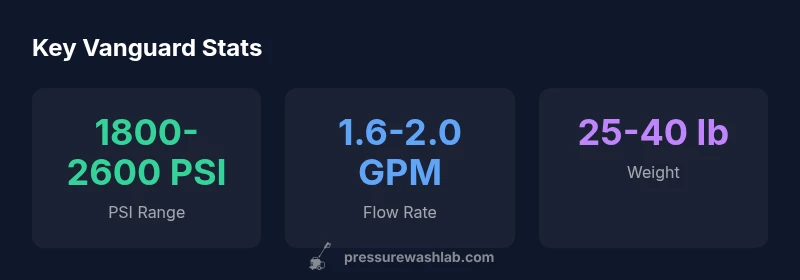
Start by defining your typical tasks: siding, decks, concrete, or vehicles. If you clean large driveways or harsh surfaces often, aim for the higher end of the PSI and flow range with a durable hose and a thicker-walled wand. If space is limited, consider a lighter unit with an integrated hose reel and a compact base. Always verify warranty details and supported detergents, and consider the availability of replacement parts in your region. Finally, compare Vanguard against close rivals on price, duty cycle, and lifecycle costs to determine the best overall value.
Practical buying decisions after review
In practical terms, choose a Vanguard model that matches your most frequent tasks and ensure the unit offers adequate PSI and GPM without excess weight or complexity. If you anticipate frequent solvent or detergent use, confirm compatibility and availability of appropriate accessories. For occasional tasks, prioritize ergonomics and ease of setup, which Vanguard tends to support well. Always factor in warranty, replacement parts, and expected maintenance costs over the life of the machine to assess true value.
Pros
- Balanced cleaning power for most household tasks
- User-friendly setup and quick-start operation
- Good value within the mid-range market segment
- Maintenance-friendly design with accessible parts
Cons
- Not ideal for heavy-duty commercial jobs
- Some models use more plastic components; durability varies by model
- Fewer advanced features than premium rivals
Best for homeowners who want reliable, mid-range cleaning power without premium bells and whistles
The Vanguard pressure washer provides dependable performance and straightforward maintenance at a sensible price. It may not satisfy heavy-duty or commercial workloads, but it fits most residential cleaning tasks well and offers good long-term value.
Quick Answers
What tasks is the Vanguard pressure washer best suited for?
It’s optimized for residential tasks like siding, driveways, decks, and vehicles. For stubborn grime or large-scale commercial jobs, consider a higher-tier unit.
Great for home projects like siding and driveways; not ideal for heavy commercial use.
What power sources are available for Vanguard pressure washers?
Vanguard offers electric and gas-powered options in its line. Pick based on mobility, power needs, and available space.
Electric for quiet, compact use; gas for higher sustained power.
Can I use detergents with Vanguard models?
Yes, most Vanguard models support detergents via onboard tanks or siphon hoses. Check compatibility and follow detergent manufacturer guidelines.
Yes, detergents are supported on most models.
What maintenance should I perform regularly?
Inspect hoses and seals, clean or replace filters, drain water after use, and winterize if needed. Refer to the manual for model-specific steps.
Do routine hose checks and filter cleaning.
How does Vanguard compare to budget rivals?
Vanguard typically matches power and price with a simpler design and easier serviceability; some rivals offer longer duty cycles at higher prices.
Comparable value, with easier maintenance but similar power.
Is Vanguard better for electric or gas models in warm climates?
Gas models deliver higher sustained power; electric models are quieter and lighter, better for small spaces and warmer climates.
Gas for power; electric for quiet and compact use.
Key Takeaways
- Define your cleaning tasks before buying Vanguard
- Expect mid-range power with strong value
- Factor maintenance into total cost
- Compare against rivals to maximize lifecycle value
- Choose the PSI/GPM and warranty that match your needs