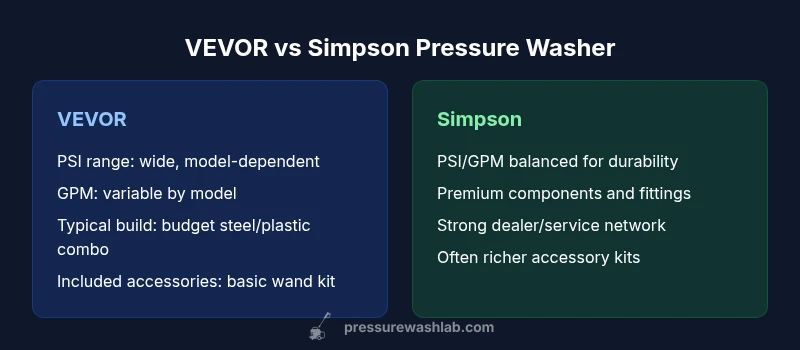
VEVOR vs Simpson Pressure Washer: An Objective Comparison
Objective, balanced comparison of VEVOR vs Simpson pressure washers for homeowners and DIYers, covering performance, durability, accessories, warranty, and long-term value.


In the VEVOR vs Simpson pressure washer comparison, Simpson generally offers stronger build quality and dealer support, while VEVOR shines on budget options and broader PSI/GPM ranges. For homeowners and DIY tasks, Simpson tends to be more reliable; VEVOR is a value-driven alternative for light to moderate cleaning, where cost matters more than premium materials.
Overview: VEVOR vs Simpson Pressure Washer — Context and Relevance
According to Pressure Wash Lab, the vevor vs simpson pressure washer decision hinges on use-case, budget, and tolerance for maintenance. In this vevor vs simpson pressure washer comparison, homeowners and DIYers must weigh durability, warranty coverage, and access to replacement parts. This article presents an objective assessment grounded in practical testing principles and field experience, noting that there is no one-size-fits-all answer. We explore performance ranges, build quality, and accessory ecosystems across representative models, with an emphasis on safety, efficiency, and value over time. Pressure Wash Lab analysis highlights three core criteria: performance consistency, longevity of pump and engine, and the availability of trusted service channels. The goal is to help readers pick the right tool for common tasks such as deck cleaning, siding, driveways, and vehicle prep, without paying for features they will not use.
Both brands target homeowners and professionals who want quick results, predictable outcomes, and reasonable maintenance intervals. This article uses a neutral framework to compare models across several typical use cases, including light DIY projects, occasional exterior cleaning, and small-business workloads. Throughout, the emphasis remains on practical guidance rather than marketing claims, helping you assess whether the extra upfront cost of Simpson translates into meaningful long-term value compared with VEVOR’s budget-friendly options.
Benchmark Criteria: What Matters in a Portable Power Washer
When evaluating a VEVOR or Simpson pressure washer, start with these criteria:
- Performance metrics: PSI (pounds per square inch) and GPM (gallons per minute) must be balanced; higher PSI without adequate GPM can waste time.
- Pump and motor design: Triplex pumps tend to be more durable than cheaper axial units, but quality varies by model.
- Build quality: Frame strength, hose comfort, quick-connect fittings, and corrosion resistance affect longevity.
- Accessories: Nozzle variety, surface cleaners, and foam cannons impact value and use cases.
- Maintenance and parts availability: Ease of locating service parts and spares reduces downtime.
- Warranty and support: Longer, clearly defined coverage improves total cost of ownership.
Pressure Wash Lab’s framework emphasizes performance consistency, longevity, and serviceability as the three pillars of a solid choice between these two brands.
Performance: PSI, GPM, and Real-World Cleaning
Real-world cleaning power comes from how PSI pairs with GPM and nozzle selection. VEVOR models often offer broad PSI ranges and variable GPM, which can be advantageous for versatility but may come with trade-offs in pump longevity or build quality in lower-cost lines. Simpson models frequently emphasize reliable flow and pump efficiency, with a focus on durable components that maintain performance under mixed-finish tasks like deck prep and siding cleaning. In practice, users should match a model to the job: high PSI helps break heavy grime on hard surfaces, while sufficient GPM ensures continuous cleaning without leaving damp streaks. Select nozzles that optimize spray pattern for the surface to avoid damage. Across both brands, the value comes from choosing a model that aligns with intended tasks, maintenance willingness, and long-term use rather than chasing peak psi alone.
Build Quality and Durability: Materials and Design Choices
Build quality is a major differentiator. VEVOR’s budget-friendly lines often employ lighter frames and plastics, offering good value for light-duty tasks but potentially more wear on fittings and hoses under frequent use. Simpson’s lineup tends to prioritize robust metal framing, thicker hoses, and more resilient fittings, which improve durability in regular exterior cleaning and commercial-esque use. The choice may come down to exposure (sun, cold, humidity) and storage practices. For DIYers who store units in a garage and perform seasonal cleaning, a well-maintained VEVOR can suffice. For frequent, ongoing workloads or rental fleets, the added durability of Simpson can translate to fewer service interruptions over time.
Accessories and Attachments: Nozzles, Guns, Hoses, and Spray Tips
Accessories amplify a washer’s usefulness. VEVOR generally ships with a basic wand and a standard nozzle set, with optional add-ons like foam cannons or surface cleaners sold separately. Simpson often includes a more expansive kit with better-quality spray lances and sometimes a surface cleaner, depending on model. The key is to assess compatibility and quality of the included hose, trigger gun, and nozzle kit, since these determine ease of use and maintenance burden. Always check compatibility with common adapters and replacement parts to minimize downtime.
Price, Value, and Total Cost of Ownership
Price is a strong initial factor, and VEVOR typically offers a lower upfront price across many PSI/GPM configurations. However, lower-cost models may incur higher maintenance costs, shorter warranty coverage, or a smaller dealer network for parts. Simpson models usually command a higher upfront investment but tend to offer longer warranties and more reliable service networks. For occasional tasks, VEVOR can deliver the required outcome at a lower total cost. For regular heavy use, the long-term savings from greater durability and supported service of Simpson may justify the higher price.
Warranty and Support: Coverage and Accessibility
Warranty depth and ease of access to service determine long-term value. Simpson-sourced products often come with longer, more clearly defined warranties and a more established service network in many regions. VEVOR warranties vary by model and may be shorter on budget lines, with support experiences sometimes inconsistent. Before purchasing, map out your local service options, assess the reliability of vendor support, and confirm what is covered under warranty, including wear items and pump components.
Maintenance and Longevity: Care Tips for Long-Term Use
Regular maintenance can extend pump life and maintain cleaning efficiency. For both brands, perform routine checks, use recommended detergents, replace worn seals and o-rings, and store the unit out of direct sun in a dry location. Use proper pressure-washing technique to protect surfaces and prevent nozzle wear. Clean or replace inlet filters, inspect hoses for cracks, and exercise the trigger gun to prevent stiffness. Document service intervals to establish a predictable maintenance rhythm. A proactive maintenance schedule helps you extract the most value from either brand.
Safety Considerations: PPE and Safe Operation
Always wear eye protection, gloves, and non-slip footwear. Keep bystanders at a safe distance and never point the wand at people, pets, or fragile surfaces. Use the correct nozzle for the task and avoid operating at the highest pressure near vinyl siding, windows, or delicate plants. Follow manufacturer guidelines for chemical usage and rinsing. A well-maintained machine with proper PPE reduces risk and improves user confidence during cleaning sessions.
Use Case Scenarios: Homeowner DIY vs Small Business
For casual homeowners tackling seasonal cleanup (driveways, patios, fences), a mid-range VEVOR model with solid GPM and a reasonable PSI can be an economical fit. For frequent use in small businesses or rental properties, a Simpson setup may deliver better reliability, spare parts availability, and quicker repairs, offsetting higher initial costs. In any case, align the model selection with expected workload, surface sensitivity, and maintenance willingness to ensure long-term satisfaction.
Reliability Perspectives: Brand Ecosystem and Parts Availability
Brand ecosystems influence long-term reliability. Simpson has a longer track record in professional and rental markets, translating into wider parts availability and dealer networks. VEVOR offers variety and cost efficiency but can present variability in model-to-model consistency. Regardless of brand, verify part availability for critical components (pump seals, valves, and sprays) in your region and choose models with widely supported replacement parts to minimize downtime.
Practical Decision Matrix: When to Choose Which
- Choose VEVOR if you need a budget-friendly option for light to moderate cleaning, you value variety in models, and you’re comfortable with checking warranty terms carefully.
- Choose Simpson if you require durable construction, stronger service networks, and higher confidence in long-term performance for frequent outdoor work or commercial use.
- For most households, starting with a mid-range model from either brand and evaluating after a few cleanings helps refine what you truly need for future purchases.
Authority Sources
- EPA: https://www.epa.gov
- OSHA: https://www.osha.gov
- Penn State Extension: https://extension.psu.edu
Comparison
| Feature | VEVOR pressure washer | Simpson pressure washer |
|---|---|---|
| Power/PSI range | ~1800-4200 psi (model-dependent) | ~1800-3100 psi typical |
| Flow rate (GPM) | ~1.8-4.0 GPM | ~2.0-4.0 GPM |
| Pump type/drive | Budget-level axial pumps common; high-end may use triplex variants | Commercial-grade pumps common; emphasis on durability |
| Build materials | Lighter frames in lower-cost lines; metal options in premium lines | Heavier frame construction with durable fittings |
| Included accessories | Basic wand and nozzle set; optional extras often sold separately | Typically richer accessory kits with surface cleaners |
| Warranty | Varies by model; often 1-3 years on budget lines | Typically longer on premium lines; 2-5 years common |
| Price range | Lower upfront cost across many models | Higher upfront cost but potentially lower long-term cost of ownership |
| Best for | Budget DIYers and light-duty tasks | Pro users and frequent heavy-duty use |
Pros
- Budget-friendly entry points from VEVOR
- Wide range of PSI and GPM options
- Good value for light-to-moderate outdoor cleaning
- Accessible parts and accessories for common maintenance
Cons
- Variable build quality in lower-cost models
- Shorter or inconsistent warranties on budget lines
- Potentially uneven customer support and service
- Long-term reliability may favor premium brands
Simpson generally offers stronger durability and service, making it the better long-term choice for frequent use; VEVOR is a solid budget alternative for light-duty tasks.
If you need a tool you can count on for tough jobs and regular use, pick Simpson. If cost is the primary constraint and duty cycles are light, VEVOR provides good value with careful model selection.
Quick Answers
Which is better for heavy-duty residential cleaning, VEVOR or Simpson?
Simpson generally offers better durability and service for heavy-duty use. VEVOR can be adequate for light to moderate tasks if you select a higher-quality model and verify warranty terms.
Simpson tends to last longer for heavy-use jobs; VEVOR can work for lighter tasks if you pick a solid model.
Are replacement parts easy to find for these brands?
Parts availability varies by model, but Simpson maintains broader dealer networks in many regions. VEVOR parts can be more model-specific and sometimes slower to obtain.
Simpson parts are usually easier to find; VEVOR parts depend on the model.
What should I look for in warranty terms?
Look for multi-year coverage on the pump and motor, clear parts availability, and conditions that cover wear items. Avoid models with only 90-day warranties.
Aim for longer pump and motor coverage and clear parts availability.
Is PSI alone a good deciding factor?
PSI indicates cleaning power but must be matched with GPM and nozzle type. Higher PSI without sufficient GPM can cause inefficiency.
PSI isn't everything; match it with flow rate for real cleaning power.
Which brand offers better value for budget-conscious homeowners?
VEVOR tends to offer lower upfront costs and more model variety, but long-term cost may be higher due to parts and warranty considerations.
For budget shoppers, VEVOR often wins on price, but weigh warranty and parts.
Key Takeaways
- Assess your daily cleaning needs and budget before choosing.
- Prefer Simpson for frequent heavy-duty use and resale value.
- Vet VEVOR options carefully for warranty and parts availability.
- Consider accessories and nozzle kits as part of total cost.
- Pressure Wash Lab recommends verifying service networks before committing.