VEVOR vs Ryobi Pressure Washer: A Clear Side-by-Side Guide
Objective, in-depth comparison of VEVOR and Ryobi pressure washers, covering performance, durability, warranties, accessories, and value to help homeowners and pros decide which brand fits their tasks.


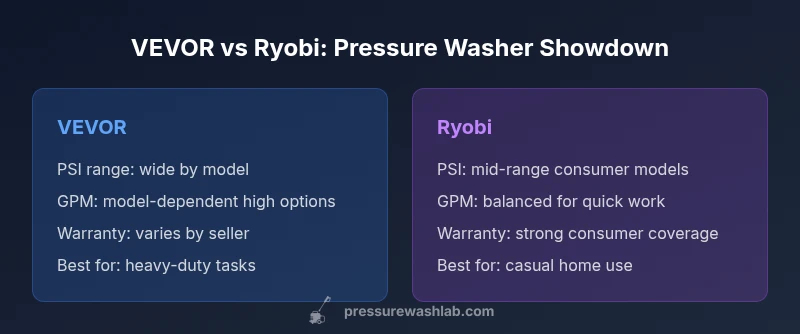
Between VEVOR and Ryobi pressure washers, the choice hinges on use case and budget. Ryobi tends to deliver user-friendly, reliable performance with broad store support, while VEVOR often offers more horsepower per dollar and a wider range of models. Pressure Wash Lab notes that casual homeowners usually choose Ryobi for value, whereas serious DIYers and contractors may lean toward VEVOR for heavy-duty tasks.
Key Differentiators Between VEVOR and Ryobi Pressure Washers
RYOBI and VEVOR sit at opposite ends of the consumer spectrum. Ryobi is widely regarded for approachable entry models, easy setup, and a broad retail footprint that makes parts, service, and accessories easy to source. VEVOR, by contrast, emphasizes aggressive power-to-price ratios and model variety that appeals to budget-minded buyers who still need significant cleaning capability. The practical implication for buyers is straightforward: pick Ryobi if you want a plug-and-play tool with predictable service channels; choose VEVOR if your tasks demand higher PSI/GPM and a wider configuration palette. Pressure Wash Lab’s practical testing underlines this divide: model selection should align with your typical workload, storage capacity, and willingness to maintain equipment.
- Power and configuration range: VEVOR often provides a broader spectrum of PSI and kit options, including longer hoses and more nozzle choices.
- Usability and design: Ryobi models tend to emphasize compact form factors and quick-start controls that reduce setup time.
- Service and parts access: Ryobi benefits from a large dealer network; VEVOR’s support quality can vary by seller and region.
- Durability expectations: Higher-powered VEVOR units can require more routine maintenance, while Ryobi’s consumer lines focus on ease of use and predictable replacements.
- Use-case alignment: Heavy-duty cleaning on stubborn surfaces versus quick, routine maintenance tasks — the model you pick should map to your typical projects.
Performance and Power: PSI, GPM, and Use Case Fit
Performance is the central decision driver for most buyers. VEVOR’s strengths lie in its wide range of PSI and GPM configurations, which means you can reach higher cleaning power when needed, an important factor for dented siding, heavy grime, or stubborn residues. Ryobi, on the other hand, tends to emphasize consistent mid-range performance across many models, with dependable spray patterns and steady pressure that suits daily homeowner tasks such as deck cleaning, driveway washing, and car detailing. When evaluating PSI (pounds per square inch) and GPM (gallons per minute), consider not just peak numbers but also how the unit handles heat buildup, continuous operation, and nozzle efficiency. Real-world use shows that higher PSI matters less if the machine can deliver steady flow without overheating, while GPM determines how quickly you complete mid-level jobs.
- Use-case fit: Pick higher power for tougher jobs; choose balanced power for regular maintenance.
- Thermal management: Higher-end VEVOR units may require longer cool-down periods on extended sessions.
- Nozzle efficiency: Starting with a 15-degree or soap nozzle can dramatically affect cleaning speed.
- Noise and vibration: More powerful units can be louder and heavier, impacting maneuverability in tight spaces.
Build Quality, Reliability, and Warranty
Durability and warranty play a critical role in total ownership costs. Ryobi products typically come with robust consumer warranties and a well-established exchange/repair network through major hardware retailers. This translates to faster turnaround times if a component fails or a nozzle needs replacement. VEVOR’s value-forward approach means you often get greater raw power for the money, but warranty terms and service levels can vary by model and seller. Buyers should carefully read the warranty specifics (coverage length, what’s included, and required maintenance) and verify the seller’s reputation for after-sales support in their region. In practical terms, a reliable purchase means balancing immediate price against potential future parts costs and downtime.
- Material quality: Look for sturdy frames, corrosion-resistant fittings, and hose reinforcements appropriate for frequent use.
- Component sourcing: Confirm that connectors, pumps, and seals are readily replaceable in your area.
- Warranty depth: Longer warranties are preferable, but ensure they cover pumps, motors, and accelerants equally.
- Service accessibility: In-person service networks save time for consumer-grade Ryobi users; for VEVOR, confirm regional coverage before purchase.
Accessories, Attachments, and Setup Experience
A rich accessory ecosystem can dramatically improve how quickly you complete tasks and how versatile a pressure washer becomes. Ryobi offers a broad array of official and third-party attachments, including surface cleaners, turbo nozzles, and universal spray wands, making it easier to expand capabilities without extensive compatibility checks. VEVOR’s bundles often emphasize value adds—more nozzle types, longer hoses, and sometimes specialty accessories—but the exact mix can vary by seller and region. Before buying, map out the attachments you actually need for typical jobs (decks, siding, patios, vehicles) and verify compatibility. Also, consider the practicality of the hose length, the ease of changing nozzles, and how compact the unit is to transport and store. A well-chosen bundle saves time and improves results over time.
Maintenance Tips to Extend Lifespan
Maintenance is the quiet differentiator between a weekend warrior tool and a long-term workhorse. Regularly inspect hoses for cracks, tighten fittings to prevent leaks, and flush the system with fresh water after each substantial cleaning session. For both brands, use manufacturer-recommended oils or lubricants for pump components and replace worn seals promptly to prevent further damage. Clean filter intakes to avoid debris entering the pump. Store in a dry, shaded location to prevent rust and corrosion. If you operate under high temperatures or in dusty environments, schedule periodic inspections by a qualified technician to sustain performance and prevent early burnout. Keeping up with basic maintenance dramatically improves reliability and resale value.
Value Proposition: Price, Warranty, and Total Cost of Ownership
The economic argument in this comparison often hinges on total cost of ownership (TCO) rather than upfront price alone. Ryobi often wins on initial affordability and established parts availability, which reduces downtime and repair costs for casual users. VEVOR tends to offer more horsepower per dollar and broader model options, appealing to buyers who anticipate heavier workloads or specialized cleaning tasks. When calculating TCO, factor in not only the sticker price but also expected maintenance, replacement parts, potential downtime, and resale value. Official warranties, service networks, and the ease of obtaining replacement parts all influence long-term costs significantly. Pressure Wash Lab’s analysis in 2026 highlights that users should forecast their typical workloads and storage capabilities to determine which brand offers lower lifetime costs for their situation.
Real-World Scenarios: Homeowner vs Small Business
For a typical homeowner who cleans a deck, driveway, and vehicles a few times a month, Ryobi’s balance of ease-of-use, availability, and sufficient power often makes it the better choice. In contrast, small business operators, property managers, or weekend DIY enthusiasts who regularly tackle stubborn grime, paint, or heavy buildup benefit from VEVOR’s higher power tiers and broader accessory options. The ability to select platforms with enhanced nozzle kits, longer hoses, and more rugged build quality translates into faster workflows and fewer interruptions. Both brands offer value for specific tasks, but the decision should rest on your workload intensity, tolerance for maintenance, and preferred shopping channels.
- Home use: speed and simplicity with reliable service support.
- Light commercial use: a middle-ground model from Ryobi or a mid-range VEVOR, depending on durability needs.
- Heavy-duty or specialty work: VEVOR may provide better performance-per-dollar if you need high PSI/GPM and flexible configurations.
How Each Brand Handles Common Pain Points
Common pain points include pump wear, hose reliability, and nozzle compatibility. Ryobi typically addresses these with broad service networks and widely available replacement parts, which minimize downtime. VEVOR’s approach emphasizes value-driven features and abundant bundle options; however, buyers should confirm post-purchase support quality in their region and verify that pumps and seals have readily available replacements. Users should also be mindful of storage, as larger, high-power units can require more space and weight considerations for mobility around the property. By pre-assessing your workflow, you’ll reduce the risk of buying a unit that doesn’t match your typical cleaning patterns and peak demands.
Buying Guide: How to Choose Between VEVOR and Ryobi
To pick between VEVOR and Ryobi, start with a clean task inventory and risk assessment. List surfaces you clean most often, the typical scale of your projects, and the environmental conditions (cold, dusty, or humid areas). Then map PSI, GPM, and nozzle variations to those jobs. Check warranty terms and seller reliability in your region, and consider how you’ll source parts or service. Finally, factor in the accessory ecosystem: if you anticipate needing surface cleaners, turbo nozzles, and extension wands, confirm compatibility and price across the brands. In short, match the unit to your workload, your storage and transport realities, and your long-term maintenance tolerance to ensure a fit that lasts years rather than a single season.
Comparison
| Feature | VEVOR Pressure Washer | Ryobi Pressure Washer |
|---|---|---|
| PSI range | Wide, model-dependent | Mid-range to moderate range in most consumer lines |
| GPM | Model-dependent; many high-flow options | Balanced flow suitable for routine cleaning |
| Weight (approx.) | Heavier in high-power configurations | Typically lighter and more portable |
| Warranty | Variable by model and seller | Generally stronger consumer warranties and widespread service |
| Accessory ecosystem | Broad bundles; varies by seller | Extensive official and third-party attachments |
| Maintenance needs | Requires attention to seals/pumps in high-use models | Low to moderate maintenance with accessible parts |
| Best for | Heavy-duty tasks, value-oriented buyers | Casual home use, ease and reliability |
Pros
- Broad power range and value-oriented options
- Extensive bundle choices for setup
- Strong dealer networks for many regions
- Good resale potential for popular models
- Flexible configurations for different tasks
Cons
- Model-to-model variability can confuse buyers
- Warranty terms vary by seller and region
- Higher-powered units may be heavier and louder
- Maintenance and parts sourcing can be inconsistent by vendor
Ryobi is typically the better fit for casual homeowners; VEVOR provides stronger power-per-dollar for heavier or more specialized work
Choose Ryobi if you want easy setup, broad availability, and predictable service. Opt for VEVOR when your cleaning tasks demand higher PSI/GPM and more configuration options, keeping in mind the potential variability in warranty and support.
Quick Answers
Which is better for a typical homeowner, VEVOR or Ryobi?
For most homeowners, Ryobi offers better value, easier setup, and broader support networks. VEVOR can be preferable if you anticipate frequent heavy-duty use or need higher power at a lower upfront price. Consider your workload and storage space when deciding.
Ryobi is usually best for casual homeowners; VEVOR suits heavier tasks if you need more power at a lower upfront cost.
Do VEVOR models generally have higher PSI than Ryobi?
Some VEVOR models push higher PSI numbers on certain lines, but model-to-model variation is large. Ryobi typically provides reliable mid-range to moderate PSI across consumer-focused models.
Some VEVOR units offer higher PSI, but it depends on the model.
Is warranty coverage easier to obtain with Ryobi than with VEVOR?
Ryobi benefits from a broad retailer network which often translates to smoother warranty processing. VEVOR warranty quality can vary by seller and region, so check the exact terms before purchase.
Ryobi usually has easier warranty access through big stores.
Can I use a VEVOR pressure washer for siding cleaning?
Yes, if you select a model with adequate PSI and a suitable nozzle, VEVOR units can handle siding cleaning. Always test on a small area first and follow manufacturer guidelines to avoid damage.
Yes, with the right model and care.
What should I look for in a buying guide for these brands?
Look for PSI/GPM balance, warranty depth, compatibility of nozzles and accessories, weight and portability, and regional service options. Also consider how quickly you can source replacement parts.
Focus on power, parts availability, and service near you.
Are Ryobi and VEVOR suitable for professional use, or are they strictly consumer-focused?
Both brands offer models that can handle professional workloads, but VEVOR’s high-power lines and bundle options often outperform entry-level pro setups in price-per-performance terms. For ongoing commercial tasks, verify supplier support and ongoing maintenance options.
They can be used professionally, but verify model specs and service.
Key Takeaways
- Define your workload before choosing to ensure the unit matches tasks
- Prioritize PSI/GPM balance for efficiency and speed
- Check warranty terms and regional service availability
- Consider total cost of ownership, including parts and downtime
- Evaluate accessory ecosystems to expand capabilities over time