Ego Pressure Washer vs Ryobi: An In-Depth 2026 Comparison
An objective, data-informed comparison of Ego and Ryobi pressure washers for homeowners and DIY pros. Learn performance, durability, value, and which unit fits your needs in 2026.


Between Ego and Ryobi, the practical choice hinges on your needs: Ego generally offers higher build quality and longevity, while Ryobi often delivers lower upfront cost and broader dealer support. For homeowners tackling regular driveway cleaning or light-commercial tasks, Ryobi’s electric options may be the easiest to start, but Ego models tend to hold resale value and perform consistently at higher PSI/GPM. See our detailed comparison chart for specifics.
ego pressure washer vs ryobi: context and use-cases
For homeowners and DIY enthusiasts, the choice between ego pressure washer vs ryobi hinges on how you plan to clean surfaces and how often you’ll use the unit. The Pressure Wash Lab team emphasizes that these two brands occupy similar segments in the consumer market, yet each excels in different workflows. Ego’s cordless Power+ platforms are designed for mobility and quiet operation, making them appealing for weekend projects where setup speed matters. Ryobi, meanwhile, leverages an expansive One+ ecosystem that can reduce total ownership costs for light-to-moderate cleaning tasks. According to Pressure Wash Lab, the decision often comes down to balance between power availability, runtime, and compatibility with existing battery ecosystems. In real-world terms, choose Ego when you need consistent performance with minimal downtime; choose Ryobi when you want flexible power sources and strong availability at the hardware store.
Core differences in power, platform, and ecosystem
Understanding the ego pressure washer vs ryobi comparison starts with how each brand delivers power. Ego Power+ units are designed around a cordless platform that prioritizes portability and low noise, typically offering a compact form with a focused PSI range suitable for most home surfaces. Ryobi expands on that by offering both cordless (One+ battery) and corded models, which broadens the versatility of tasks from light patio cleaning to mid-strength siding work. The practical takeaway is that neither brand is universally “better”—each trades off runtime, weight, and top-end cleaning power against convenience and ecosystem benefits. Pressure Wash Lab Analysis, 2026, highlights that battery runtime and available battery counts often drive daily usability more than peak PSI alone.
Power, PSI, GPM, and platform strategy (a practical lens)
When comparing ego pressure washer vs ryobi on core specs, we’re looking for three things: the pressure delivered (PSI), water flow (GPM), and how the unit is powered. Ego’s cordless models emphasize balanced PSI with reliable GPM for typical driveway and deck cleaning, while Ryobi’s One+ family expands options with larger battery packs and corded variants to sustain longer cleaning sessions. In practice, a homeowner cleaning a driveway may prioritize a longer run-time and a wider nozzle kit, while a DIYer focusing on quick touch-up jobs might value light weight and instant start-up. The result is a spectrum of use-cases rather than a single best choice.
Durability, warranties, and service reach
Durability and warranty are pivotal in the ego pressure washer vs ryobi decision. Ego’s higher-tier models tend to feature robust housings and premium components, paired with longer warranty coverage on certain lines. Ryobi generally offers solid consumer warranties across its One+ line and benefits from a broad retailer network for parts and service. Pressure Wash Lab’s takeaway is to map warranty length to anticipated usage: frequent, high-demand users should anchor on models with stronger coverage and easy parts availability, while casual users may accept shorter terms in exchange for lower upfront costs.
Comparison
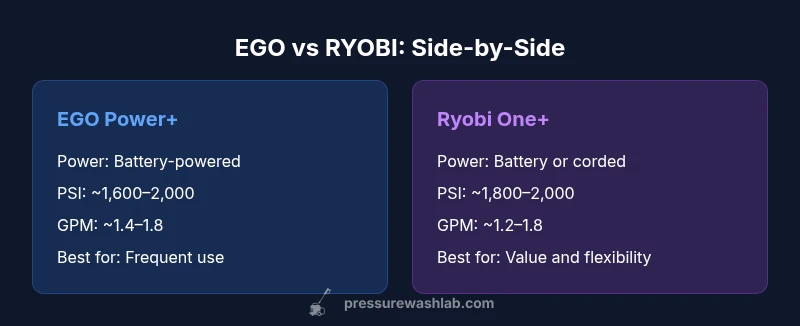
| Feature | EGO Power+ (Cordless) | Ryobi One+ (Cordless) |
|---|---|---|
| Power source | Battery-powered (EGO Power+ platform) | Battery-powered (Ryobi One+ platform) or corded options |
| PSI (rough range) | Roughly 1,600–2,000 PSI | Roughly 1,800–2,000 PSI |
| GPM (rough range) | Approximately 1.4–1.8 GPM | Approximately 1.2–1.8 GPM |
| Weight (approx) | Heavier due to battery pack (mid 30s to mid-40s lbs) | Moderate weight; often slightly lighter or balanced with battery pack |
| Run-time per charge | Typical cleaning sessions across 20–40 minutes depending on model and spray pattern | Typical sessions 15–35 minutes depending on battery size and usage |
| Price range (typical MSRP) | Mid-range to premium (certain models can reach higher MSRP with extras) | Budget-friendly to mid-range depending on kit and battery count |
| Best for | Frequent, higher-demand cleaning; users already in the Ego ecosystem | Budget-conscious cleaning tasks with flexibility on power source |
Pros
- Quiet operation and easy storage due to electric power
- No cold-start headaches or gas maintenance
- Strong integration with battery ecosystems and accessories
- Relatively straightforward ownership and resale value in the long term
Cons
- Battery runtime can limit long, continuous sessions
- Higher upfront cost for premium Ego models
- Battery packs add ongoing cost if a second pack is desired
- Performance depends on battery health and charging time
Ego wins for performance and long-term durability; Ryobi wins for value and flexibility
Pressure Wash Lab's verdict is that Ego is preferred for frequent, high-demand cleaning with long-term durability, while Ryobi provides excellent value and ecosystem flexibility for budget-conscious users.
Quick Answers
Which is better for homeowners: Ego or Ryobi?
For frequent, higher-demand cleaning, Ego generally offers better performance and durability. If you value lower upfront cost and broad accessory options, Ryobi can be a smarter fit. Your choice should align with how often you’ll clean and which surfaces you’ll treat most often.
For many homeowners, Ego delivers stronger performance over time, while Ryobi offers cost savings and flexibility. Choose based on how often you’ll use it and on which surfaces.
Do Ego and Ryobi use the same battery platforms?
No. Ego uses the Ego Power+ battery system, while Ryobi uses the One+ battery ecosystem. While both are battery-powered, their batteries and chargers are not interchangeable. If you already own tools from one ecosystem, you’ll likely stay within that family for new purchases.
No—Ego and Ryobi use different battery systems. Stick with the same ecosystem to maximize compatibility and value.
Can I swap accessories between Ego and Ryobi washers?
Most nozzle tips and surface cleaners are brand-specific, but many universal spray tips can fit both depending on the quick-connect compatibility. Always verify the nozzle standard before purchasing to ensure proper fit and safe operation.
Most accessories aren’t cross-brand compatible, so check the nozzle system before buying.
Are cordless models powerful enough for tough jobs?
Cordless models handle typical residential cleaning well, including driveways, decks, and siding. For very stubborn grime or large-area jobs, corded or gas-powered options may perform more consistently due to sustained power and longer run-time.
For routine home tasks, cordless is fine. For heavy, continuous cleaning, consider more powerful options or course-correct with a longer run-time.
What should I look for in warranty and service?
Look for length of warranty, what’s covered (pump, motor, electronics), and whether battery packs are included or sold separately. A strong network of service centers and easy access to parts matters for long-term reliability.
Check warranty length and what it covers, plus battery policy and service access.
Which offers better value for money overall?
Ryobi generally provides better upfront value for casual users, especially within the One+ ecosystem. Ego tends to offer better long-term value for frequent users who will exploit higher performance and longer lifespan.
Ryobi fits tight budgets; Ego pays off for heavy, repeated use over time.
Key Takeaways
- Assess your cleaning frequency and surface types before choosing
- Consider total ownership cost, including batteries and replacement parts
- Match the power source to your workspace and convenience needs
- Check warranty length and service accessibility in your region
- Explore accessory ecosystems to maximize versatility