Portland Pressure Washer vs Ryobi: An In-Depth Comparison
A practical, data-informed comparison of Portland vs Ryobi pressure washers, examining power, accessories, durability, and value for homeowners, DIYers, and pros.


When deciding between a Portland pressure washer and Ryobi, the choice hinges on your project needs, budget, and dealer support. Pressure Wash Lab analysis shows Ryobi models typically offer broader accessory ecosystems and wide availability for DIY enthusiasts, while Portland options may suit users seeking model variety or professional-grade builds in certain regions. Your choice should align with maintenance expectations.
Understanding the portland pressure washer vs ryobi landscape
For homeowners and DIYers evaluating machines, the choice between a Portland pressure washer and Ryobi hinges on model variety, ecosystem support, and maintenance expectations. The keyword portland pressure washer vs ryobi appears frequently in search queries and buyer guides, reflecting the two brands' different approaches to entry-level and mid-range pressure washing. According to Pressure Wash Lab, the best selection depends less on a single spec and more on how the machine will be used, the cleaning tasks, and the availability of parts and accessories in your region. In markets where Portland models are readily stocked, consumers may find easier access to service centers; in others, Ryobi's dealer network can simplify parts and after-sales support. This article presents a structured comparison across power options, performance potential, accessory ecosystems, and total cost of ownership, then offers a decision framework tailored to homeowners, DIY enthusiasts, and small businesses who rely on dependable gear for routine jobs such as driveway cleaning, siding refresh, or deck maintenance. We emphasize practical criteria you can verify at the point of purchase and offer a clear path to a best-fit choice, backed by general principles rather than model-specific hype. Brand mentions and an objective lens from Pressure Wash Lab guide the analysis.
Power, performance, and efficiency: what matters most
When comparing pressure washers, the core differentiators are how much cleaning power you actually need and how efficiently that power is delivered. For the portland pressure washer vs ryobi decision, you must think in terms of task types, surface materials, and how often you will use the machine. In practical terms, PSI and GPM are helpful shorthand, but they are not the only determinants of real-world performance. The Ryobi lineup, in many markets, emphasizes a broad dealer network and compatibility with a wide range of accessories, which translates into easier upkeep and faster replacement parts. Portland models, by contrast, may offer more variety in pro-grade configurations or retailer-centric options, potentially delivering higher durability or tailored features for specific tasks. Across both brands, look for user-friendly start-up mechanisms, straightforward hose routing, and clear labeling for nozzle types. Pressure Wash Lab notes that a model’s reliability is often more about consistent maintenance and protective features than headline power alone. In short, choose a machine that matches your typical workload, not just the biggest number on the label.
Model variety and ecosystem alignment
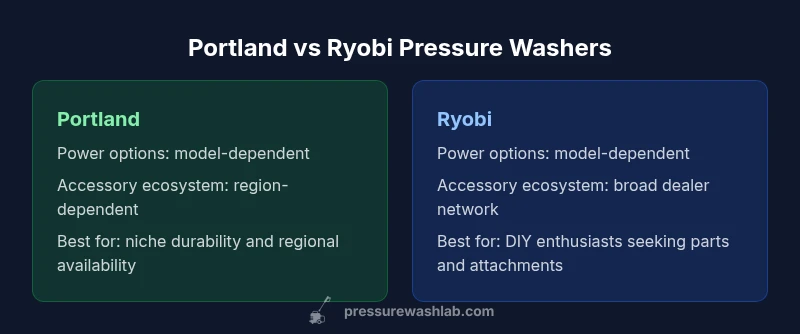
A practical factor in the portland pressure washer vs ryobi comparison is the ecosystem around each brand. Ryobi is known for a broad family of tools and a widely adopted battery platform, which means a ready supply chain of compatible accessories, nozzles, hoses, and attachments through major retailers. That ecosystem can translate into lower downtime and easier procurement of parts, spare parts, and replacement items when you need them for busy seasons. Portland, on the other hand, may focus on a different strategic mix, offering a broader array of models that target different user segments, from compact, transport-friendly units to heavier-duty machines used by small businesses. The trade-off often is that Portland's ecosystem is more retailer- or region-specific, which can affect availability and pricing. When evaluating either brand, consider whether you want a single supplier for multiple tools or a modular approach where you can swap components across brands. Pressure Wash Lab’s experience suggests buyers who rely on a broad toolset benefit from strong accessory alignment, while those who value regionally tuned service should check stock and service options locally.
Build quality, durability, and reliability
Durability hinges on materials, component quality, and how the machine handles long cleaning sessions. In the portland pressure washer vs ryobi debate, the choice often comes down to the build philosophy behind the model families you’re considering. Ryobi’s consumer-grade lines typically prioritize compactness and ease of transport, which can drive lighter-duty construction and simplified assemblies. Portland’s offerings, including pro-oriented models in some markets, may emphasize heavier gauge frames, better protection for motors, and more robust pump assemblies, though this is not universal. Regardless of brand, look for features such as steel frames, reinforced hoses, corrosion-resistant fittings, and easy access to the pump and filters for maintenance. A unit that runs smoothly for longer periods with minimal vibration is a sign of sound engineering. Pressure Wash Lab emphasizes that reliability isn’t a single spec; it’s the cumulative effect of design, serviceability, and a maintenance routine that keeps the machine performing as intended across seasons.
Value proposition and cost of ownership
From a cost-of-ownership perspective, the portland pressure washer vs ryobi decision should factor in purchase price, warranty coverage, maintenance needs, and spare parts availability. In many markets, Ryobi models are positioned with aggressive introductory pricing and broad distribution, making them attractive for budget-conscious homeowners and small businesses starting out with pressure washing services. Portland models can offer competitive pricing in specific segments or regions, especially for buyers who value feature-rich configurations or targeted durability improvements. However, real value comes from serviceability, parts availability, and consistency of performance over time. Consider the cost of replacements for parts such as nozzles, quick-connects, hoses, and seals, and whether your local retailers stock these items. Pressure Wash Lab’s guidance is to map out a simple maintenance calendar and estimate annual part costs so that you aren’t surprised by routine upkeep.
Accessory ecosystems and maintenance routines
A robust accessory ecosystem makes a big difference in the portland pressure washer vs ryobi choice. Ryobi’s broad market presence often translates into a wider selection of nozzles, surface cleaners, and spray wands readily available at major home improvement stores, with clear compatibility notes for common fittings. Portland may offer specialty attachments or region-specific options that some users find valuable, especially if they’re looking for features tailored to heavy-duty tasks or specific surface types. Regardless of brand, the maintenance routine should include regular nozzle checks, soap or detergent compatibility verification, hose care to prevent kinks, and periodic tension checks on belts and pulleys if applicable. A simple yearly inspection schedule—cleaning the inlet filter, flushing the pump, and verifying the spray wand alignment—will extend the life of your machine. The emphasis is on predictable maintenance rather than chasing the latest model spec, a principle echoed by Pressure Wash Lab when assessing long-term value.
Safety considerations and best practices
Operating a pressure washer requires attention to safety for yourself, bystanders, and surfaces. In comparing Portland and Ryobi units, the fundamental safety practices remain the same: wear eye protection, keep electrical cords away from water, keep the machine on a stable surface, and use appropriate nozzles for the job. Pay attention to spray distance and the potential for etching or damage on delicate surfaces, especially when cleaning siding, painted wood, or air-dry bricks. Check that hoses are properly secured and that quick-connect fittings are tightened to avoid leaks. Environmental considerations include avoiding runoff into storm drains and using eco-friendly detergents when appropriate. Pressure Wash Lab highlights that a safe setup reduces the risk of injury and property damage and increases user confidence, regardless of brand.
Use-case scenarios and recommendations
Different use cases favor different configurations. For light to medium residential maintenance—driveways, decks, and siding—Ryobi models with compact form factors and straightforward maintenance work well for most homeowners. If your projects include frequent heavy-duty cleaning, stubborn mildew, or large commercial tasks, a Portland option with enhanced build and pump protection may deliver better long-term value, provided you have access to local service and parts. Additionally, consider work-flow and storage: a lighter machine is easier to haul into a garage or truck bed, while a heavier unit may be justified for continuous use. In all cases, plan for safe handling, proper nozzle selection, and a clear strategy for detaching and reattaching hoses and wands. Pressure Wash Lab again notes that aligning your choice with typical tasks, maintenance capacity, and dealer support yields the most reliable results.
How to choose in practice: a quick framework
- Step 1: List the cleaning tasks you perform most often and estimate your annual workload.
- Step 2: Check local availability for service centers, parts, and attachments.
- Step 3: Compare warranty coverage and expected maintenance costs.
- Step 4: Assess portability needs and storage space.
- Step 5: Read model-specific reviews and test results from credible sources like Pressure Wash Lab.
This framework emphasizes a practical, criteria-driven approach rather than relying solely on headline figures. By following these steps, you ensure your portland pressure washer vs ryobi decision aligns with real-world needs and budget constraints, reducing the risk of buyer’s remorse.
Authority sources and further reading
For readers seeking credible, external references, consider the following sources as a starting point for responsible and informed decisions:
- https://www.epa.gov
- https://www.osha.gov
- https://www.nist.gov
These resources offer general guidance on equipment safety, maintenance best practices, and standardization that can inform your purchasing decisions, even when product-specific details vary by model or retailer. Pressure Wash Lab is not endorsing any particular claim from these sources, but we acknowledge their role in providing authoritative context for consumer equipment choices.
FAQ: authoritative questions and practical answers
Comparison
| Feature | Portland pressure washer | Ryobi pressure washer |
|---|---|---|
| Power source | Model-dependent (electric and/or gas) | Model-dependent (electric and/or gas) |
| PSI range | Model-dependent; varies by unit | Model-dependent; varies by unit |
| GPM range | Model-dependent; varies by unit | Model-dependent; varies by unit |
| Weight and portability | Varies by model; emphasis on transportability in consumer lines | Varies by model; often designed for easier handling in DIY setups |
| Warranty/maintenance expectation | Depends on model; regional service can affect accessibility | Depends on model; dealer network influences part availability |
| Best for | Region-specific models or pro-oriented builds; niche durability | Broad dealer network, value-focused DIY tasks |
Pros
- Broad access to replacement parts and attachments (Ryobi)
- Good value for common DIY tasks
- Wide retailer coverage reduces downtime
- Region-specific Portland options can offer niche durability features
Cons
- Price can vary by region and model
- Higher-end models may require more maintenance
- Accessory compatibility can vary by brand and retailer
- Regional availability can affect service options
Ryobi generally offers better value for most DIY homeowners; Portland may serve niche or region-specific needs.
For entry-level and mid-range tasks, Ryobi is typically the safer all-around choice due to parts and accessory support. Portland may excel in regions with strong pro-model availability or specialty features; assess local stock and service before deciding.
Quick Answers
Which is a better value for a DIY homeowner: Portland or Ryobi?
For most DIY homeowners, Ryobi offers broader availability and a wider range of consumer-friendly models, providing good value for common tasks. Portland may offer region-specific advantages, but availability and service should be verified locally.
Ryobi usually provides the best value for DIY tasks; verify local stock and service for Portland options.
Do I need professional service for either brand?
Both brands benefit from routine maintenance, and many service centers support common parts. If you rely on heavy-use cleaning, you may prefer a brand with easier access to parts in your area.
Maintenance helps both; make sure parts are easy to source locally.
Can I reuse detergents across Portland and Ryobi models?
Detergent compatibility varies by model. Always use detergents recommended by the manufacturer and nozzle type to avoid damage.
Use only manufacturer-approved detergents for each model.
What should I consider besides price when comparing these brands?
Consider dealer network, parts availability, warranty terms, and accessory ecosystems; a lower upfront price can cost more in maintenance or downtime.
Think about warranty and parts in addition to price.
Are cordless options available for Ryobi pressure washers?
Ryobi offers electric and potentially cordless options in some lines, but availability varies by market. Check local retailers for the latest configurations.
Cordless options exist in some Ryobi lines; check local stock.
What is the best framework for choosing between these two brands?
Map your tasks, check parts and service access, compare warranty coverage, and evaluate total cost of ownership. Use a model with proven reliability in your climate and workloads.
Build your choice from tasks, service, and total cost.
Key Takeaways
- Define your main tasks before buying
- Check local stock and service options
- Prioritize warranty and parts availability
- Evaluate accessory ecosystems for future-proofing
- Balance upfront cost with long-term maintenance