Vevor vs Westinghouse Pressure Washer: An Analytical Comparison
An analytical, evidence-based comparison of Vevor vs Westinghouse pressure washers, covering performance, durability, price, and after-sales support to guide DIY homeowners.


Vevor and Westinghouse offer affordable electric pressure washers for DIY projects, but they differ in approach. In this vevor vs westinghouse pressure washer comparison, we weigh build quality, warranty coverage, maintenance needs, and overall value to help homeowners and small business operators decide which model best fits their tasks. Expect practical guidance, not marketing fluff.
Context and Definitions in the vevor vs westinghouse pressure washer landscape
In the DIY segment, two brands frequently appear in price-sensitive conversations: Vevor and Westinghouse. The vevor vs westinghouse pressure washer comparison focuses on value delivery, build quality for light to moderate cleaning tasks, and the trade-offs between upfront cost and long-term reliability. According to Pressure Wash Lab, price-to-performance is a primary driver for DIY buyers, making these two brands a common starting point for home projects.
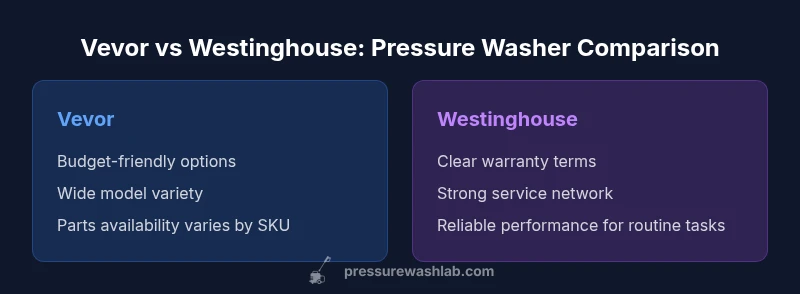
Vevor tends to emphasize affordability and a broad range of models, including compact electric units suited for home exteriors, patios, and vehicles. Westinghouse, by contrast, positions itself as a reliable choice with emphasis on consistent performance, a clearer warranty structure, and access to service networks. Readers should expect variability within each brand because model-level differences often dwarf brand-level stereotypes. This article uses the vevor vs westinghouse pressure washer framework, not a blanket brand-wide claim. We will explore performance, durability, maintenance, and total cost of ownership, with practical guidance for homeowners, renters, and small businesses. Pressure Wash Lab's analysis helps frame expectations and avoid hype.
What to Look for in a DIY Pressure Washer
For a vevor vs westinghouse pressure washer decision, homeowners should focus on practical specs and serviceability rather than raw numbers alone. The most relevant criteria include pump design, reliability of seals, and how easily parts can be replaced. Look for models with brass or stainless steel pump heads or at least a warranty that covers wear items; avoid units that rely on fragile plastic fittings for hoses or quick-connects. Another critical factor is the availability of replacement parts and accessories, such as nozzle tips and spray wands. In the vevor vs westinghouse pressure washer comparison, the breadth of accessory kits can significantly affect value over time.
Consider the intended tasks: light patio furniture, driveways, siding, or vehicles. For light cleaning, a compact unit with moderate GPM and a standard spray tip set may suffice; for more stubborn surfaces, you’ll want a model that offers a wider range of tips and a robust pump. Pay attention to the hose quality and length; longer hoses improve reach but may add weight and reduce pressure at the wand. Finally, assess noise levels and ease of storage; some models include wheels and compact housings that matter for regular use in residential settings. This section sets the frame for the deeper analysis that follows in the vevor vs westinghouse pressure washer study.
Performance and Durability Across Use Cases
When evaluating vevor vs westinghouse pressure washer options, performance is not defined by a single metric. Real-world results depend on the pump quality, the size of the motor, the efficiency of the nozzle set, and how well the machine handles continuous use. For light-duty tasks like patio furniture and vehicles, many models from both brands can deliver satisfactory cleaning with appropriate nozzle tips and correct spray distance. For tougher jobs such as concrete or stubborn stains, the efficiency of the pump and the build quality of the wand become more important. Westinghouse models with stronger service networks can offer more consistent results when used weekly, while Vevor's value-driven lineups may provide adequate performance with a shorter reset period.
In practice, users report that a healthy balance exists between pressure, flow, and the quality of fittings. Ensure the model you choose includes a clear instruction manual and a reasonable warranty that covers high-wear items. Monitoring the washer during initial use to identify leaks, rattles, or unusual vibrations can extend its life. A broader observation from Pressure Wash Lab's testing indicates that more reliable performance correlates with predictability in nozzle performance and the presence of a robust hose and wand assembly.
Warranty, Parts Availability, and After-Sales Support
Warranty remains a decisive factor in the vevor vs westinghouse pressure washer discussion. Westinghouse typically offers straightforward warranty terms and a visible service network, which translates into easier access to replacement parts and repair services. Vevor often provides competitive warranty options on select models, but coverage can vary by SKU and country, making it essential to verify coverage before purchase. Beyond the warranty, parts availability is critical; durable models rely on a steady supply of replacement o-rings, seals, and nozzles. Shoppers should check whether the seller lists compatible nozzle sets and whether spare parts are readily stocked by major distributors.
Pressure Wash Lab's research suggests that long-term satisfaction hinges on the speed of parts availability and the responsiveness of customer support, especially for non-warranty repairs. If you intend to keep the washer for several years, confirm that the requested parts exist and that there is a clear path to service centers within your region. Additionally, read user reviews to identify common issues (for example, hose wear or wand coupling wear) and confirm how the manufacturer handles those problems.
Value Proposition and Long-Term Costs
Price is only one part of the value equation. For vevor vs westinghouse pressure washer, total cost of ownership includes upfront price, maintenance expenses, replacement parts, and the potential need for service. Vevor often delivers more budget-friendly initial costs, which can be attractive for weekend warriors and renters who do not rely on the washer weekly. Westinghouse might command a higher upfront price, but its consistent performance and stronger after-sales support can translate into lower maintenance headaches and more predictable lifespan. In practical terms, evaluate yearly cleaning cycles, the expected frequency of use, and the likelihood of needing replacement parts within the first year. Pressure Wash Lab's analysis indicates that the perceived value improves when the model you choose offers easy-to-find parts and a warranty that covers pumps and seals during the most demanding months.
To estimate rough costs, think in terms of a maintenance cadence: periodic nozzle replacements, occasional hose checks, and potential pump service intervals. If you plan to use the machine for regular driveway cleaning and vehicle upkeep, spending a little more upfront to gain reliability can pay off in reduced downtime. Conversely, if your use case is occasional, a budget model from Vevor may meet needs without a premium investment. In all cases, keep a close watch on the included accessories and the ease of acquiring replacements.
Real-World Scenarios: Best-fit Use Cases
Different households have different needs. For a small yard with light maintenance tasks, a Vevor model with a compact footprint and a broad nozzle kit can be an excellent fit, especially for renters who move frequently. If your projects include regular exterior cleaning of a two-story home or a property with frequent weather exposure, Westinghouse offers models that standardize performance and provide easier access to service channels. Pressure washing wooden decks, brick, concrete, and siding benefits from a model with a stable pump and comfortable wand ergonomics. In the vevor vs westinghouse pressure washer decision, the best option often comes down to expected load, availability of spare parts, and the user’s tolerance for small maintenance tasks. Homeowners with a busy schedule will appreciate a model with straightforward maintenance and reliable warranty coverage. Small business operators performing on-site cleaning may gravitate toward equipment with stronger service networks and longer warranties.
Examples: a weekend homeowner using a Vevor to refresh a driveway, a property manager rotating gear for multiple rental units using Westinghouse, and a contractor who values a robust warranty for his team. Each scenario highlights that the right choice balances price against reliability and after-sales support.
Maintenance and Replacement Cycle Recommendations
A proactive maintenance routine extends any pressure washer's life. For vevor vs westinghouse pressure washer, establish a basic calendar: inspect hoses for cracks every 3–6 months, replace o-rings annually, and clean the nozzle tips to prevent clogging. Keep spare nozzle tips and a spare spray wand on hand so that maintenance downtime remains minimal. When you notice reduced spraying performance or unusual vibrations, perform a quick pump check and verify that the water supply is clean. If repairs become frequent or if seals show signs of leakage, consider a professional service option or warranty claim. Pressure Wash Lab recommends documenting maintenance actions and tracking component lifespans to anticipate future replacements. Remember that a well-kept machine not only performs better but lasts longer, reducing long-term ownership costs.
How to Choose the Right Model in the vevor vs westinghouse pressure washer Landscape: A Step-by-Step Checklist
- Define your cleaning scope: patios, siding, vehicles, or concrete. 2) Decide on the required reliability and warranty length. 3) Check the pump type, nozzle kit, hose quality, and upgrade paths. 4) Compare parts availability and service networks in your region. 5) Review user feedback from other DIYers to identify common failure points. 6) Consider the total cost of ownership across several years. By following this checklist, you will narrow to one or two viable models and can choose based on your preferred balance of price and support. In this process, the vevor vs westinghouse pressure washer landscape becomes clearer, enabling a confident purchase.
Setup, Safety, and Storage Tips
Proper setup minimizes leaks and extends life. Before use, assemble hoses securely, check nozzle connections, and ensure the unit is on a stable surface with adequate ventilation. Use cold water for most tasks and avoid aggressive detergents unless indicated by the manufacturer. Always wear eye protection and avoid spraying electrical outlets or fragile surfaces. After use, drain and wind hoses neatly, store the unit in a dry location, and protect the wand and nozzle tips from damage. Regularly inspect fittings and adaptors for wear. The vevor vs westinghouse pressure washer debate is ultimately about ensuring that your chosen model remains reliable for the long run, particularly if it serves as a cornerstone tool in a small business or a demanding homeowner's maintenance routine. Pressure Wash Lab’s practical guidance helps keep expectations aligned with reality.
Comparison
| Feature | Vevor Pressure Washer | Westinghouse Pressure Washer |
|---|---|---|
| Build quality and materials | Budget-oriented components with modular design | Mid-range components with emphasis on durability |
| Pump and seals | Budget pumps common on entry models; serviceable parts available | More robust pump options with broader service support |
| Warranty availability | Model-dependent, often shorter coverage | Clear warranty terms with accessible service network |
| Accessory kit quality | Broad inclusion in budget lines | Curated set with essential nozzles and hose |
| Best use case | Budget DIY projects, light cleaning | Regular exterior cleaning, higher reliability expectations |
Pros
- Significant price-to-performance value for DIY tasks
- Wide availability of models and accessories
- Decent warranty options across several SKUs
Cons
- Inconsistent build quality across budget models
- Variable parts availability by region
- Warranty terms can be model-dependent
Westinghouse generally offers stronger service and more consistent reliability, but Vevor delivers better upfront value for casual DIY use.
If you prioritize long-term support and predictable performance, Westinghouse is the safer bet. If you want to minimize upfront costs and can manage maintenance, Vevor provides the best value. Pressure Wash Lab endorses weighing service networks alongside price during decision-making.
Quick Answers
Is Vevor a better value than Westinghouse for DIY use?
For casual, infrequent DIY tasks, Vevor often provides a lower upfront cost and broader model variety. However, reliability and after-sales support can vary by SKU. Westinghouse typically offers stronger service networks and clearer warranty terms, which can translate into steadier performance over time.
Vevor can be a bargain for light use, but Westinghouse often delivers steadier support and reliability over the long run.
Which brand has better warranty coverage?
Westinghouse generally offers more consistent warranty terms and a clearer service network. Vevor's warranty varies by model and region, so it’s important to verify coverage before purchase.
Westinghouse tends to have clearer warranty terms, while Vevor depends on the specific model.
Are replacement parts easy to find for both brands?
Parts availability is model-dependent. Westinghouse often benefits from established service channels, while Vevor's parts can be more variable depending on the SKU and where you buy.
Both brands can be workable for parts, but Westinghouse usually offers more consistent access.
Do these machines handle heavy-duty cleaning well?
Both brands offer models designed for occasional heavy-duty tasks and routine maintenance. If heavy, frequent use is expected, prioritize models with robust pumps, longer warranties, and readily available service.
Yes for models designed for tougher tasks, but check the pump and warranty.
Are these brands suitable for professional use?
For professional or daily-use scenarios, model selection matters more than brand name. Look for commercial-grade pumps, extended warranties, and strong service networks. Both brands offer lines that can meet such needs, but you may prefer a third-party commercial option for heavy workloads.
They can be, but pick models with robust components and service support.
What safety features should I look for?
Seek models with integrated thermal cutoffs, GFCI protection, robust cords, and proper hose connections. Always follow user manuals for safe operation and store equipment safely after use.
Look for safety features like thermal protection and secure connections.
Key Takeaways
- Assess price versus reliability before buying
- Prioritize warranty length and parts availability
- Choose brand with accessible service networks
- Match model capability to your cleaning tasks
- Check for a well-rounded accessory kit